Cecil B. DeMille: Born August 12, 1881

“If 1,000 years from now, archaeologists happen to dig beneath the sands of Guadalupe, I hope they will not rush into print with the amazing news that Egyptian civilization, far from being confined to the valley of the Nile, extended all the way to the Pacific coast of North America.”  ~”The Autobiography of Cecil B. DeMille,” 1959

So why did DeMille choose to bulldoze his set, rather than truck it back to Los Angeles?
“I think there were two things were going on,” Brosnan said, starting with DeMille’s pledge to leave the site as he’d found it. “Hauling away all that statuary would have been very expensive … so I think he pulled a fast one and buried it.”
In addition, he said, “(DeMille) knew that if he left it standing … the very next day somebody would be there filming a quickie on his set and they’d be on the streets with it in a few weeks. He was protecting his patent by taking it down.”
FROM http://www.kcet.org/arts/artbound/counties/santa-barbara/cecil-b-demill-ten-commandments-excavation-nipomo-dunes.html

~ California Historical Society: Stills from “The Ten Commandments” 1923
~ Cecil B. Demille’s biography
~ Special Extended Trailer, 1956, announcing the upcoming release of “The Ten Commandments”

Roberta Dodd Crawford: Born August 5, 1897

CrawfordIn the 1920s and 1930s, Bonham mezzo-soprano Roberta Dodd Crawford (1897-1954) shot across the concert world like a rare comet, blazing with talent and demonstrating the power of black performers to seriously engage American and European critics and audiences. In the end, through bad luck and poor circumstance, she flamed out, dying broke and forgotten by the world she had made richer by her incandescent presence.

She came from humble circumstances, spent long years training her remarkable voice, toured extensively in the U.S. and France, socialized and worked with fellow ex-patriots in Paris during the 1920s and early 1930s, married an American World War I hero and, later, an African prince; and suffered physically and mentally while under Nazi detention during World War II.
FROM
http://ntxe-news.com/cgi-bin/artman/exec/view.cgi?archive=51&num=81273

Texas State Historical Association~
https://tshaonline.org/handbook/online/articles/fcr69

Save

Max Fleischer: Born July 19, 1883

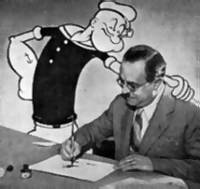
In 1900 Max began to work as an errand boy at the Brooklyn Daily Eagle. By 1904 he was a staff artist.MF2 In 1905 he married his childhood sweetheart, Essie Gold; they had two children. After he left the Eagle, Max briefly did artwork for two companies and then became art editor of Popular Science Monthly in 1914. There his childhood interest in mechanical matters was reignited.

In fact, it was a mechanical problem that pulled Max Fleischer into the field of animation. Early animation was frequently very choppy. Max theorized that if live-action footage were traced, frame by frame, fluid motion could be achieved. He enlisted the help of his brothers Dave and Joe, and the three developed the Rotoscope, a camera mounted under a piece of frosted glass with a crank to advance the film, so each frame could be traced.

MF1It took the brothers a week to build the Rotoscope, but it was a full year before they finished their first cartoon. Dave donned a clown suit, and Max and Joe filmed him. Then they traced the clown on the Rotoscope. Work on the cartoon was completed in 1916, and a patent for the Rotoscope came through a year later.
FROM http://anb.org/articles/20/20-01567.html

The Fleischers put popular, modern music at the center of many of their films, building entire cartoons around jazz legends such as Cab Calloway, Louis Armstrong and Don Redman. These cartoons often featured the Fleischers’ signature MF3combination of live action and animation; in fact the earliest known footage of Cab Calloway in performance can be seen in the Fleischer classic Minnie the Moocher.

In 1929 the Studio made a major agreement with Paramount that would allow Paramount to distribute all Fleischer films. That same year the Studio changed its name to ‘Fleischer Studios.’
FROM http://www.fleischerstudios.com/history.html


OUT OF THE INKWELL~  https://youtu.be/KHDeCkDUNlk
Max Fleischer NEWS SKETCHES compilation~ https://archive.org/details/max_fleischer_news_sketches
Lambiek Comiclopedia~  https://www.lambiek.net/artists/f/fleischer_max.htm

E. B. White: Born July 11, 1899

ebwhite_newyorker

INTERVIEWER
You were also an artist. What did Thurber and the other New Yorker artists think of your drawings and New Yorker covers?
WHITE
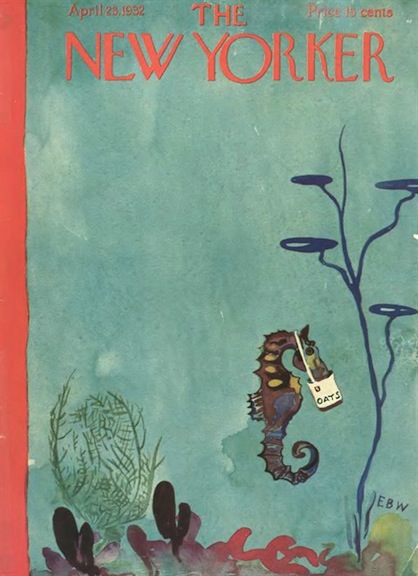
I’m not an artist and never did any drawings for The New Yorker. I did turn in a cover and it was published. I can’t draw or paint, but I was sick in bed with tonsillitis or something, and I had nothing to occupy me, but I had a cover idea—of a sea horse wearing a nose bag. I borrowed my son’s watercolor set, copied a sea horse from a picture in Webster’s dictionary, and managed to produce a cover that was bought. It wasn’t much of a thing. I even loused up the whole business finally by printing the word “oats” on the nose bag, lest somebody fail to get the point. I suppose the original of that cover would be a collector’s item of a minor sort, since it is my only excursion into the world of art. But I don’t know where it is. I gave it to Jed Harris. What he did with it, knows God.
FROM http://www.theparisreview.org/interviews/4155/the-art-of-the-essay-no-1-e-b-white

https://en.wikipedia.org/wiki/E._B._White

July 1~ Willie Dixon & James Cotton


Willie Dixon was born July 1, 1915, in Vicksburg, MS.
http://www.allmusic.com/artist/willie-dixon-mn0000959770/biography
Illustration: William Stout / Legends of the Blues


James Cotton was born July 1, 1935, in Tunica, MS.
http://www.allmusic.com/artist/james-cotton-mn0000131841/biography
Illustration: Jack Coughlin / A Brush with the Blues: 26 Portraits


Willie Dixon and James Cotton with Muddy Waters, Sunnyland Slim, Otis Spann, Sonny Terry, Brownie McGhee, and Mable Hillery in 1966 at the Canadian CBC Television studio, recording a portion of a CBC “Festival” series:

http://www.allmovie.com/movie/masters-of-the-blues-v204117

Paul McCartney: Born June 18, 1942

youngpaul

I was saying to someone the other day that one of the very first gigs we did – I don’t even think we were Beatlesthe Beatles, it was the Quarrymen – one the very first times I ever played with John, we did a very early gig at a thing called a Co-Op Hall, and I had a lead solo in one of the songs and I totally froze when my moment came. I really played the crappiest solo ever. I said, “That’s it. I’m never going to play lead guitar again.” It was just too nerve-wracking onstage. So for years, I just became rhythm guitar and bass player and played a bit of piano, do a bit of this, that and the other. But nowadays, I play lead guitar, and that’s the thing that draws me forward. I enjoy it. So, yeah, that means the answer to “Are you going to retire?” is “When I feel like it.” But that’s not today.
FROM https://www.rollingstone.com/music/music-news/paul-mccartney-the-long-and-winding-qa-242714/

At the deepest level, McCartney has little idea where all the olderpaulmelodies come from. He still hasn’t figured out how he wrote “Yesterday” in his sleep. “I don’t like to use the word ‘magic,’ unless you spell it with a ‘k’ on the end, because it sounds a bit corny. But when your biggest song – which 3,000 people and counting have recorded – was something that you dreamt, it’s very hard to resist the thought that there’s something otherworldly there.”
FROM http://www.rollingstone.com/music/news/paul-mccartney-yesterday-today-20120618

Jackie Wilson: Born June 9, 1934

WilsonThey called him “Mr. Excitement,” and indeed Jackie Wilson was a gifted singer of considerable range and a charismatic showman who commanded a stage like few before or since. Wilson possessed a natural tenor. He sang with the graceful control of Sam Cooke and moved with the frenzied dynamism of James Brown…A mainstay of the R&B and pop charts from 1958 to 1968, Wilson amassed two dozen Top Forty singles, all released on the Brunswick label.

Wilson launched his solo career in November 1957 with the single “Reet Petite (The Finest Girl You Ever Want To Meet).” The song was written by Berry Gordy, Jr., a struggling songwriter who had yet to found his Motown empire. Another Gordy composition, “Lonely Teardrops,” was Wilson’s breakthrough, topping the R&B chart and becoming a Top Ten hit on the pop side. More R&B chart-toppers followed in quick succession
FROM https://rockhall.com/inductees/jackie-wilson/bio/

Jackie Wilson Discography~ http://www.discogs.com/artist/69375-Jackie-Wilson

Josephine Baker: Born on June 3, 1906

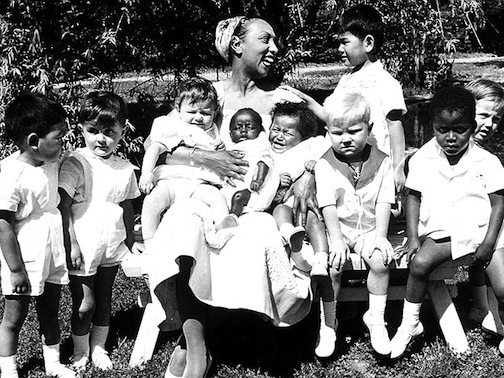
JBJoséphine Baker (June 3, 1906-April 12, 1975) was an American-born French entertainer, French Resistance agent, and civil rights activist.

“Baker flourished as a dancer in several Vaudeville shows, which was a popular theatre genre in the 20th century. She eventually moved to New York City and participated in the celebration of black life and art now known as the Harlem Renaissance. A few years later her success took her to Paris. Baker became one of the most sought-after performers due to her distinct dancing style and unique costumes. Although her audiences were mostly white, Baker’s performances followed African themes and style. In her famed show Danse Sauvage she danced across stage in a banana skirt. Baker was multitalented, known for her dancing and singing she even played in several successful major motion pictures released in Europe.
FROM https://www.womenshistory.org/education-resources/biographies/josephine-baker

JBfamilyOfficial Site~ http://www.cmgww.com/stars/baker/

JBDCSpeech at the March on Washington~http://www.blackpast.org/1963-josephine-baker-speech-march-washington
FBI files~ http://vault.fbi.gov/josephine-baker

Discography~ http://www.discogs.com/artist/378436-Josephine-Baker