Salmagundi

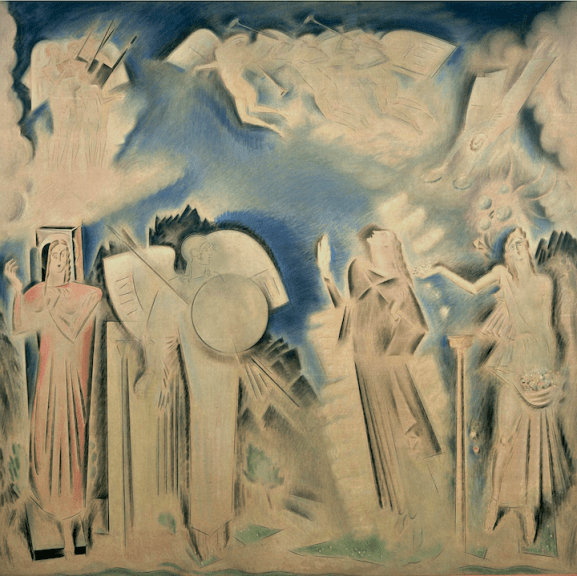
The Apotheosis of Athanasios Diakosby Konstantinos Parthenis

c.1933 / Oil on canvas / 150”x150” / National Art Gallery and Alexandros Soutzos Museum, Athens

Konstantinos Parthenis (1878-1967), Greek painter

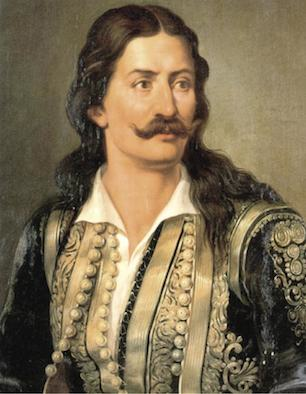
Athanasios Diakos was a hero of the Greek War of Independence. Prior to the war he entered a monastery and was ordained a deacon (“diakos” in the Greek language). One day a Turkish pasha came to his monastery and made some crude remarks about his good looks. Diakos slew him and fled to the mountains. He join a band of klephts who made him second in command. Eventually, he headed his own band. In April 1821, Omer Vrioni, the commander of the Turkish army, advanced with 9,000 men from Thessaly to crush the revolt in Peloponnesus.

Athanasios Diakos

Diakos’ men fought for several hours before they were overwhelmed. The wounded Diakos was taken to Vrioni. Vrioni offered to make Diakos an officer in his army but Diakos refused and replied “I was born a Greek and I will die a Greek”.
FROM http://wiki.phantis.com/index.php/Athanasios_Diakos

(Learn more by clicking on embedded hyperlinks)

Salmagundi

The Kiss

Auguste Rodin (French, 1840-1917)

The Tate’s The Kiss is one of three full-scale versions made in Rodin’s lifetime. Its blend of eroticism and idealism makes it one of the great images of sexual love. However, Rodin considered it overly traditional, calling The Kiss ‘a large sculpted knick-knack following the usual formula.’
~http://www.tate.org.uk/art/artworks/rodin-the-kiss-n06228
~The Rodin Museum in Paris, France
~Ny Carlsberg Glyptotek in Copenhagen, Denmark

The three larger marble versions were exhibited together at the Musée d’Orsay in 1995. A fourth copy was made after the death of Rodin by sculptor Henri-Léon Gréber for the Rodin Museum of Philadelphia.

(Learn more by clicking on embedded hyperlinks)

Salmagundi

Fifteen officers of the 17th Regiment of Foot posed on a hill at camp, 1855

Roger Fenton (1819-1869) [War]

Photograph of Roger Fenton (1819-1869) dressed in traditional Zouave costume.

…the British government hired photographer Roger Fenton to travel to Crimea and create some of the first war photographs in history. He arrived in March 1855 and stayed for 3.5 months.
FROM https://mashable.com/2016/01/06/crimean-war/#JJZDNMTVAuqa

While the sight of soldiers with a sketchbook as well as the occasional artist was not uncommon in the Crimea, the idea of a photographer ‘at the seat of war’ was new. Consequently, Fenton was pestered by troops wanting their ‘likeness’ taken, so much so that he noted he would ‘dread the sight of English officers riding up to my van’.
FROM http://www.tate.org.uk/context-comment/articles/terrible-beauty

The Valley of the Shadow of Death, 1855

In the course of a single decade, Fenton had played a pivotal role—by advocacy and example—in demonstrating that photography could rival drawing and painting not only as a means of conveying information, but also as a medium of visual delight and powerful expression.
FROM https://www.metmuseum.org/toah/hd/rfen/hd_rfen.htm

(Learn more by clicking on embedded hyperlinks)

Salmagundi

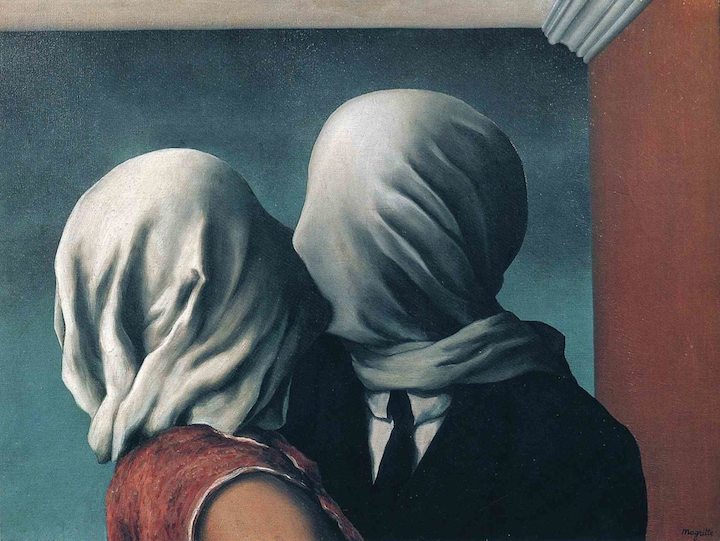
René MagritteThe Lovers (Les Amants) / 1928 / Oil on canvas / 21”x29” / Museum of Modern Art, NYC

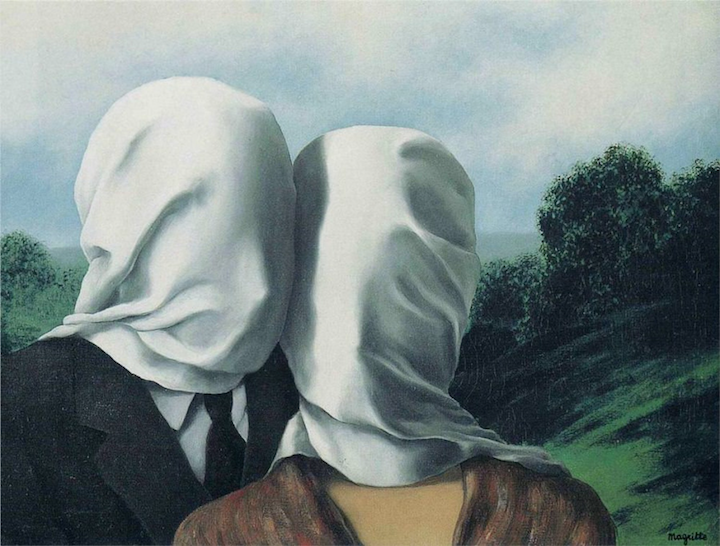
The Lovers (Les Amants) / 1928 / Oil on canvas / 21”x29” / National Gallery of Australia

Enshrouded faces were a common motif in Magritte’s art. The artist was 14 when his mother committed suicide by drowning. He witnessed her body being fished from the water, her wet nightgown wrapped around her face. Some have speculated that this trauma inspired a series of works in which Magritte obscured his subjects’ faces. Magritte disagreed with such interpretations, denying any relation between his paintings and his mother’s death. “My painting is visible images which conceal nothing,” he wrote, “they evoke mystery and, indeed, when one sees one of my pictures, one asks oneself this simple question, ‘What does it mean?’ It does not mean anything, because mystery means nothing either, it is unknowable.”
FROM https://www.moma.org/learn/moma_learning/rene-magritte-the-lovers-le-perreux-sur-marne-1928

(Learn more by clicking on embedded hyperlinks)

Salmagundi

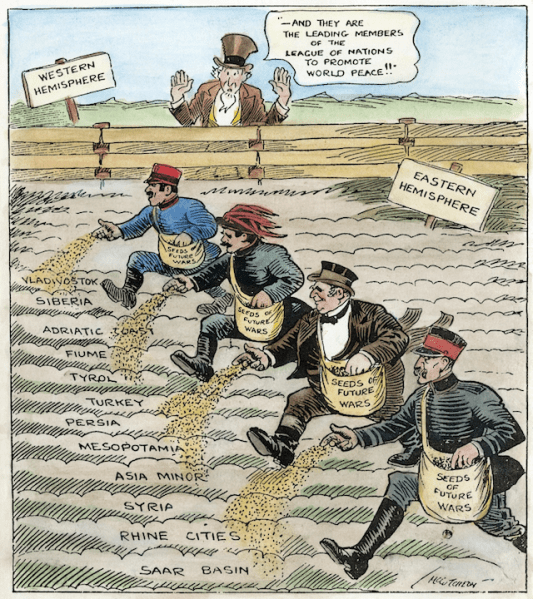
John Tinney McCutcheon (1870-1949)

John T. McCutcheon, in full John Tinney McCutcheon, (born May 6, 1870, South Raub, Indiana, U.S.—died June 10, 1949, Lake Forest, Illinois), American newspaper cartoonist and writer…He received a Pulitzer Prize in 1932 for a cartoon dealing with bank failure.
https://www.britannica.com/biography/John-T-McCutcheon

After graduating from Purdue with a B.S. degree in 1889, McCutcheon moved to Chicago and was hired to work for the Chicago Morning News (later known as the Chicago Record) as an artist. He began doing front page cartoons for the newspaper in 1895. In 1903, McCutcheon joined the staff of the Chicago Tribune and served in capacities as both an editorial cartoonist and occasional foreign correspondent until his retirement in 1946.
http://www4.lib.purdue.edu/archon/?p=collections/findingaid&id=950&q=&rootcontentid=7101#bioghist

Although McCutcheon is best known for his illustration work, he also served as a Chicago Tribune correspondent for the Spanish American War, the Philippine insurrection, the South African (Boer) War and World War I, from both the German and Allied fronts.
https://www.chipublib.org/fa-john-t-mccutcheon-cartoons/

(Learn more by clicking on embedded hyperlinks)

Salmagundi

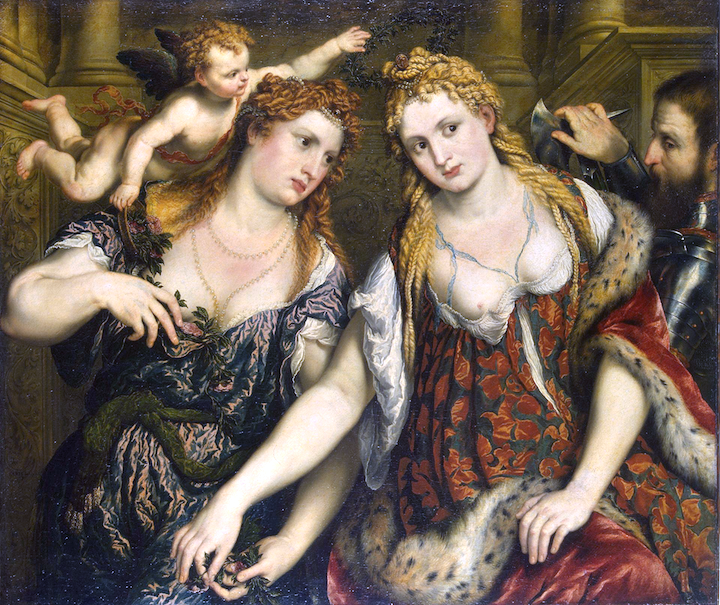
Paris BordoneAllegory with Lovers
1550 / Oil on canvas / 43.8”x68.7” / Kunsthistorisches Museum, Vienna

Victory crowns Mars and Venus with myrtle, Venus plucks a lemon from a tree,
and Cupid tips roses into her lap

Venus, Flora, Mars and Cupid (Allegory)
c.1560 / Oil on canvas / 42.5”x50.7” / Hermitage Museum, Saint Petersburg

Cupid crowns Venus and showers Flora with roses while the two exchange flowers;
Mars, in the background, holds a battle axe

Paris Bordone was from Treviso on the Venetian mainland…After the death of his father (a master saddler), he was taken at the age of eight by his mother to Venice. According to Vasari, he trained for a time with Titian, who is said to have treated him badly…Whether because of a continuing hostility by Titian towards his former pupil or because of competition from other artists, Bordone had difficulty securing major commissions in Venice and, though he continued to live mainly in the city, much of his work was done for patrons elsewhere. ~cavallinitoveronese.co.uk

Bordone increasingly became identified with glossy portraiture, frequently illustrating the theme of problematic love. He often painted beautiful courtesans and erotic mythological and allegorical subjects, which appealed to his wealthy clients. ~getty.edu

(Learn more by clicking on hyperlinks embedded in text)

Salmagundi

The Battle of the USS “Kearsarge” and the CSS “Alabama”
Édouard Manet (1832-1883)
1864 / Oil on canvas / 54 1/4”x50 3/4” / Philadelphia Museum of Art

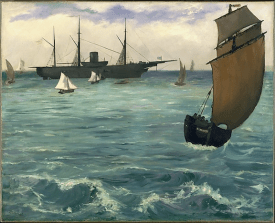
During the American Civil War, the United States warship Kearsarge made headlines after sinking the Confederate raider Alabama off the coast of France. Manet did not witness firsthand the widely-covered event but devoted two paintings to the subject: a scene of the naval battle (Philadelphia Museum of Art) and [The “Kearsarge” at Boulogne, 1864, The Met], prompted by his subsequent visit to the victorious ship at anchor near Boulogne. They were his first depictions of a current event.
https://www.metmuseum.org/art/collection/search/438144

Although he did not witness the historic battle, Manet made a painting of it partly as an attempt to regain the respect of his colleagues after having been ridiculed for his works in the 1864 Salon. Manet’s picture of the naval engagement and his portrait of the victorious Kearsarge belong to a group of his seascapes of Boulogne whose unorthodox perspective and composition would profoundly influence the course of French painting.
https://www.metmuseum.org/art/metpublications

(Learn more by clicking on embedded hyperlinks)

Salmagundi

The Birthday (1915)
“In life, just as on the artist’s palette, there is but one single colour that
gives meaning to life and art — the colour of love.” ~Marc Chagall

From the moment they fell for each other in 1909, Marc Chagall and his wife, Bella, seemed to share a particular way of seeing the world. Bella was a talented writer and her description of their first encounter is like a Chagall painting in words: “When you did catch a glimpse of his eyes, they were as blue as if they’d fallen straight out of the sky. They were strange eyes … long, almond-shaped … and each seemed to sail along by itself, like a little boat.”

Bella swiftly became Marc’s muse and continued to visit his canvases for the rest of his life. Famously, he often depicted himself and Bella flying together, as if their shared joy had such physical force it countermanded the law of gravity itself. In Birthday, they appear surprised by their flight, rising towards the ceiling like two astonished bubbles of ecstasy.
https://www.theguardian.com/stage/2016/may/27/marc-and-bella-chagall-the-flying-lovers-of-vitebsk-emma-rice

(Learn more by clicking on embedded hyperlinks)

Salmagundi

Take-Off: Interior of a Bomber Aircraft / c.1943 / Oil on canvas / 72”x60” / Imperial War Museums, UK

Dame Laura Knight (1877-1970)

A talented artist, Laura entered Nottingham School of Art when she was fourteen. While there she met Harold Knight and was deeply influenced by his work…Laura married Knight in June, 1903. Knight established herself as the most important woman artist in Britain and in 1936 became the first woman to be elected to the Royal Academy since 1760. During the Second World War Laura became an official war artist. She was also sent to cover the Nuremberg War Crimes Trials.
FROM http://spartacus-educational.com/ARTknight.htm

This slideshow requires JavaScript.

(Learn more by clicking on embedded hyperlinks)

Salmagundi

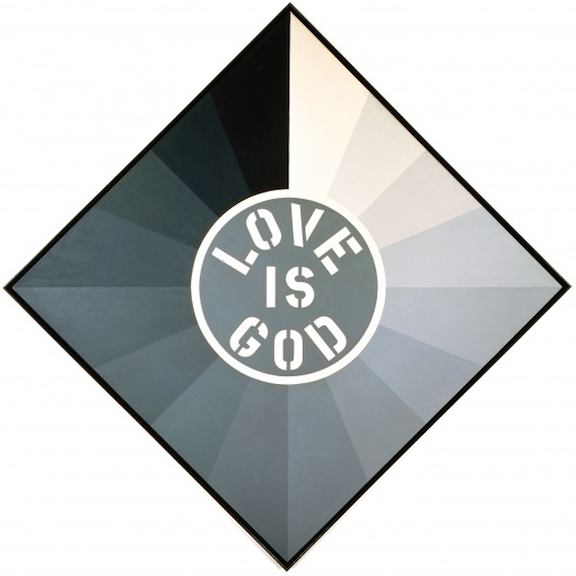
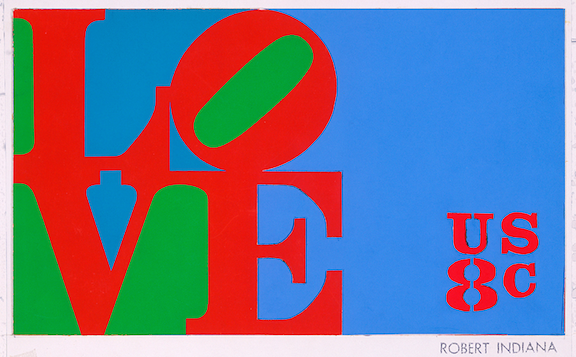
Robert Indiana’s LOVE

The inspiration came from his childhood as a Christian Scientist, when the phrase “God is love” was prominent. Indiana inverted the idea to suggest that “Love is God.

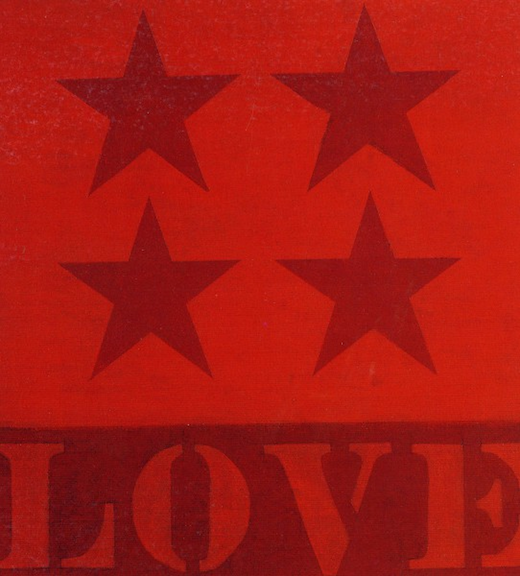
The first LOVE painting was a small canvas in 1961 called 4-Star Love, which was the word “love” with four stars stacked above it and that was really the inspiration for stacking the letters.

The motif first appeared as a series of rubbings in 1964 on his personal Christmas cards.

[In 1965] MoMA asked him to design a Christmas card. Inspired by his recent painting, he chose the single word ‘love’, the letters of which he arranged on two lines to fit the card’s square format better. To create a more interesting design he angled the ‘o’. Indiana submitted several colour variations. The museum chose the one with red letters against a blue and green background.

It was inspired by a sign at a gas station. During the Depression, my father worked for Phillips 66, which had a huge sign up in the sky. I can still see that red and green sign against the blue Indiana sky. My first ”Love” was red, green and blue.

Few Pop images are more widely recognized than Indiana’s LOVE…[it]has appeared in prints, paintings, sculptures, banners, rings, tapestries, and stamps. Full of erotic, religious, autobiographical, and political underpinnings—especially when it was co-opted as an emblem of 1960s idealism—LOVE is both accessible and complex in meaning. In printed works, Indiana has rendered LOVE in a variety of colors, compositions, and techniques. He even translated it into Hebrew for a print and a sculpture at the Israel Museum in Jerusalem

(Learn more by clicking on text-embedded hyperlinks leading to sources)