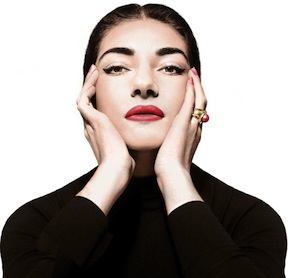
Maria made her first professional appearance in von Suppe’s Boccacio in 1939 and sang the leading part in Tosca in 1942. After a series of disappointments and resenting envy by her colleagues, she returned to the American land of her birth. She lived there for two years (1945-1947), met the bass Nicola Rossi – Lemeni and through him came to know the tenor Giovanni Zenatello, artistic director of the Arena of Verona. Maria Kalogeropoulos left for Italy, met the industrialist Giovanni Batista Meneghini, married him, became Maria Callas and experienced her artistic life’s curtain raiser without suspecting that she was about to emerge as the lyric theatre’s most brilliant personality. FROM http://www.hri.org/MFA/thesis/autumn97/callas.html
Callas’ ability to sing such a wide range of roles was one of the things that led to her meteoric rise. But critic Conrad Osborne says it also contained the seeds of her vocal decline. Callas’ voice was already starting to fail her by the time she was in her 40s — quite young for an opera singer. A number of factors, including a rapid loss of weight, may explain why…But for Callas fans like James Jorden, the diva more than made up for her vocal flaws with her talent for bringing the music to life. FROM http://www.npr.org/templates/story/story.php?storyId=123612228
By the time of her retirement, she had performed more than 40 different roles and had recorded more than 20 complete operas. Callas’s personality and philosophy of performance are powerfully depicted in Terrence McNally’s play Master Class (first performed and published 1995), based on her classes at Juilliard. FROM http://www.britannica.com/biography/Maria-Callas
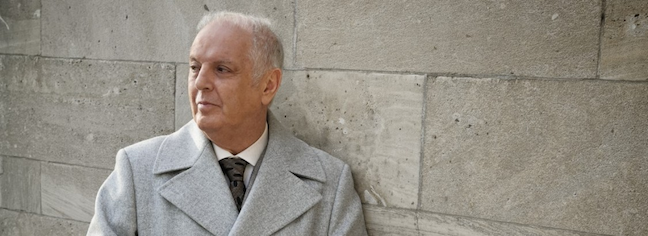
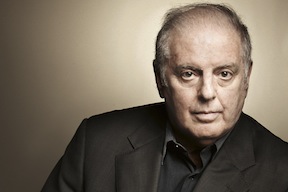
Barenboim’s parents were both pianists, and his father, Enrique Barenboim, was also a noted music professor. The family moved from Argentina to Salzburg, Austria, when Daniel was nine and then on to Israel in 1952. Barenboim had already debuted as a pianist at age seven, and in Europe he became known as something of a child prodigy. He made his debut in London (with the Royal Philharmonic Orchestra) in 1956 and in the United States (at Carnegie Hall) in 1957… Barenboim started conducting professionally in 1962, first in Israel and then in Australia with the Melbourne and Sydney symphony orchestras. He thereafter was guest conductor in several cities in European countries as well as in Israel and the United States. He served as music director of the Orchestre de Paris from 1975 to 1989. In 1987 he signed to become musical and artistic director of the new Bastille Opera in Paris, but he fell into disputes with representatives of the socialist government in Paris and was dismissed (in January 1989) before the first season was to commence, in 1990. Almost immediately, in January 1989, he accepted the post of music director of the Chicago Symphony Orchestra in succession to Sir Georg Solti. FROM http://www.britannica.com/biography/Daniel-Barenboim
In 1999, together with the late Palestinian-born writer and Columbia University professor Edward Said, Barenboim founded the West-Eastern Divan workshop and orchestra, bringing together talented young musicians from the Arab countries of the Middle East, Israel and Spain to make music under the guidance of some of the world’s finest musicians, enabling dialogue between the various cultures of the Middle East. Musicians of the Berlin Staatskapelle have participated as teachers in the project since its inception. In summer 2005, the West-Eastern Divan Orchestra presented a concert of historic significance in the Palestinian city of Ramallah, which was telecast and recorded for DVD. Since then, Barenboim and the orchestra have toured extensively, including appearances at the festivals in Lucerne and Salzburg, the BBC Proms in London and making a debut in the United Arab Emirates. In June 2015 Barenboim celebrated the imminent opening of the future home of the Barenboim-Said Akademie in Berlin, an educational institution that will expand upon the vision of the West-Eastern Divan Orchestra. Barenboim also initiated a project for music education in the Palestinian territories, which includes a music kindergarten as well as a youth orchestra. FROM https://www.deutschegrammophon.com/en/artists/daniel_barenboim/biography
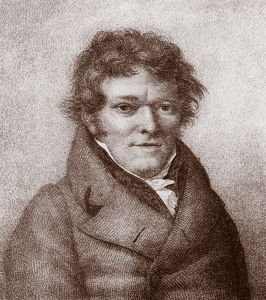
Alois Senefelder (1771-1834) was an Austrian actor and playwright who invented the printing technique of lithography in 1798. Born Aloys Johann Nepomuk Franz Senefelder in Prague where his actor father was appearing on stage. He was educated in Munich and won a scholarship to study law at Ingolstadt. The death of his father in 1791 forced him to leave his studies to support his mother and eight siblings, and he became an actor and wrote a successful play Connoisseur of Girls.
Problems with the printing of his play Mathilde von Altenstein caused him to fall into debt, and unable to afford to publish a new play he had written, Senefelder experimented with a novel etching technique using a greasy, acid resistant ink as a resist on a smooth fine-grained stone of Solnhofen limestone. He then discovered that this could be extended to allow printing from the flat surface of the stone alone, the first planographic process in printing. He joined with the André family of music publishers and gradually brought his technique into a workable form, perfecting both the chemical processes and the special form of printing press required for using the stones. He called it “stone printing” or “chemical printing”, but the French name “lithography” became more widely adopted. FROM http://www.radio.cz/en/static/inventors/senefelder
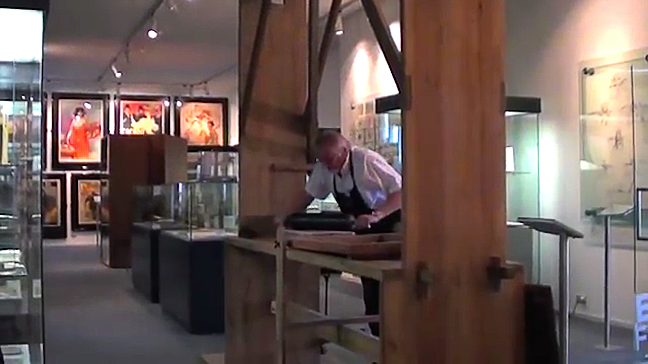
Lithography is a printing technique that gives multiple reproductions of an image drawn with ink or crayon on a certain type of limestone. The image must be prepared with a chemical process so that the grease contained in the ink or crayon (both being specially made for lithographic work) becomes permanently fixed to the stone. When the naturally absorbant stone is wetted before printing the lithographic ink will be retained in all areas containing grease and repelled in all other areas. The characteristic of this printing technique lies in the fact that the image area and the non-image area react differently to the presence of ink. FROM http://www.polymetaal.nl/beguin/mapl/lithography/lithodefinition.htm
Milstead met maverick film director & good friend, John Waters, at high school in Baltimore, and the two combined to star in and direct several ultra low budget, taboo breaking cult films of the early 1970s. Their first efforts included Roman Candles (1966), Eat Your Makeup (1968) and Mondo Trasho (1969)….however, their most infamous work together was the amazing Pink Flamingos (1972), in which Divine starred as “Babs Johnson”, the “filthiest person alive” living in a pink trailer with her egg-eating grandmother, chicken-loving son and voyeuristic daughter. FROM http://www.imdb.com/name/nm0001145/bio
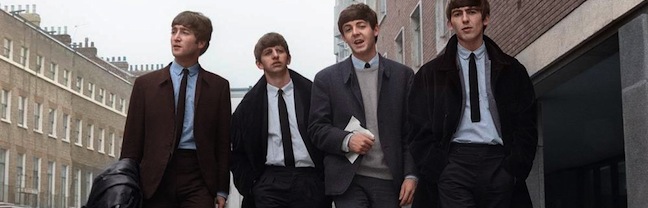
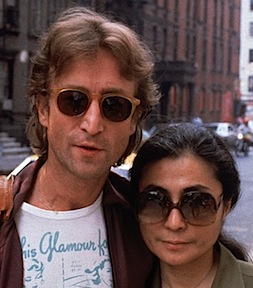
He was born John Winston Lennon on October 9, 1940. Like the other three Beatles, Lennon grew up in a working-class family in Liverpool. His parents, Julia and Fred, separated before he was two (Lennon saw his father only twice in the next 20 years), and Lennon went to live with his mother’s sister Mimi Smith; when Lennon was 17 his mother was killed by a bus. He attended Liverpool’s Dovedale Primary School and later the Quarry Bank High School, which supplied the name for his first band, a skiffle group called the Quarrymen, which he started in 1955. FROM https://www.rollingstone.com/music/
John Lennon didn’t invent rock and roll, nor did he embody it as toweringly as figures like Elvis Presley and Little Richard, but he did more than anyone else to shake it up, move it forward and instill it with a conscience. As the most daring and outspoken of the four Beatles, he helped shape the agenda of the Sixties – socially and politically, no less than musically. As a solo artist, he made music that alternately disturbed and soothed, provoked and sought community. As a human being, he served as an exemplar of honesty in his art and life. FROM https://www.rockhall.com/inductees/john-lennon
Alfred Abraham Knopf Sr. (September 12, 1892-August 11, 1984) was an American publisher of the 20th century, and founder of Alfred A. Knopf, Inc. His contemporaries included the likes of Bennett Cerf and Donald Klopfer, and (of the previous generation) Frank Nelson Doubleday, J. Henry Harper and Henry Holt. Knopf paid special attention to the quality of printing, binding, and design in his books, and earned a reputation as a purist in both content and presentation. FROM https://en.wikipedia.org/wiki/Alfred_A._Knopf_Sr.
Asked how to say his name, Knopf told the Literary Digest: “Sound the k: k’nupf.”
Purcell wrote only one full opera, a short work supposedly designed for a girls’ school. The tragic story of Dido and Aeneas, with a libretto by Nahum Tate, has a perfection of its own. Dido’s final lament, before she kills herself, follows the model for such compositions established by Monteverdi eighty years before. Other stage works by Purcell are in the hybrid form now known as semi-opera, combining spoken drama and a musical element that in the concert-hall may be performed apart from its wider dramatic context. FROM~ https://www.orfeomusic.de/Composer/Detail/20995
Maria made her first professional appearance in von Suppe’s Boccacio in 1939 and sang the leading part in Tosca in 1942. After a series of disappointments and resenting envy by her colleagues, she returned to the American land of her birth. She lived there for two years (1945-1947), met the bass Nicola Rossi – Lemeni and through him came to know the tenor Giovanni Zenatello, artistic director of the Arena of Verona. Maria Kalogeropoulos left for Italy, met the industrialist Giovanni Batista Meneghini, married him, became Maria Callas and experienced her artistic life’s curtain raiser without suspecting that she was about to emerge as the lyric theatre’s most brilliant personality.
Conrad Osborne says it also contained the seeds of her vocal decline. Callas’ voice was already starting to fail her by the time she was in her 40s — quite young for an opera singer. A number of factors, including a rapid loss of weight, may explain why…But for Callas fans like James Jorden, the diva more than made up for her vocal flaws with her talent for bringing the music to life.
By the time of her retirement, she had performed more than 40 different roles and had recorded more than 20 complete operas. Callas’s personality and philosophy of performance are powerfully depicted in Terrence McNally’s play Master Class (first performed and published 1995), based on her classes at Juilliard.










 The Misty Miss Christy