 “In June 2008, Phil Terry, founder of the Reading Odyssey and founder and CEO of Collaborative Gain, held an experiment. He wanted to know what would happen if museum and gallery visitors changed the way they looked at art. Instead of breezing past hundreds of artworks in the standard 8 seconds, he wondered what would happen if people looked slowly at just a few.
For the first Slow Art Day, he decided to look himself at Hans Hoffman’s Fantasia, Jackson Pollock’s Convergence, and a few other pieces of art hanging as part of the New York Jewish Museum’s 2008 Action/Abstraction exhibit.
As expected, it was a much better way to see the exhibit. Phil loved it.
A year later, in the summer of 2009, Phil continued the experiment: he asked four people to join him at the Museum of Modern Art in New York City and look at another small set of works, slowly.
That second experiment was a success.
Participants felt invigorated – and feedback was so positive that a few months later, in October 2009, Phil organized a third test, this time featuring 16 museums and galleries in the U.S., Canada and Europe with groups being led by volunteer hosts.
The third test worked really well – participants continued to report great feedback.
People loved the experience of looking slowly – and the host job was easy. Importantly, it was clear that anyone could host: trained museum staff or community volunteers. The host had only to pick a few pieces of art and get out of the way.
After that third test, Phil launched Slow Art Day as an annual global event with now hundreds of museums and galleries around the world participating.” http://www.slowartday.com/about/history/
How To Participate~ http://www.slowartday.com/participate/
2017 Slow Art Day Venues~ http://www.slowartday.com/2017-venues/
This slideshow requires JavaScript.
 Slow Art Day 2017 at the Barnes Foundation~ http://www.barnesfoundation.org/programs/april-2017/slow-art-day
Slow Art Day 2017 at the Walters Art Museum~ https://thewalters.org/events/event.aspx?e=4723
Facebook page~ https://www.facebook.com/SlowArtDay/
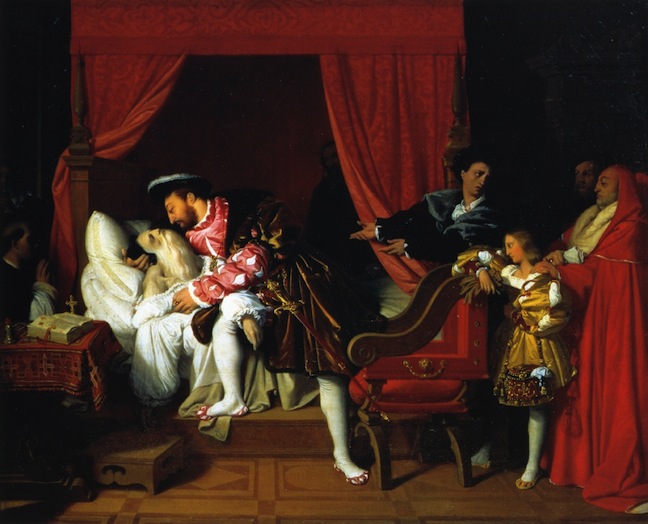 Francis I Receives the Last Breaths of Leonardo da Vinci





 The Misty Miss Christy