Salmagundi

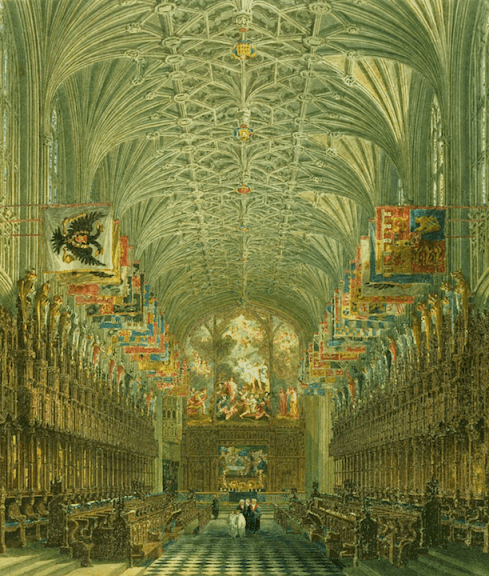
Windsor Castle: The Quire of St George’s Chapel by Charles Wild
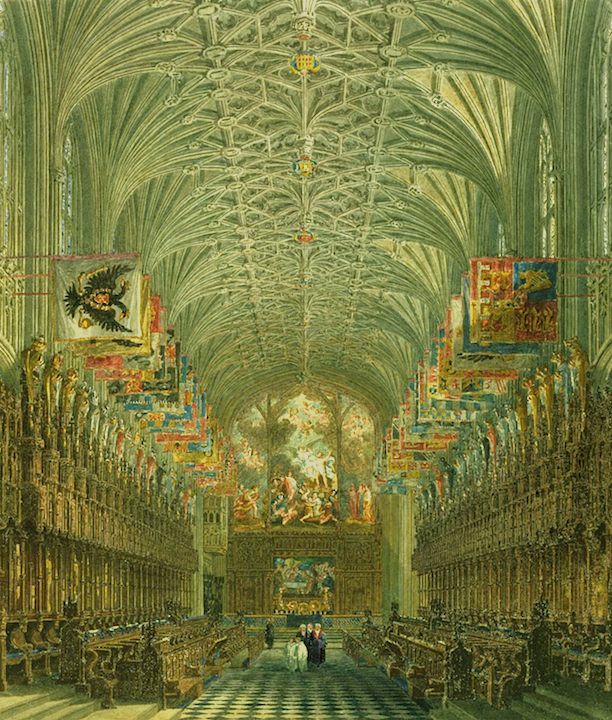
1818 / Watercolor and bodycolour over pencil / 9.8”x8.3” / Royal Collection

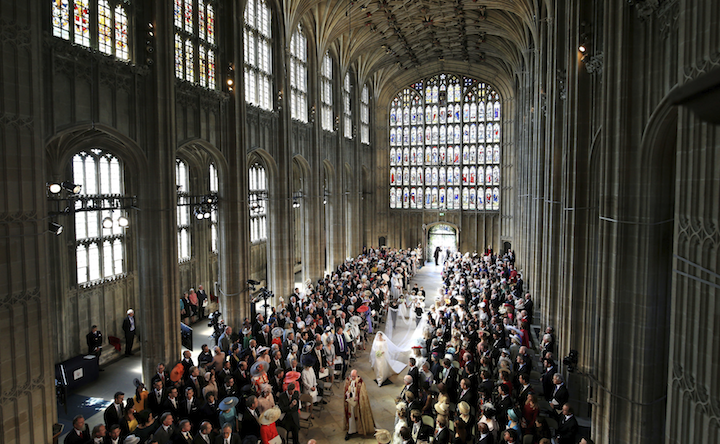
Prince Harry and Meghan Markle at St. George’s Chapel in Windsor Castle in Windsor, near London, England, Saturday, May 19, 2018. (Danny Lawson/pool photo via AP)

On May 19, 2018, Prince Harry and Meghan Markle’s wedding took place in St George’s Chapel, Windsor Castle. Prince Harry was baptised in St George’s Chapel in December, 1984.
FROM https://www.stgeorges-windsor.org/news/royal-wedding-2/

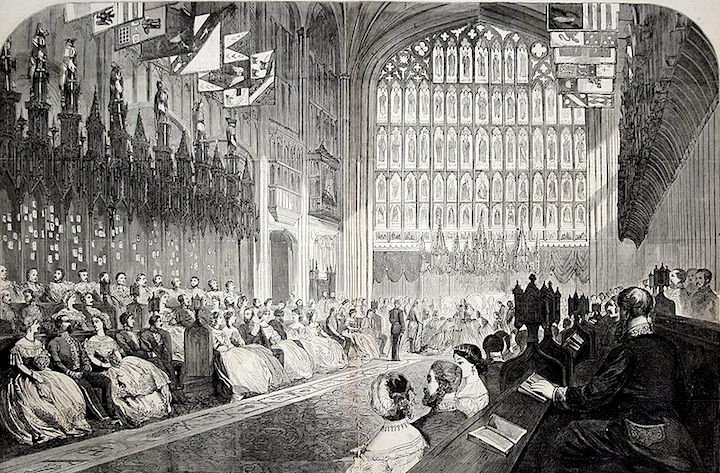
Engraved illustration from Harper’s Weekly newspaper of the wedding of the Prince of Wales (later King Edward VII) and Alexandra of Denmark / Harper’s Weekly newspaper dated 11 April 1863 / Artist unknown

St. George’s Chapel was built in the 15th century and is a towering piece of Gothic architecture. It is lauded for its stone fan-vault ceilings, but the intricate stained glasswork along each of its walls, and the tall arched windows, intricate woodwork, and ironwork doorframes add to the historic feel of the grand room. The tombs of ten sovereigns also lie within the chapel, including Henry VIII and Charles I. FROM https://www.architecturaldigest.com/story/prince-harry-and-meghan-markle-will-marry-at-st-georges-chapel-at-windsor-castle-this-may
(Learn more by clicking on hyperlinks embedded in text)

Salmagundi

Mathew Brady [War]

Mathew Brady is often referred to as the father of photojournalism and is most well known for his documentation of the Civil War. His photographs, and those he commissioned, had a tremendous impact on society at the time of the war, and continue to do so today. He and his employees photographed thousands of images including battlefields, camp life, and portraits of some of the most famous citizens of his time including Abraham Lincoln and Robert E. Lee.
https://www.battlefields.org/learn/biographies/mathew-brady

The Civil War as Photographed by Mathew Brady~
http://www.archives.gov/education/lessons/brady-photos/


(Learn more by clicking on embedded hyperlinks)

Salmagundi

Frida Kahlo and Diego Rivera: Love and War

Two years after [her] accident, in 1927, [Kahlo] met the painter Diego Rivera, whose work she’d come to admire and who became her mentor. In 1929, despite the vocal protestations of Kahlo’s mother, Frida and Diego were wedded and one of art history’s most notoriously tumultuous marriages commenced. 
FROM https://www.brainpickings.org/2013/04/19/frida-kahlo-diary-love-letters/

Kahlo…believed that her relationship with Rivera transcended the bodily, physical, even painterly world. “It’s not love, or tenderness, or affection, it’s life itself, my life, that I found when I saw it in your hands, in your mouth and in your breasts,” she [wrote] to him. “I have the taste of almonds from your lips in my mouth. Our worlds have never gone outside. Only one mountain can know the core of another mountain.”
FROM https://www.artsy.net/article/artsy-editorial-frida-kahlos-love-letters-diego-rivera-reveal-volatile-relationship

(Learn more by clicking on the embedded hyperlinks above)

This slideshow requires JavaScript.

Salmagundi

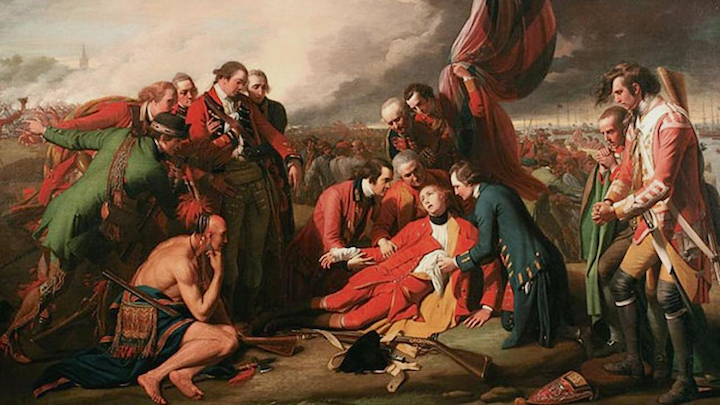
The Death of General Wolfe by Benjamin West

On September 13, 1759, during the Seven Years’ War (1756-63) [known in the United States as the French and Indian War], the British General James Wolfe achieved a dramatic victory; Wolfe was fatally wounded during the battle, but his victory ensured British supremacy in Canada.
https://www.history.com/topics/native-american-history/battle-of-quebec-1759

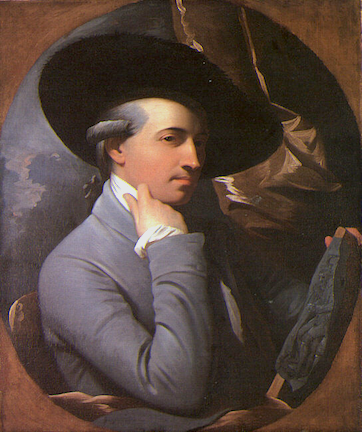
Benjamin West, Self-portrait 1770

Besides the original, at least four other additional versions of The Death of General Wolfe were also produced by West. The primary copy of The Death of General Wolfe is currently in the collection of the National Gallery of Canada, with further examples at the Royal Ontario Museum (Canadiana art collection), as well as the University of Michigan Museum of Art. The fourth copy produced resides at Ickworth House, Suffolk, England. Each reproduction had its own variation in the depiction of Wolfe’s death. A fifth autograph copy was commissioned by George III in 1771 and is still in the Royal Collection.
FROM https://en.wikipedia.org/wiki/The_Death_of_General_Wolfe

(Learn more by clicking on embedded hyperlinks)

Salmagundi

Venus de Milo / Musée du Louvre

Venus de Milo, the ancient statue commonly thought to represent Aphrodite…was carved from marble by the artist Alexandros* about 150 BCE. It was found in pieces on the Aegean island of Melos on April 8, 1820, and was subsequently presented to Louis XVIII (who then donated it to the Louvre in 1821).  ~https://www.britannica.com/topic/Venus-de-Milo

*Alexandros of Antioch (2nd-1st century BC) was a Greek sculptor of the Hellenistic age. His dates of birth and death are unknown. ~https://en.wikipedia.org/wiki/Alexandros_of_Antioch

(Learn more by clicking on hyperlinks embedded in text)

What Happened to the Venus De Milo’s Arms?
http://mentalfloss.com/article/62722/what-happened-venus-de-milos-arms
The Mystery of What Venus de Milo Was Once Holding
https://www.smithsonianmag.com/smart-news/3-d-printing-offers-guess-what-venus-de-milo-might-have-been-holding-180955176/

Salmagundi

Meta Vaux Warrick Fuller
“Peace Halting the Ruthlessness of War”

1917 / Bronze cast sculpture / 14”x16 3/4”x9”/ Private collection

Meta Vaux Warrick Fuller (June 9, 1877-March 18, 1968) was…a multi-talented artist who wrote poetry, painted, and sculpted but was most noted for her sculpture. Warrick was a protegé of Auguste Rodin…Warrick is considered a forerunner of the Harlem Renaissance. ~FROM Wikipedia

In May, 1917, Meta Warrick Fuller took second prize in a competition under the auspices of the Massachusetts Branch of the Woman’s Peace Party, her subject being “Peace Halting the Ruthlessness of War.” War is personified as on a mighty steed and trampling to death numberless human beings. In one hand he holds a spear on which he has transfixed the head of one of his victims. ~FROM Documenting the American South

(Learn more by clicking on hyperlinks embedded in text)

In the Studio: The Meta Vaux Warrick Fuller Collection~ https://danforth.framingham.edu/exhibition/meta-fuller/

Salmagundi


Mother’s Day: Love

The artist’s mother, comtesse Adèle de Toulouse-Lautrec, at breakfast, Malromé Chateau
by Henri de Toulouse-Lautrec
c.1881-1883 / Oil on canvas / 36.8”x31.8” / Musée Toulouse-Lautrec, France

Portrait of the Artist’s Mother by Vincent van Gogh
1888 / Oil on canvas / 16”x12-3/4” / Norton Simon Museum, Pasadena

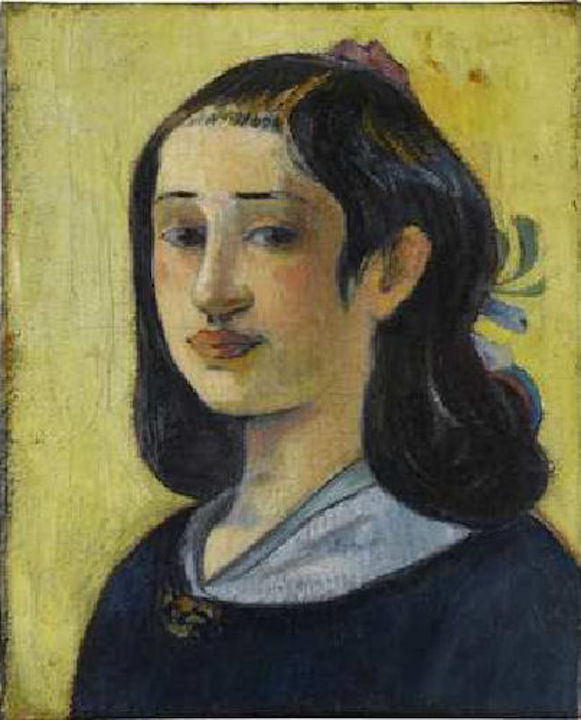
The Artist’s Mother by Paul Gauguin
Between 1890 & 1893 / Oil on canvas / 16.1”x12.9” / Staatsgalerie Stuttgart, Germany

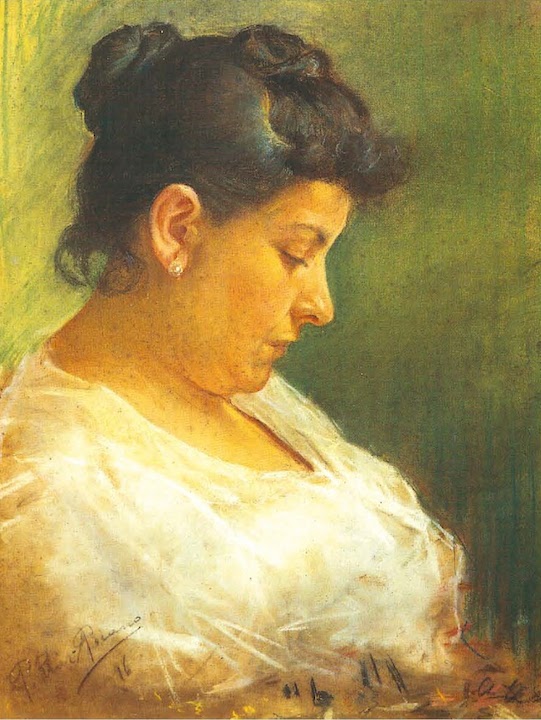
The Artist’s Mother by Pablo Picasso
1896 / Pastel on paper / 19.6”x15.3” / Museu Picasso, Barcelona

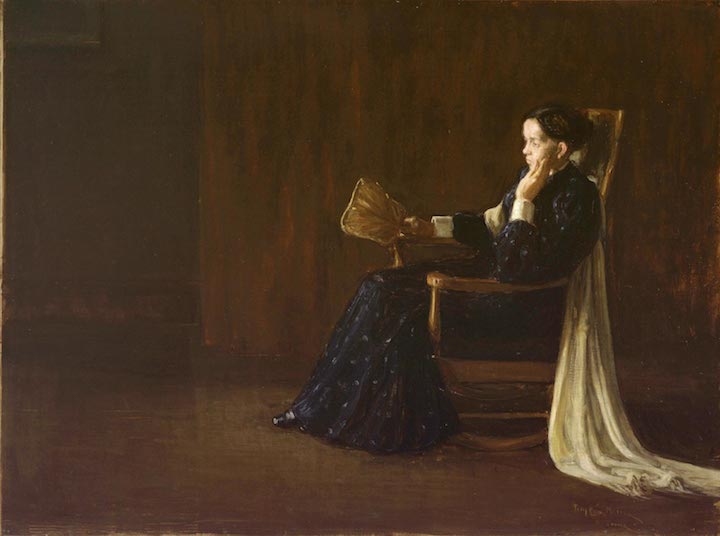
Portrait of the Artist’s Mother by Henry Ossawa Tanner
1897 / Oil on canvas / 29 1/4”x39 1/2” / Philadelphia Museum of Art

Mrs. Robert S. Cassatt, the Artist’s Mother by Mary Cassatt
c.1889 / Oil On Canvas / 38”x27” / Fine Arts Museums of San Francisco

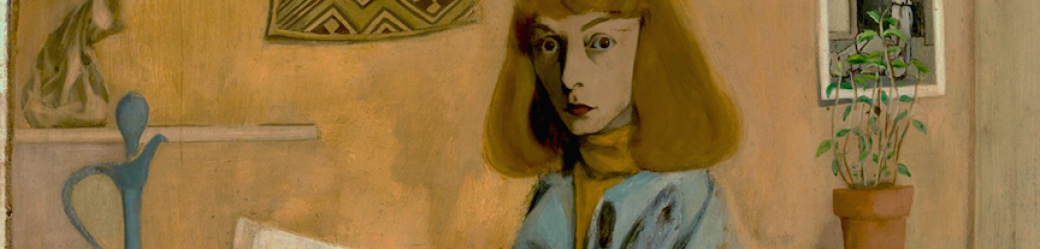
Woman with Plants by Grant Wood
1929 / Oil on upsom board / 20 1/2”x17 7/8” / Museum of Art Cedar Rapids, Iowa

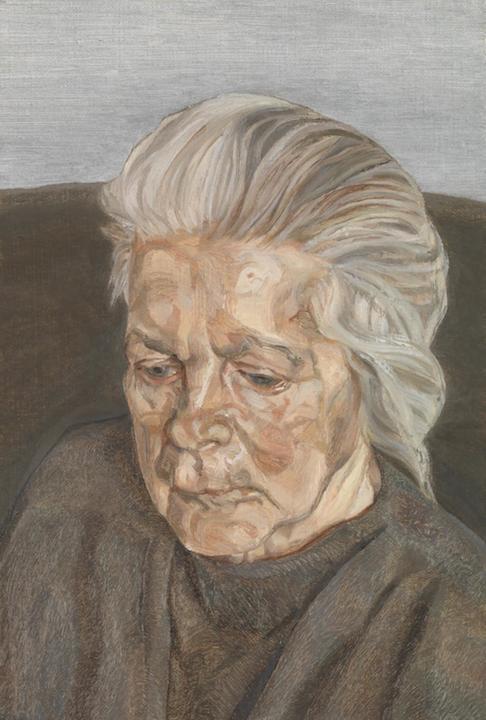
The Painter’s Mother IV by Lucian Freud
1973 / Oil on canvas / 10 3/4”x 7 1/3” / Tate, London

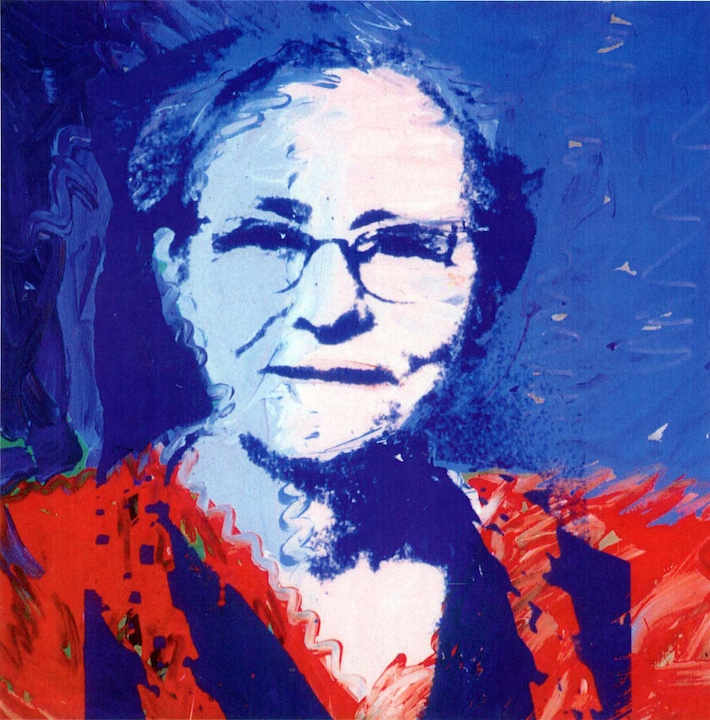
Julia Warhola by Andy Warhol
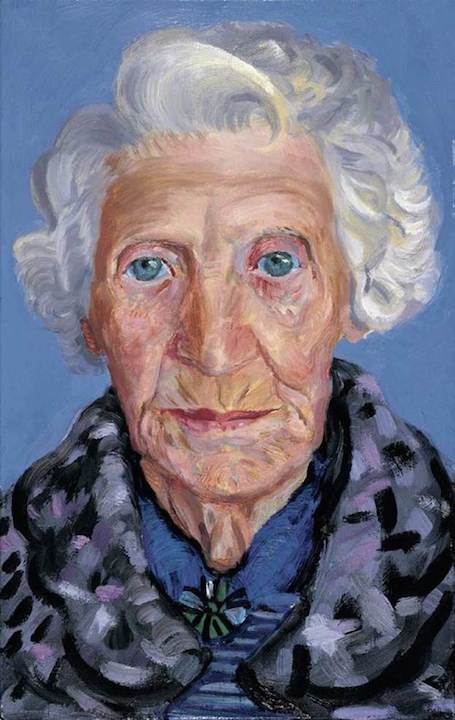
1974 / Silkscreen ink and synthetic polymer paint on canvas / 40”x40” / The Andy Warhol MuseumMum by David Hockney
1988 / Oil on canvas / 16 1/2”x10 1/2” / The David Hockney Foundation

(Learn more by clicking on embedded hyperlinks)

Salmagundi

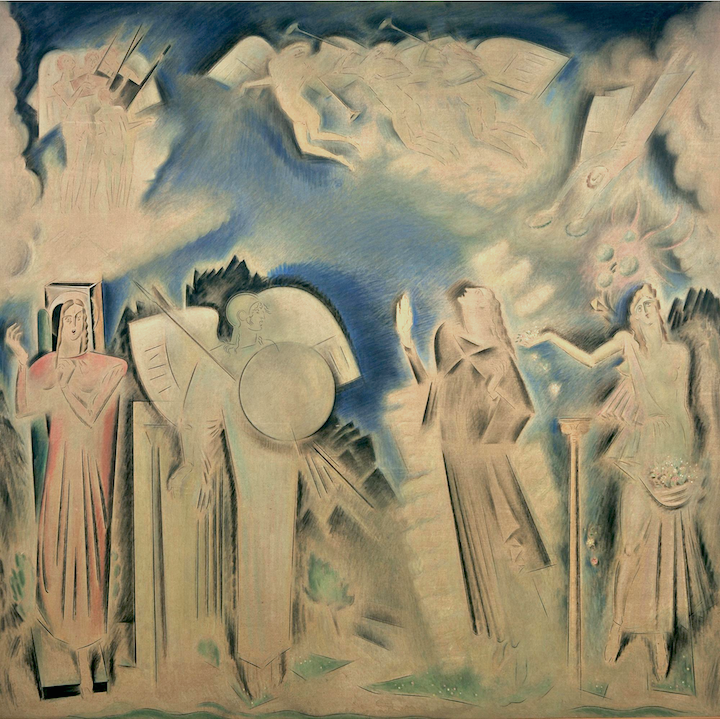
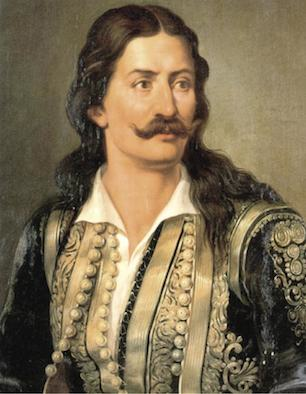
The Apotheosis of Athanasios Diakosby Konstantinos Parthenis

c.1933 / Oil on canvas / 150”x150” / National Art Gallery and Alexandros Soutzos Museum, Athens

Konstantinos Parthenis (1878-1967), Greek painter

Athanasios Diakos was a hero of the Greek War of Independence. Prior to the war he entered a monastery and was ordained a deacon (“diakos” in the Greek language). One day a Turkish pasha came to his monastery and made some crude remarks about his good looks. Diakos slew him and fled to the mountains. He join a band of klephts who made him second in command. Eventually, he headed his own band. In April 1821, Omer Vrioni, the commander of the Turkish army, advanced with 9,000 men from Thessaly to crush the revolt in Peloponnesus.

Athanasios Diakos

Diakos’ men fought for several hours before they were overwhelmed. The wounded Diakos was taken to Vrioni. Vrioni offered to make Diakos an officer in his army but Diakos refused and replied “I was born a Greek and I will die a Greek”.
FROM http://wiki.phantis.com/index.php/Athanasios_Diakos

(Learn more by clicking on embedded hyperlinks)

Salmagundi

The Kiss

Auguste Rodin (French, 1840-1917)

The Tate’s The Kiss is one of three full-scale versions made in Rodin’s lifetime. Its blend of eroticism and idealism makes it one of the great images of sexual love. However, Rodin considered it overly traditional, calling The Kiss ‘a large sculpted knick-knack following the usual formula.’
~http://www.tate.org.uk/art/artworks/rodin-the-kiss-n06228
~The Rodin Museum in Paris, France
~Ny Carlsberg Glyptotek in Copenhagen, Denmark

The three larger marble versions were exhibited together at the Musée d’Orsay in 1995. A fourth copy was made after the death of Rodin by sculptor Henri-Léon Gréber for the Rodin Museum of Philadelphia.

(Learn more by clicking on embedded hyperlinks)

Salmagundi

Fifteen officers of the 17th Regiment of Foot posed on a hill at camp, 1855

Roger Fenton (1819-1869) [War]

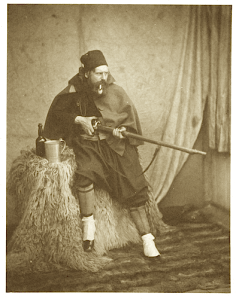
Photograph of Roger Fenton (1819-1869) dressed in traditional Zouave costume.

…the British government hired photographer Roger Fenton to travel to Crimea and create some of the first war photographs in history. He arrived in March 1855 and stayed for 3.5 months.
FROM https://mashable.com/2016/01/06/crimean-war/#JJZDNMTVAuqa

While the sight of soldiers with a sketchbook as well as the occasional artist was not uncommon in the Crimea, the idea of a photographer ‘at the seat of war’ was new. Consequently, Fenton was pestered by troops wanting their ‘likeness’ taken, so much so that he noted he would ‘dread the sight of English officers riding up to my van’.
FROM http://www.tate.org.uk/context-comment/articles/terrible-beauty

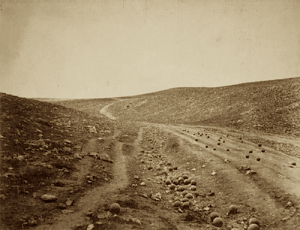
The Valley of the Shadow of Death, 1855

In the course of a single decade, Fenton had played a pivotal role—by advocacy and example—in demonstrating that photography could rival drawing and painting not only as a means of conveying information, but also as a medium of visual delight and powerful expression.
FROM https://www.metmuseum.org/toah/hd/rfen/hd_rfen.htm

(Learn more by clicking on embedded hyperlinks)