Salmagundi

Christo and Jeanne-Claude: Love

The Gates / 1979-05 / 7,503 vinyl “gates” / Central Park, NYC, February 12, 2005-February 27, 2005

Christo Vladimirov Javacheff and Jeanne-Claude were a married couple who created environmental works of art. Christo and Jeanne-Claude were born on the same day, June 13, 1935; Christo in Gabrovo, Bulgaria, and Jeanne-Claude in Morocco. They first met in Paris in October 1958 when Christo painted a portrait of Jeanne-Claude’s mother.
Their works include the wrapping of the Reichstag in Berlin and the Pont-Neuf bridge in Paris, the 24-mile (39 km)-long artwork called Running Fence in Sonoma and Marin counties in California, and The Gates in New York City’s Central Park.
Jeanne-Claude died, aged 74, on November 18, 2009, from complications of a brain aneurysm. Christo died at his home in New York City on May 31, 2020, at 84.  ~Wikipedia

Their relationship lasted 51 years, and they did everything together, Jeanne-Claude said, except three things: “We never fly on the same airplane… I do not draw. Christo is the one who puts on paper our ideas… And I have always deprived him of the joy of working with our accountant.”  ~The Guardian

Salmagundi

In Flanders Field-Where Soldiers Sleep and Poppies Grow / Robert Vonnoh
1890 / Oil on canvas / 58”x104” / The Butler Institute of American Art

In Flanders Fields By John McCrae

In Flanders fields the poppies blow
Between the crosses, row on row,
That mark our place; and in the sky
larks, still bravely singing, fly
Scarce heard amid the guns below.

We are the Dead. Short days ago
We lived, felt dawn, saw sunset glow,
Loved and were loved, and now we lie,
In Flanders fields.

Take up our quarrel with the foe:
To you from failing hands we throw
The torch; be yours to hold it high.
If ye break faith with us who die
We shall not sleep, though poppies grow
In Flanders fields.

“ ‘In Flanders Field’  became popular almost immediately upon its publication. It was translated into other languages and used on billboards advertising Victory Loan Bonds in Canada. The poppy soon became known as the flower of remembrance for the men and women in Britain, France, the United States, and Canada who have died in service of their country.” ~poets.org

^^  (Learn more by clicking on the six hyperlinks embedded in text)  ^^

Salmagundi

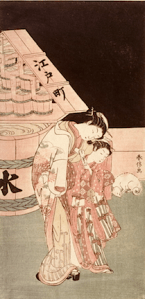
Lovers Walking in the Snow (Crow and Heron) by Suzuki Harunobu

1764–72 / Polychrome woodblock print; ink and color on paper, with embossing / 11 1/4”x8 1/8” / The Met

Courtesan Senri Receiving a Love Letter

Suzuki Harunobu (1725?-1770) “played a pivotal role in the evolution of Japanese printmaking during its great period — the last half of the i8th and the first years of the 19th century. In the final years of his relatively brief life, he opened up a new dimension of expression in that tradition of graphics by introducing many colors to what had essentially been a mono-chromatic art form”. ~archive.org

A Woman Sweeping up Her Love Letters

“Just 20 years previously, the invention of benizuri-e had made it possible to print in three or four colors; Harunobu applied tis new technique to ukiyo-e prints using up to ten different colors on a single sheet of paper. Harunobu was the first ukiyo-e artist to consistently use more than three colors in each print.” ~Wikipedia

A Caged Bird and a Love Letter

“Harunobu died in 1770, only five years after introducing the nishiki-e print. However, in those last few years of his life, he produced over one thousand print designs, chiefly depictions of willowy young girls, and also a fair percentage of shunga (erotic prints), as most ukiyo-e artists did. He is known to have produced at least seven shunga volumes.”~samuraipodcast.com

Suzuki Harunobu / ukiyo-e.org
_________________________________

(Learn more by clicking on hyperlinks embedded in text)

Salmagundi

Dorothea Lange [War]Lange

Mules

Biographies:
International Photography Hall of Fame and Museum~ http://www.iphf.org/hall-of-fame/dorothea-lange/
PBS~ http://www.pbs.org/video/2365971488/

Three months after Pearl Harbor, President Franklin Roosevelt ordered the relocation of Japanese-Americans into armed camps in the West. Soon after, the War Relocation Authority hired [Dorothea Lange (1895-1965)] to photograph Japanese neighborhoods, processing centers, and camp facilities.

To capture the spirit of the camps, Lange created images that frequently juxtapose signs of human courage and dignity with physical evidence of the indignities of incarceration. Not surprisingly, many of Lange’s photographs were censored by the federal government, itself conflicted by the existence of the camps.

The true impact of Lange’s work was not felt until 1972, when the Whitney Museum incorporated twenty-seven of her photographs into Executive Order 9066, an exhibit about the Japanese internment. New York Times critic A.D. Coleman called Lange’s photographs “documents of such a high order that they convey the feelings of the victims as well as the facts of the crime.”
FROM http://www.loc.gov/exhibits/wcf/wcf0013.html

FatherSonNational Archives~ https://www.archives.gov/news/articles/japanese-internment-75th-anniversary
National Park Service~ https://www.nps.gov/manz/learn/photosmultimedia/dorothea-lange-gallery.htm

(Learn more by clicking on embedded hyperlinks)

Salmagundi

Charles & Ray Eames: Love

(Learn more by clicking on hyperlinks embedded in text)

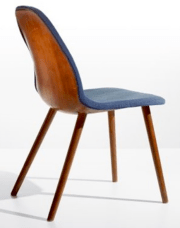
“Charles was a designer with an eye for form. Ray was an artist with an eye for color. They complemented each other on projects like coat hangers, films, their namesake chairs, and large architectural projects. Through four decades of creative work, they revolutionized design and created an indelible mark on American History. The duo was not without faults, but the pair proved to be inseparable and inspirational. They were the Eameses.”
https://www.pastemagazine.com/design/charles-and-ray-eames/first-couple-of-design-charles-eames/

“Their partnership, which obliterated the distinctions between private and professional lives, inspired numerous contemporary working marriages…Charles and Ray, architect and artist, wanted to do everything — disciplinary boundaries meant nothing to them — and, by and large, succeeded.” https://nymag.com/nymetro/arts/features/1437/

The Work of Charles and Ray Eames: A Legacy of Invention
AD Classics: Eames House / Charles and Ray Eames
The Love Letters of Charles & Ray Eames

Salmagundi

Victory Gardens [War]

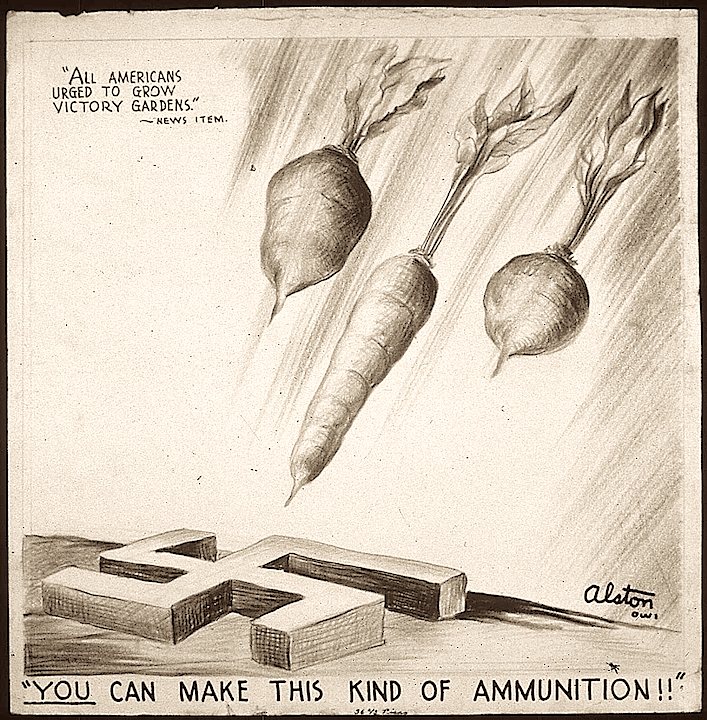
During World War I, Liberty Gardens (and later, Victory Gardens) grew out of the government’s efforts to encourage home gardening among Americans, both to express their patriotism and to aid the war effort by freeing up food production for soldiers. ~cbsnews.com
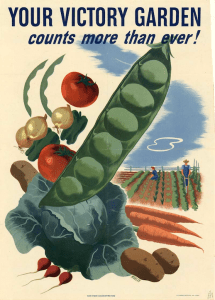
As part of the (World War II) effort, the government rationed foods like sugar, butter, milk, cheese, eggs, coffee, meat and canned goods. Labor and transportation shortages made it hard to harvest and move fruits and vegetables to market. So, the government turned to its citizens and encouraged them to plant “Victory Gardens.” They wanted individuals to provide their own fruits and vegetables. ~livinghistoryfarm.org

Americans were encouraged to grow their own to ensure everyone at home had enough to eat…There were 20 million gardens everywhere from rooftops and empty lots to backyards and schoolyards. 40% of produce, which made over 1 million tons, consumed in America was grown in victory gardens. People learned how to can and preserve so the harvests lasted all year. ~nww2m.com

(Learn more by clicking on links in the images and text)

Salmagundi

Weddings in the Renaissance

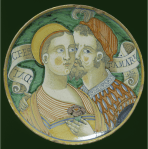
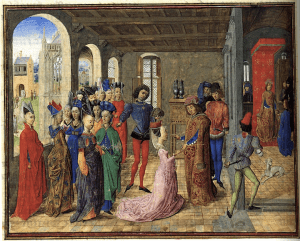
The scholars Silvana Seidel Menchi and Diego Quaglion…provide startling information demonstrating just how informal the act of marriage could be and how it could take place in almost any location. “With the assistance of a ladder, the groom, flanked by witnesses, reached the bride, and facing each other they pronounced the formula of the ritual, balanced in an equilibrium as unstable as the tie that thus bound them.” Indeed, before the edicts of The Council of Trent systematized the requirements of a proper wedding in 1563, only mutual consent was an absolute necessity for marriage. FROM Art and Love in Renaissance Italy / MetPublications /
The Metropolitan Museum of Art

(Learn more by clicking on hyperlinks embedded in text)

Salmagundi

Sir Winston Churchill by Ernest Hamlin Baker
[War]

1949 / Gouache, ink and graphite pencil on paperboard / 11 3/4”x10 1/2″

Ernest Baker, born in 1889 in Rhode Island, was a self-taught illustrator. Most of his works were covers for Time magazine, although he was responsible for eleven covers for Fortune magazine between 1929 and 1941.

Beginning in 1939, Baker produced over 300 covers for Time during his seventeen-year tenure with the magazine. He was described by Time publisher, Ralph Ingersoll, as an artist who could do anything.
http://www.askart.com/artist_bio/Ernest_Hamlin_Baker/28830/Ernest_Hamlin_Baker.aspx

In December of 1949, Winston Churchill was chosen by Time magazine as theMan of the Half-Century, celebrated in a 16-page supplement which was contained in the January 2nd issue of 1950. Baker did the cover illustration for that issue.

This slideshow requires JavaScript.

(Learn more by clicking on embedded hyperlinks)

Salmagundi

Hannah Höch: Love

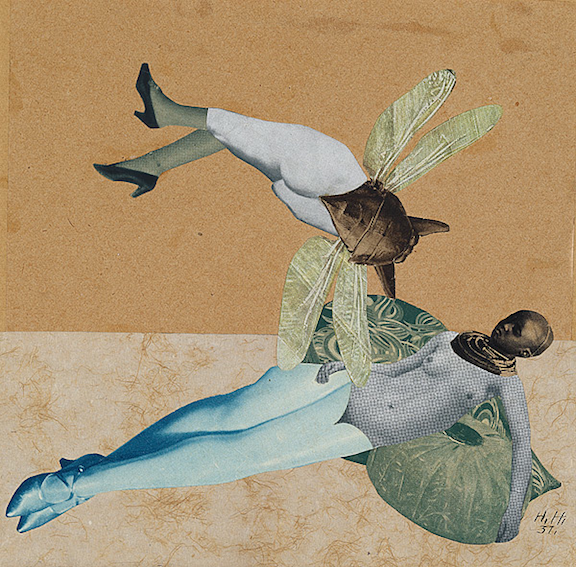
Liebe [Love] / 1931 / Drawing, collage / 8.5”x8.25” / National Gallery of Australia

Hannah Höch was a German Dada artist. She is best known for her work of the Weimar period, when she was one of the originators of photomontage.  FROM monoskop.org

While she may have been remembered by her bombastic Dada colleagues for her “sandwiches, beer and coffee”, her lifetime of artistic practice reveals a vital and critical woman who could magically collide disparate reproductions of needlepoint patterns, political figures, film stars, animal life and non-Western artifacts into explorations of androgyny, Aryan activity, gender roles, imperialism, race and lesbianism.  FROM frieze.com

The Coquette I (1923-1925)

Hoch began the Love series as early as 1923, and worked on it intermittently through about 1931. Each of the six or seven works in this series depict sexuality in some way. My understanding is that the following pieces were in this series:

Love in the Bush (1925)
Peasant Wedding Couple (1931)
Love (1926)
Love (1931)
The Coquette I (1923-1925)
The Coquette II (c.1925)
The Large Step (1931)

MoMA’s catalog for their 1997 exhibition “The photomontages of Hannah Höch” is available to download in pdf format~
https://www.moma.org/calendar/exhibitions/241

Love (1926)

(Learn more by clicking on embedded hyperlinks)

Salmagundi

Vietnam Veterans Memorial

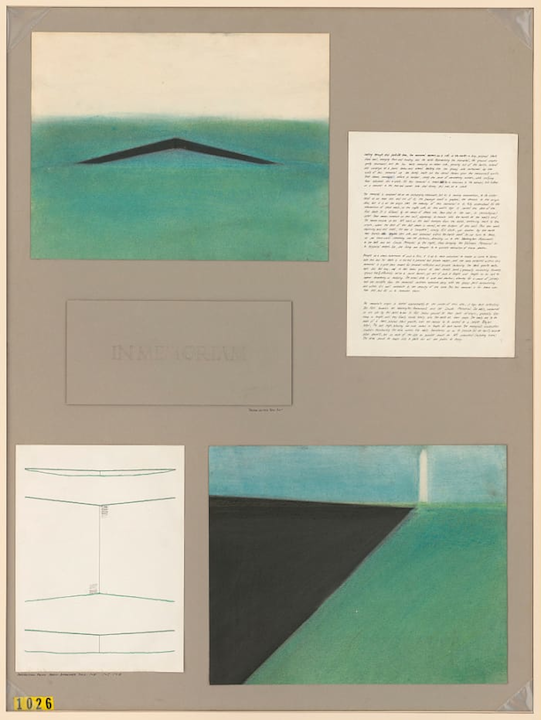
Maya Lin’s original competition submission for the Vietnam Veterans Memorial in Washington, D.C. Architectural drawings and a one-page written summary, 1980 or 1981.

In 1979, Congress grants a Vietnam War veterans’ committee the right to build a memorial on the Mall in Washington, D.C., dedicated to American soldiers killed in the conflict in Vietnam…When the winner is announced, no one is more surprised than the student architect herself, Maya Lin, a 20-year-old Yale undergraduate…Lin describes the Memorial thus: “I went to see the site. I had a general idea that I wanted to describe a journey…a journey that would make you experience death and where you’d have to be an observer, where you could never really fully be with the dead. It wasn’t going to be something that was going to say, ‘It’s all right, it’s all over,’ because it’s not.”
FROM http://www.pbs.org/wgbh/cultureshock/flashpoints/visualarts/thewall_a.html

Spotlight: Maya Lin~ https://www.archdaily.com/774717/spotlight-maya-lin

(Learn more by clicking on embedded hyperlinks)