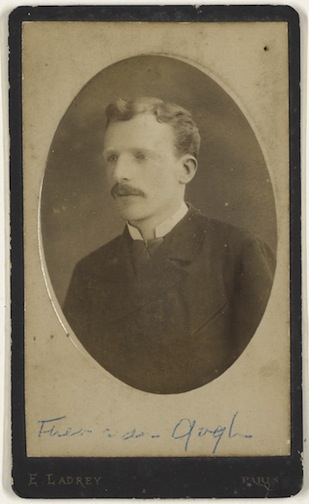
Erik Satie~ Born May 17, 1866

Portrait of Erik Satie Playing the Harmonium by Santiago Rusiñol

Erik Satie, original name in full Eric Alfred Leslie Satie (born May 17, 1866, Honfleur, Calvados, France—died July 1, 1925, Paris), French composer whose spare, unconventional, often witty style exerted a major influence on 20th-century music, particularly in France.

During his last 10 years Satie’s best friends were painters, many of whom he had met while a café pianist. Satie was nonetheless deeply admired by composers of the rank of Darius Milhaud, Maurice Ravel, and, in particular, Claude Debussy—of whom he was an intimate friend for close to 30 years.

His ballet Parade (1917; choreographed by Léonide Massine, scenario by Jean Cocteau, stage design and costumes by Pablo Picasso) was scored for typewriters, sirens, airplane propellers, ticker tape, and a lottery wheel and anticipated the use of jazz materials by Igor Stravinsky and others. The word Surrealism was used for the first time in Guillaume Apollinaire’s program notes for Parade.
FROM https://www.britannica.com/biography/Erik-Satie

Watch the 1917 Ballet “Parade”: Created by Erik Satie, Pablo Picasso & Jean Cocteau,
It Provoked a Riot and Inspired the Word “Surrealism” (from Open Culture)
http://www.openculture.com/2017/05/the-1917-ballet-parade-created-by-erik-satie-pablo-picasso-jean-cocteau.html

This slideshow requires JavaScript.

Woody Herman: Born May 16, 1913

A fine swing clarinetist, an altoist whose sound was influenced by Johnny Hodges, a good soprano saxophonist, and a spirited blues vocalist, Woody Herman’s greatest significance to jazz was as the leader of a long line of big bands. He always encouraged young talent and, more than practically any bandleader from the swing era, kept his repertoire quite modern. Although Herman was always stuck performing a few of his older hits (he played “Four Brothers” and “Early Autumn” nightly for nearly 40 years), he much preferred to play and create new music.
http://www.allmusic.com/artist/woody-herman-mn0000958076/biography

William Grant Still~ Born May 11, 1895


William Grant Still (1895-1978)
“African American Composer, Arranger, Conductor & Oboist
Dean of African American Composers”
http://chevalierdesaintgeorges.homestead.com/still.html

On this date in 1895, William Grant Still was born. He was an African American musician and composer.

Still was the first African American to conduct a major symphony orchestra, the first African-American to have an opera, “Troubled Island” (1949) performed by a major opera company, and the first to have an opera, “A Bayou Legend,” performed on national television (1981).

https://aaregistry.org/story/william-grant-still-a-symphonic-composer/

Irving Berlin~ Born May 11, 1888

“Irving Berlin has no place in American music – he is American music.”  ~Jerome Kern

Irving Berlin was born Israel Beilin on May 11, 1888. In 1907 he published his first song, “Marie from Sunny Italy,” and by 1911 he had his first major international hit — “Alexander’s Ragtime Band.” Over the next five decades, Irving Berlin produced an outpouring of ballads, dance numbers, novelty tunes and love songs that defined American popular song for much of the century. He wrote seventeen complete scores for Broadway musicals and revues, and contributed material to six more. His songs have provided memorable moments in dozens of…films. An intuitive business man, Irving Berlin was a co-founder of ASCAP (American Society of Composers, Authors and Publishers), founder of his own music publishing company, and with producer Sam Harris, builder of his own Broadway theatre, The Music Box.
https://www.songhall.org/profile/Irving_Berlin

Biography of Irving Berlin

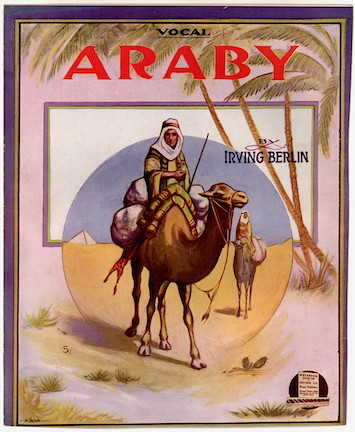
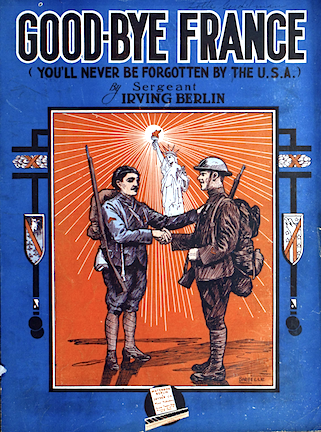
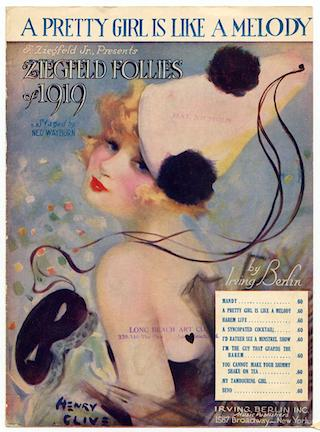
In the late 19th century the sheet music business dominated the music industry in the United States. Parlor music took over the scene as the piano became a part of the middle class home.  This led to a demand for sheet music for home consumption.  The genre that grew out of this demand was called Tin Pan Alley, from the area of New York City where most of the song publishers were located. Success was measured by the sale of sheet music.  To attract business, sheet music publishers hired artists to make beautiful covers…In the early 20th century the phonograph and recorded music grew in popularity and began to replace sheet music.  In the 1920s, radio became the rage and eventually the record industry replaced the sheet music publishers as the prevailing music medium.

http://researchguides.gonzaga.edu/c.php?g=67703&p=436739

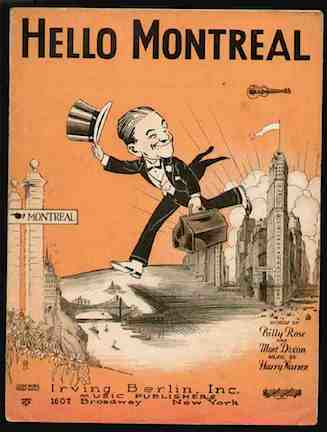
Irving Berlin Sheet Music Covers            Sheet Music Illustrators

Bob Clampett: Born May 8, 1913

Time for Beany! 9-24-50 (2 of 2)~ https://youtu.be/TUSGHun-WKc

In 1949, Clampett created “Time for Beany,” a 15-minute daily live puppet show for KTTV in Los Angeles. Played by legendary voice actor Daws Butler, Beany was a cheerful lad who flew with the help of his propeller-driven beanie. His devoted friend was Cecil the Sea-Sick Sea Serpent – voiced by the great Stan Freberg…”Time for Beany” quickly gained a following and graduated to daily syndication as part of the short-lived Paramount Television Network in an extended half-hour format.

Matty’s Funnies, Beany & Cecil 1962‬~
https://youtu.be/BJMa1EyIdes
https://youtu.be/X1VWo7HdXrg
https://youtu.be/gt0mYBrLlLM
https://youtu.be/WBVfeozyBsg
https://youtu.be/025-g4T36VY

By 1961, “Time for Beany” had been transformed from a live-action puppet show into a cartoon series, re-titled “Beany and Cecil” (ABC, 1962) and produced and directed by Clampett through his own Bob Clampett Productions…Although only a single season of “Beany and Cecil” was produced, the cartoon resided in syndication on the network’s daytime children’s lineup from spring 1962 through fall 1966.


QUOTES FROM https://www.tcm.com/tcmdb/person/337477%7C0/Robert-Clampett-Bob-/#biography

Richard D’Oyly Carte: Born May 3, 1844

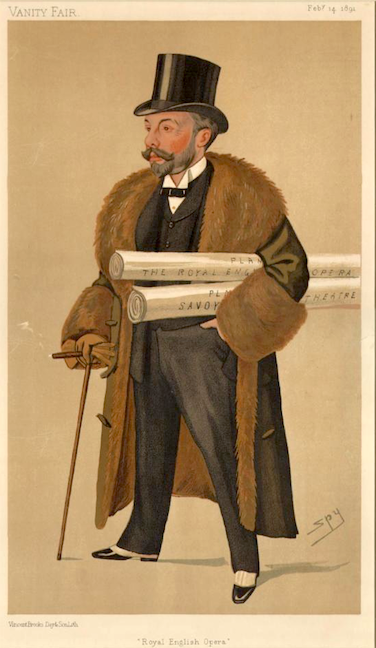
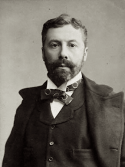
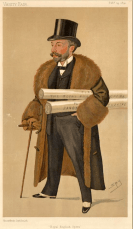
Richard D’Oyly Carte, born 1844, died 1901; was theatrical manager of the Royalty Theatre, London, where Trial by Jury was produced in 1875, when he became the originator and promoter of a scheme for English “comedy-opera,” of which the first-fruit was The Sorcerer, brought out at the Opéra Comique, London, on November 17, 1877. H.M.S. Pinafore, The Pirates of Penzance, and Patience followed at the same theatre, under the same auspices. In October, 1881, Patience was transferred to the Savoy Theatre, which Richard D’Oyly Carte had built specially for the production of Gilbert-Sullivan pieces, and of which he remained the owner and director, at the same time owning and directing numerous travelling companies both in the British provinces and in America. In January, 1891, he opened, in Cambridge Circus, London,–with Sullivan’s Ivanhoe specially written for the occasion–the English Opera House, of which he had been the projector, but which, in December, 1892, was re-christened the Palace Theatre, and later devoted, under other management, to “variety” performances. D’Oyly Carte himself wrote the music for two dramatic pieces entitled Dr. Ambrosias, his Secret (1887) and Maria (1871).
http://www.theatrehistory.com/british/richard_doyly_carte_001.html

(Click images to enlarge)

Richard D’Oyly Carte~  http://www.gsarchive.net/carte/burleigh.html

Savoy Hotel~  http://www.fairmont.com/savoy-london/hotelhistory/

Savoy Theatre~  http://grimsdyke.com/savoy-theatre-home-gilbert-sullivan/

Savoy Scaffolding etching by James McNeill Whistler (1834-1903), D’Oyly Carte was a strong supporter of Whistler and a close friend.
Theo van Gogh: Born May 1, 1857

Theo van Gogh *1882Theo van Gogh (1857-1891) first worked as an art dealer in 1873 in the Brussels art gallery owned by his uncle Hendrick van Gogh. A few months later, he was sent to the Hague as an employee of Goupil & Co., an internationally-known Parisian merchant…

Vincent, his brother and elder by four years, preceded him in this career as early as TvG21869. He acted as Theo’s mentor…These exchanges continued in Paris, where Theo was sent for the 1878 World Fair. He settled there and around 1880 he became director of the Paris branch of Goupil & Co. As for Vincent, he left Goupil & Co. in 1876 and decided, after much hesitation, to become a painter. In 1886 he came to Paris, staying with his brother, before going two years later to the south of France.TvG3
FROM Theo van Gogh : art-dealer, collector, Vincent’s brother  ~Musée d’Orsay

The Letters From Vincent to Theo~
http://www.vggallery.com/letters/to_theo_main.htm

The Letters From Theo to Vincent~ http://www.vggallery.com/letters/to_vincent.htm