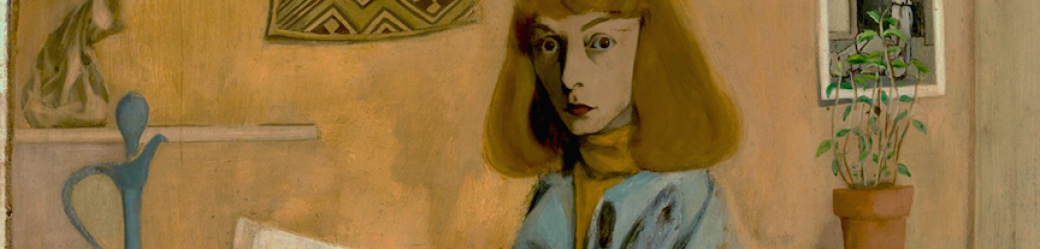
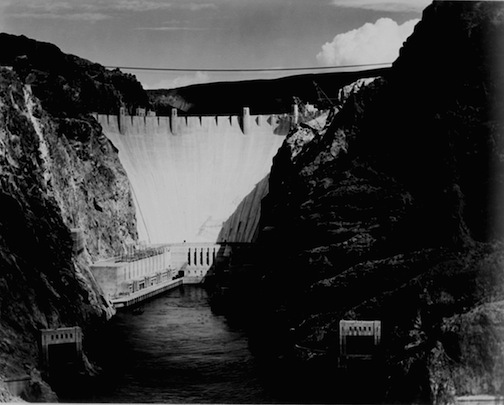
Records of the National Park Service: Ansel Adams Photographs
In 1941 the National Park Service commissioned noted photographer Ansel Adams to create a photo mural for the Department of the Interior Building in Washington, DC. The theme was to be nature as exemplified and protected in the U.S. National Parks. The project was halted because of World War II and never resumed.
The holdings of the National Archives Still Picture Branch include 226 photographs taken for this project, most of them signed and captioned by Adams.

“Subconscious Plagiarism”
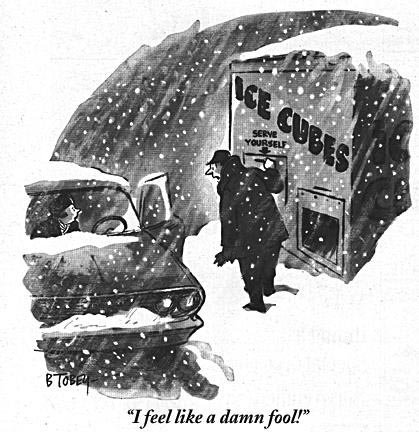
On February 19, 1981, a New York judge determined that George Harrison was guilty of “subconscious plagiarism” when he wrote My Sweet Lord, due to its similarities to the 1963 Chiffons hit He’s So Fine. Harrison was ordered to pay ABKCO Music $587,000.
Adelina Patti: Born February 19, 1843
Adelina Patti, original name Adela Juana Maria Patti (born Feb. 19, 1843, Madrid, Spain—died Sept. 27, 1919, Craig-y-Nos Castle, Brecknockshire, Wales), Italian soprano who was one of the great coloratura singers of the 19th century.
http://www.britannica.com/EBchecked/topic/446851/Adelina-Patti
Biographical sketch of Madame Adelina Patti
https://archive.org/details/biographicalsket00mortiala
Louis Comfort Tiffany: Born February 18, 1848
Since today is the birthday of Louis Comfort Tiffany, I thought it might be interesting to have a look at some of the magnificent examples of Tiffany design with which Baltimore has been favored.
Louis Comfort Tiffany’s career lasted from the 1870s through the 1920s. He was the son of Charles Lewis Tiffany who founded Tiffany & Company, but chose not to join the family business, instead embarking on a career as a painter. Although he never stopped painting, Tiffany began in the late 1870s to concentrate on the decorative arts for which we remember him today. He and his studios worked in a vast array of mediums, including stained-glass windows, glass mosaics, lamps, ceramics, enamelwork, and jewelry.
Tiffany was appointed the first design director of Tiffany & Co. upon his father’s death in 1902. He also continued his association with Tiffany Studios, which did not cease operations until his own death in 1933.
http://www.firstunitarian.net/about-us/history/our-buildings/
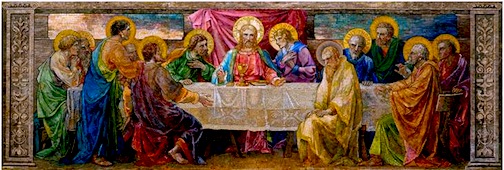
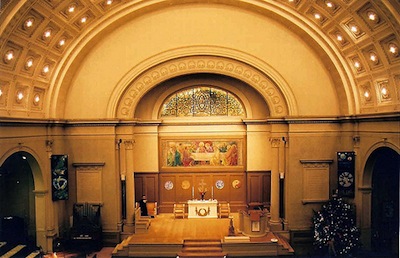
The First Unitarian Church of Baltimore has one of the only three versions of this particular Tiffany glass mosaic design for the Last Supper known to exist. It was installed in 1897 and measures 18′ wide x 9′ tall. The designer was Frederick Wilson who worked for the Tiffany Glass and Decorating Company.
http://www.browndowntown.org/index.php?s=tiffanywindows

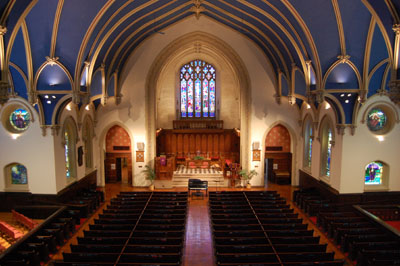
Brown Memorial Presbyterian Church was dedicated in 1870; when it was enlarged in 1905 the church commissioned Tiffany Studios in New York City to create its stained glass windows. There are 11 documented Tiffany windows, including two transept windows which measure 40′ high by 16′ wide and dominate the interior.
http://www.stmarksbaltimore.org/st-marks-architecture.html
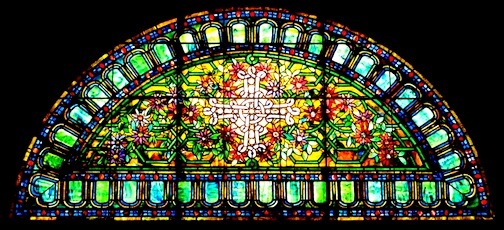
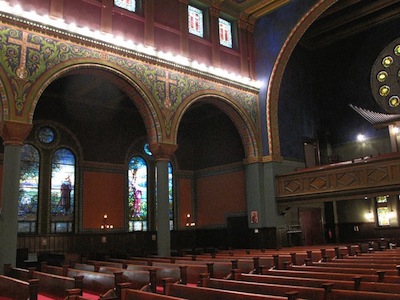
St. Mark’s Lutheran Church boasts a complete interior created by Louis Comfort Tiffany. The building was opened in 1898 and among its treasures are mosaics, lamps, and stained-glass windows. It is one of the few intact Tiffany-designed interiors left in the world.
Yoko Ono: Born February 18, 1933
http://imaginepeace.com/
http://www.allmusic.com/artist/yoko-ono-mn0000521704/biography
Since emerging onto the international art scene in the early 1960s, Yoko Ono has made profound contributions to visual art, performance, filmmaking, and experimental music. Born in Tokyo in 1933, she moved with her family to New York in the mid-1950s and enrolled at Sarah Lawrence College. Over the next decade she lived in New York, Tokyo, and London, greatly influencing the international development of Fluxus and Conceptual art.
https://www.moma.org/artists/4410
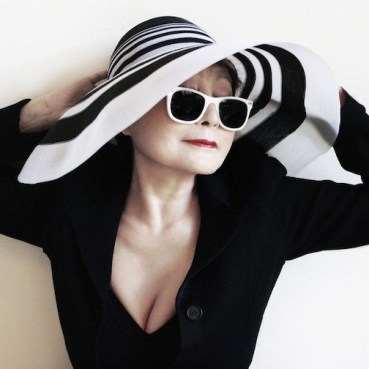
via Yoko Ono On Being An Inspiration And Her Friendship With David Bowie.
Madama Butterfly: First Performance February 17, 1904
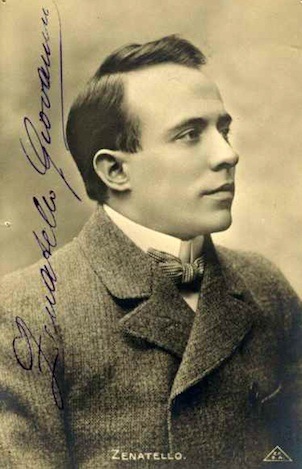
The première of February 17, 1904 would remain a bitter experience for Puccini. As Ricordi described it in the March edition of Musice e Musicisti: Growls, shouts, groans, laughter, giggling, the usual single cries of “bis,” designed to excite the public still more; that sums up the reception which the public of La Scala accorded the new work by Maestro Giacomo Puccini . . . The spectacle given in the auditorium seemed as well organized as that on the stage since it began precisely with the beginning of the opera.
FROM http://www.columbia.edu/itc/music/NYCO/butterfly/fiasco.html
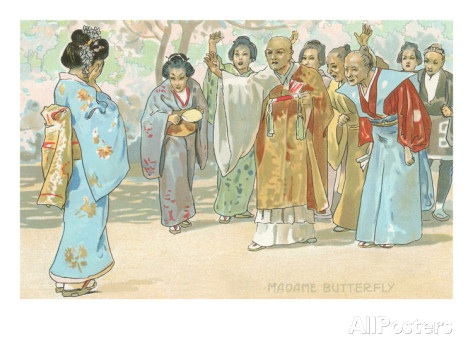
If Ricordi’s memory is accurate, the packed theater was hostile from the beginning, but it seems that the onset of the real problems coincided with Butterfly’s entrance. As Butterfly approaches her new home, she and a chorus of girls sing “Quanto cielo.” To the more belligerent elements of the audience, Butterfly’s descending line resembled a melody from the Act III duet of his earlier opera La Bohème. Nineteenth-century Italian audiences were particularly sensitive to and unforgiving of what they termed “reminiscences”; that is, a composer’s deliberate or inadvertent borrowing from another opera. When they detected this offense, Puccini’s detractors cried out, “Bohème, Bohème!!”
FROM http://www.columbia.edu/itc/music/NYCO/butterfly/fiasco.html
From this point on, the audience divided into two opposed factions: Puccini’s supporters and those determined to make a mockery of the performance–needless to say, the latter easily constituted the vocal majority. The beautiful Act I duet could not rival the cacophony in the auditorium (the offending passage mentioned earlier is repeated in this piece–this, no doubt, only added fuel to the fire). The Act I curtain fell to a mixture of hissing and scattered applause. The singers and Puccini were called out onto the stage only to receive torrents of derisive laughter.
FROM http://www.columbia.edu/itc/music/NYCO/butterfly/fiasco.html
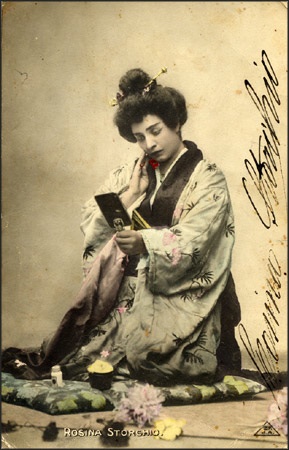
During Act II, the demonstrators redoubled their efforts. Only the letter scene and the flower duet could be heard at all; the remainder of the opera was attended by such disruptive noise that the singers complained of being unable to hear the orchestra. At one point, either owing to a backstage draft or a sudden movement on the soprano’s part, Storchio’s kimono billowed up in front whereupon several cries of “Butterfly is pregnant!” could be heard along with the more offensive “Ah, the little Toscanini!” (this latter affront referred to the highly publicized affair between Storchio and the famous Italian conductor, Arturo Toscanini).
FROM http://www.columbia.edu/itc/music/NYCO/butterfly/fiasco.html
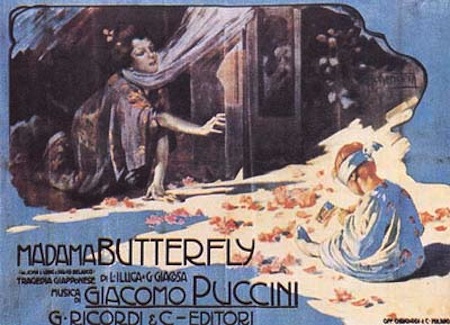
The long Intermezzo (Butterfly’s night vigil) provided another opportunity for buffoonery. In an attempt to outdo Belasco’s intense realism, the opera’s producer placed performers with bird-whistles throughout the opera house to accompany the dawn after Butterfly’s sleepless night. Unwilling to allow such a boon to pass unnoticed, the audience joined in with various animal sounds of their own, reducing the poetic gesture to lunacy. Although accounts differ, the final curtain either fell to “a glacial silence” or howls, laughter and disdain.
FROM http://www.columbia.edu/itc/music/NYCO/butterfly/fiasco.html
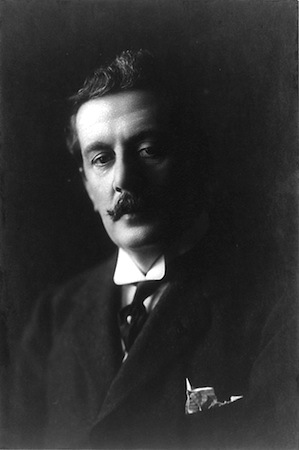
Images:
Giovanni Zenatello circa 1905 http://en.wikipedia.org/wiki/File:Giovanni_Zenatello_circa_1910.jpg
Rosina Storchio http://www.historicopera.com/xother/famousfirst1.htm
Scene from Madame Butterfly https://www.gettyimages.com/photos/leopoldo-metlicovitz
Giacomo Puccini http://en.wikipedia.org/wiki/Madama_Butterfly#mediaviewer/File:Puccini6.jpg
Illustrator Pamela Colman Smith: Born February 16, 1878
I’ve never given any thought to who might have designed and/or illustrated Tarot Cards, I suppose because I figured they were something that evolved over time and were already established by the time card/game companies began printing them. The popular version that I am familiar with turns out to have been illustrated by one Pamela Colman Smith, an illustrator who attended (but did not finish) Pratt.
Pamela Colman Smith (16 February 1878 – 18 September 1951), also nicknamed Pixie, was an artist, illustrator, and writer. She is best known for designing the Waite-Smith deck of divinatory tarot cards (also called the Rider-Waite or the Rider-Waite-Smith deck) for Arthur Edward Waite.
http://en.wikipedia.org/wiki/Pamela_Colman_Smith
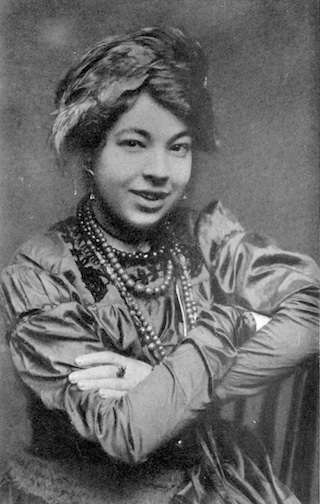
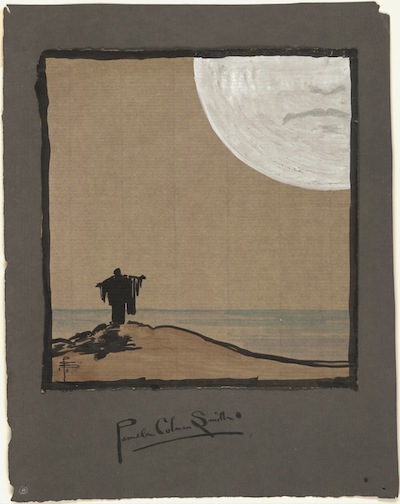
The Beinecke Rare Book & Manuscript Library of the Yale University Library:
https://collections.library.yale.edu/catalog?search_field=all_fields&q=Pamela%20Colman%20Smith

