Raymond Hood: Born March 29, 1881


American architect Raymond Mathewson Hood was born March 29, 1881 in Pawtucket, Rhode Island. He attended Brown University, transferring to and graduating from the MIT School of Architecture. He later continued his education at the École des Beaux-Arts, earning a degree in 1911. Hood has been associated with the architectural styles of Neo-Gothic, Art Deco, Streamlined Moderne, and International.

Hood made his name in 1922 when he and John Mead Howells (whom he had met while in Paris) won a competition to design the Chicago Tribune Tower (completed 1925).

Projects which Hood worked on include:
American Radiator Building, NYC ( completed 1924)
Masonic Temple (Scranton Cultural Center) Scranton, PA (completed 1930)
Daily News Building, NYC (completed 1930)
McGraw-Hill Building, NYC (completed 1934)

Raymond Hood is perhaps best known for his work on Rockefeller Center (completed 1930-40) in Midtown Manhattan. Covering 22 acres, Rockefeller Center encompasses 19 buildings, including the Art Deco Radio City Music Hall.

Hood promoted visionary proposals for Manhattan, including his “City under a Single Roof” (1931) and “Manhattan 1950” (1931) Hood championed the tower as the ideal form for the skyscraper; he imagined slender shafts soaring above expansive open spaces: a “modern city of sunlight, air, and free circulation.”

Raymond Hood died on August 14, 1934 in Stamford, Connecticut.


⬇️ Youtube Playlist: BUILDING RADIO CITY MUSIC HALL
⬇️
http://www.atlasobscura.com/articles/the-dazzling-designs-for-a-new-york-that-never-existed

Louis Comfort Tiffany: Born February 18, 1848

Since today is the birthday of Louis Comfort Tiffany, I thought it might be interesting to have a look at some of the magnificent examples of Tiffany design with which Baltimore has been favored.

Louis Comfort Tiffany’s career lasted from the 1870s through the 1920s. He was the son of Charles Lewis Tiffany who founded Tiffany & Company, but chose not to join the family business, instead embarking on a career as a painter. Although he never stopped painting, Tiffany began in the late 1870s to concentrate on the decorative arts for which we remember him today.  He and his studios worked in a vast array of mediums, including stained-glass windows, glass mosaics, lamps, ceramics, enamelwork, and jewelry.

Tiffany was appointed the first design director of Tiffany & Co. upon his father’s death in 1902. He also continued his association with Tiffany Studios, which did not cease operations until his own death in 1933.

http://www.firstunitarian.net/about-us/history/our-buildings/

unitarianunitariansanctuary

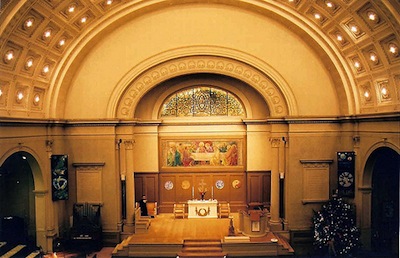
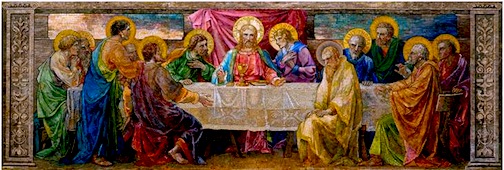
The First Unitarian Church of Baltimore has one of the only three versions of this particular Tiffany glass mosaic design for the Last Supper known to exist. It was installed in 1897 and measures 18′ wide x 9′ tall. The designer was Frederick Wilson who worked for the Tiffany Glass and Decorating Company.

http://www.browndowntown.org/index.php?s=tiffanywindows

Brownbrownsanctuary

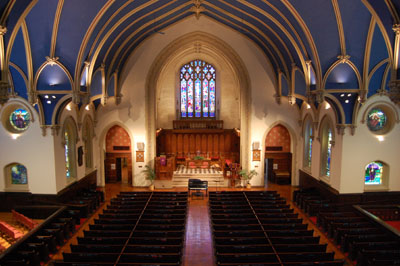
Brown Memorial Presbyterian Church was dedicated in 1870; when it was enlarged in 1905 the church commissioned Tiffany Studios in New York City to create its stained glass windows. There are 11 documented Tiffany windows, including two transept windows which measure 40′ high by 16′ wide and dominate the interior.

http://www.stmarksbaltimore.org/st-marks-architecture.html

stmarksstmarkssanctuary

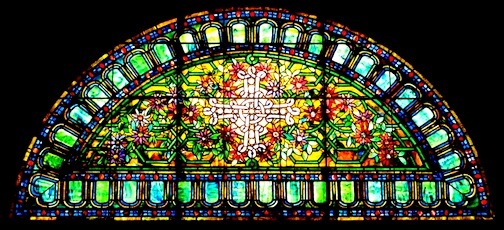
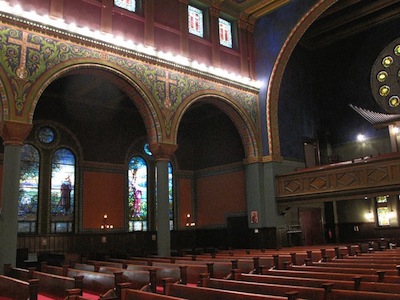
St. Mark’s Lutheran Church boasts a complete interior created by Louis Comfort Tiffany. The building was opened in 1898 and among its treasures are mosaics, lamps, and stained-glass windows. It is one of the few intact Tiffany-designed interiors left in the world.