Salmagundi

Weddings in the Renaissance

The scholars Silvana Seidel Menchi and Diego Quaglion…provide startling information demonstrating just how informal the act of marriage could be and how it could take place in almost any location. “With the assistance of a ladder, the groom, flanked by witnesses, reached the bride, and facing each other they pronounced the formula of the ritual, balanced in an equilibrium as unstable as the tie that thus bound them.” Indeed, before the edicts of The Council of Trent systematized the requirements of a proper wedding in 1563, only mutual consent was an absolute necessity for marriage. FROM Art and Love in Renaissance Italy / MetPublications /
The Metropolitan Museum of Art

(Learn more by clicking on hyperlinks embedded in text)

Salmagundi

Sir Winston Churchill by Ernest Hamlin Baker
[War]

1949 / Gouache, ink and graphite pencil on paperboard / 11 3/4”x10 1/2″

Ernest Baker, born in 1889 in Rhode Island, was a self-taught illustrator. Most of his works were covers for Time magazine, although he was responsible for eleven covers for Fortune magazine between 1929 and 1941.

Beginning in 1939, Baker produced over 300 covers for Time during his seventeen-year tenure with the magazine. He was described by Time publisher, Ralph Ingersoll, as an artist who could do anything.
http://www.askart.com/artist_bio/Ernest_Hamlin_Baker/28830/Ernest_Hamlin_Baker.aspx

In December of 1949, Winston Churchill was chosen by Time magazine as theMan of the Half-Century, celebrated in a 16-page supplement which was contained in the January 2nd issue of 1950. Baker did the cover illustration for that issue.

This slideshow requires JavaScript.

(Learn more by clicking on embedded hyperlinks)
Salmagundi

Vietnam Veterans Memorial

Maya Lin’s original competition submission for the Vietnam Veterans Memorial in Washington, D.C. Architectural drawings and a one-page written summary, 1980 or 1981.

In 1979, Congress grants a Vietnam War veterans’ committee the right to build a memorial on the Mall in Washington, D.C., dedicated to American soldiers killed in the conflict in Vietnam…When the winner is announced, no one is more surprised than the student architect herself, Maya Lin, a 20-year-old Yale undergraduate…Lin describes the Memorial thus: “I went to see the site. I had a general idea that I wanted to describe a journey…a journey that would make you experience death and where you’d have to be an observer, where you could never really fully be with the dead. It wasn’t going to be something that was going to say, ‘It’s all right, it’s all over,’ because it’s not.”
FROM http://www.pbs.org/wgbh/cultureshock/flashpoints/visualarts/thewall_a.html

Spotlight: Maya Lin~ https://www.archdaily.com/774717/spotlight-maya-lin

(Learn more by clicking on embedded hyperlinks)

Salmagundi

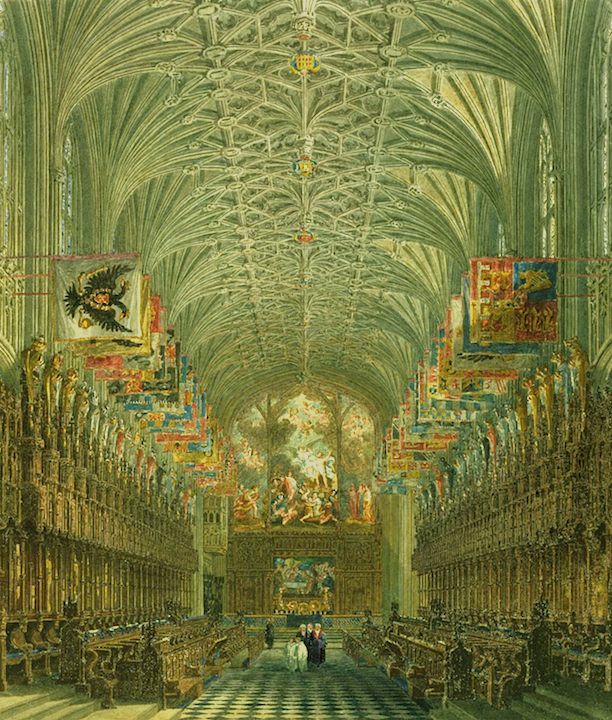
Windsor Castle: The Quire of St George’s Chapel by Charles Wild

1818 / Watercolor and bodycolour over pencil / 9.8”x8.3” / Royal Collection

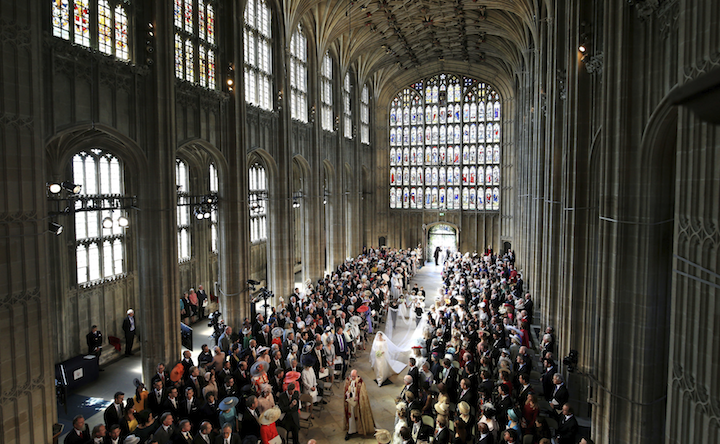
Prince Harry and Meghan Markle at St. George’s Chapel in Windsor Castle in Windsor, near London, England, Saturday, May 19, 2018. (Danny Lawson/pool photo via AP)

On May 19, 2018, Prince Harry and Meghan Markle’s wedding took place in St George’s Chapel, Windsor Castle. Prince Harry was baptised in St George’s Chapel in December, 1984.
FROM https://www.stgeorges-windsor.org/news/royal-wedding-2/

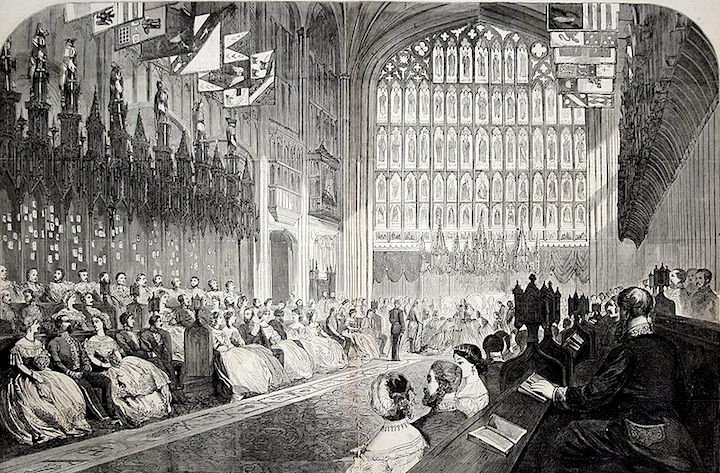
Engraved illustration from Harper’s Weekly newspaper of the wedding of the Prince of Wales (later King Edward VII) and Alexandra of Denmark / Harper’s Weekly newspaper dated 11 April 1863 / Artist unknown

St. George’s Chapel was built in the 15th century and is a towering piece of Gothic architecture. It is lauded for its stone fan-vault ceilings, but the intricate stained glasswork along each of its walls, and the tall arched windows, intricate woodwork, and ironwork doorframes add to the historic feel of the grand room. The tombs of ten sovereigns also lie within the chapel, including Henry VIII and Charles I. FROM https://www.architecturaldigest.com/story/prince-harry-and-meghan-markle-will-marry-at-st-georges-chapel-at-windsor-castle-this-may

(Learn more by clicking on hyperlinks embedded in text)

Salmagundi

Mathew Brady [War]

Mathew Brady is often referred to as the father of photojournalism and is most well known for his documentation of the Civil War. His photographs, and those he commissioned, had a tremendous impact on society at the time of the war, and continue to do so today. He and his employees photographed thousands of images including battlefields, camp life, and portraits of some of the most famous citizens of his time including Abraham Lincoln and Robert E. Lee.
https://www.battlefields.org/learn/biographies/mathew-brady

The Civil War as Photographed by Mathew Brady~
http://www.archives.gov/education/lessons/brady-photos/


(Learn more by clicking on embedded hyperlinks)

Salmagundi

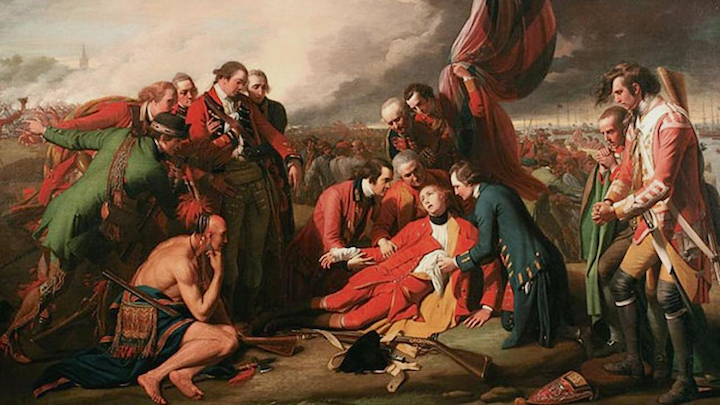
The Death of General Wolfe by Benjamin West

On September 13, 1759, during the Seven Years’ War (1756-63) [known in the United States as the French and Indian War], the British General James Wolfe achieved a dramatic victory; Wolfe was fatally wounded during the battle, but his victory ensured British supremacy in Canada.
https://www.history.com/topics/native-american-history/battle-of-quebec-1759

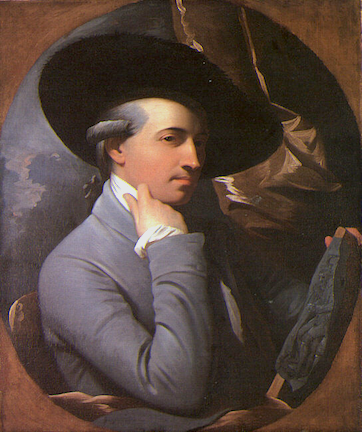
Benjamin West, Self-portrait 1770

Besides the original, at least four other additional versions of The Death of General Wolfe were also produced by West. The primary copy of The Death of General Wolfe is currently in the collection of the National Gallery of Canada, with further examples at the Royal Ontario Museum (Canadiana art collection), as well as the University of Michigan Museum of Art. The fourth copy produced resides at Ickworth House, Suffolk, England. Each reproduction had its own variation in the depiction of Wolfe’s death. A fifth autograph copy was commissioned by George III in 1771 and is still in the Royal Collection.
FROM https://en.wikipedia.org/wiki/The_Death_of_General_Wolfe

(Learn more by clicking on embedded hyperlinks)

Salmagundi

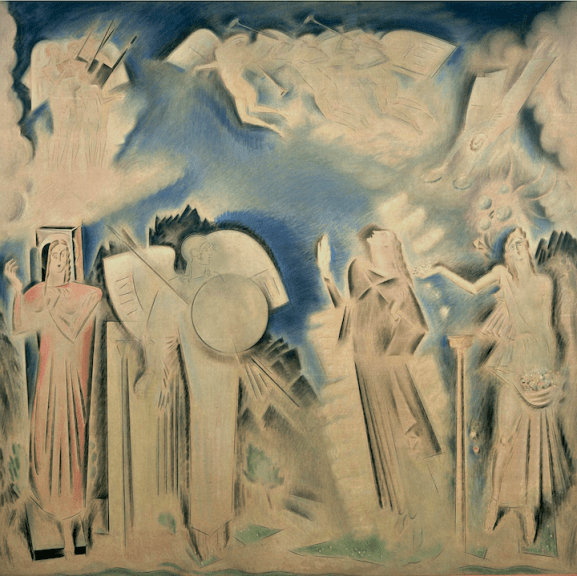
The Apotheosis of Athanasios Diakosby Konstantinos Parthenis

c.1933 / Oil on canvas / 150”x150” / National Art Gallery and Alexandros Soutzos Museum, Athens

Konstantinos Parthenis (1878-1967), Greek painter

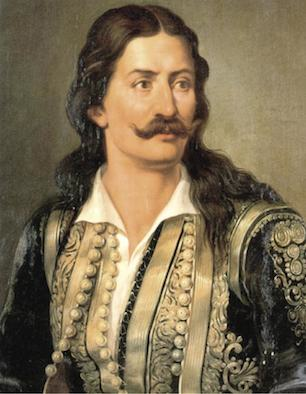
Athanasios Diakos was a hero of the Greek War of Independence. Prior to the war he entered a monastery and was ordained a deacon (“diakos” in the Greek language). One day a Turkish pasha came to his monastery and made some crude remarks about his good looks. Diakos slew him and fled to the mountains. He join a band of klephts who made him second in command. Eventually, he headed his own band. In April 1821, Omer Vrioni, the commander of the Turkish army, advanced with 9,000 men from Thessaly to crush the revolt in Peloponnesus.

Athanasios Diakos

Diakos’ men fought for several hours before they were overwhelmed. The wounded Diakos was taken to Vrioni. Vrioni offered to make Diakos an officer in his army but Diakos refused and replied “I was born a Greek and I will die a Greek”.
FROM http://wiki.phantis.com/index.php/Athanasios_Diakos

(Learn more by clicking on embedded hyperlinks)

Salmagundi

Fifteen officers of the 17th Regiment of Foot posed on a hill at camp, 1855

Roger Fenton (1819-1869) [War]

Photograph of Roger Fenton (1819-1869) dressed in traditional Zouave costume.

…the British government hired photographer Roger Fenton to travel to Crimea and create some of the first war photographs in history. He arrived in March 1855 and stayed for 3.5 months.
FROM https://mashable.com/2016/01/06/crimean-war/#JJZDNMTVAuqa

While the sight of soldiers with a sketchbook as well as the occasional artist was not uncommon in the Crimea, the idea of a photographer ‘at the seat of war’ was new. Consequently, Fenton was pestered by troops wanting their ‘likeness’ taken, so much so that he noted he would ‘dread the sight of English officers riding up to my van’.
FROM http://www.tate.org.uk/context-comment/articles/terrible-beauty

The Valley of the Shadow of Death, 1855

In the course of a single decade, Fenton had played a pivotal role—by advocacy and example—in demonstrating that photography could rival drawing and painting not only as a means of conveying information, but also as a medium of visual delight and powerful expression.
FROM https://www.metmuseum.org/toah/hd/rfen/hd_rfen.htm

(Learn more by clicking on embedded hyperlinks)

Salmagundi

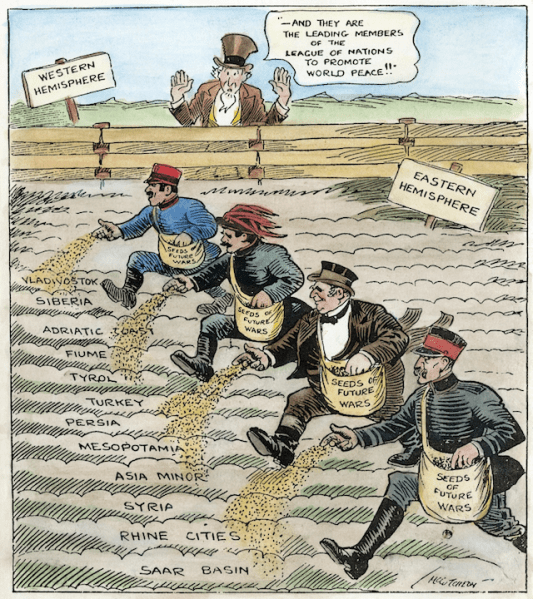
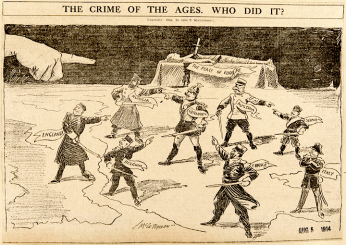
John Tinney McCutcheon (1870-1949)

John T. McCutcheon, in full John Tinney McCutcheon, (born May 6, 1870, South Raub, Indiana, U.S.—died June 10, 1949, Lake Forest, Illinois), American newspaper cartoonist and writer…He received a Pulitzer Prize in 1932 for a cartoon dealing with bank failure.
https://www.britannica.com/biography/John-T-McCutcheon

After graduating from Purdue with a B.S. degree in 1889, McCutcheon moved to Chicago and was hired to work for the Chicago Morning News (later known as the Chicago Record) as an artist. He began doing front page cartoons for the newspaper in 1895. In 1903, McCutcheon joined the staff of the Chicago Tribune and served in capacities as both an editorial cartoonist and occasional foreign correspondent until his retirement in 1946.
http://www4.lib.purdue.edu/archon/?p=collections/findingaid&id=950&q=&rootcontentid=7101#bioghist

Although McCutcheon is best known for his illustration work, he also served as a Chicago Tribune correspondent for the Spanish American War, the Philippine insurrection, the South African (Boer) War and World War I, from both the German and Allied fronts.
https://www.chipublib.org/fa-john-t-mccutcheon-cartoons/

(Learn more by clicking on embedded hyperlinks)

Salmagundi

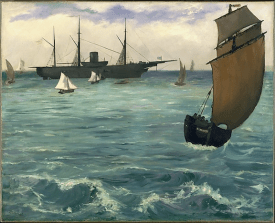
The Battle of the USS “Kearsarge” and the CSS “Alabama”
Édouard Manet (1832-1883)
1864 / Oil on canvas / 54 1/4”x50 3/4” / Philadelphia Museum of Art

During the American Civil War, the United States warship Kearsarge made headlines after sinking the Confederate raider Alabama off the coast of France. Manet did not witness firsthand the widely-covered event but devoted two paintings to the subject: a scene of the naval battle (Philadelphia Museum of Art) and [The “Kearsarge” at Boulogne, 1864, The Met], prompted by his subsequent visit to the victorious ship at anchor near Boulogne. They were his first depictions of a current event.
https://www.metmuseum.org/art/collection/search/438144

Although he did not witness the historic battle, Manet made a painting of it partly as an attempt to regain the respect of his colleagues after having been ridiculed for his works in the 1864 Salon. Manet’s picture of the naval engagement and his portrait of the victorious Kearsarge belong to a group of his seascapes of Boulogne whose unorthodox perspective and composition would profoundly influence the course of French painting.
https://www.metmuseum.org/art/metpublications

(Learn more by clicking on embedded hyperlinks)