In Flanders fields the poppies blow Between the crosses, row on row, That mark our place; and in the sky larks, still bravely singing, fly Scarce heard amid the guns below.
We are the Dead. Short days ago We lived, felt dawn, saw sunset glow, Loved and were loved, and now we lie, In Flanders fields.
Take up our quarrel with the foe: To you from failing hands we throw The torch; be yours to hold it high. If ye break faith with us who die We shall not sleep, though poppies grow In Flanders fields.
“ ‘In Flanders Field’ became popular almost immediately upon its publication. It was translated into other languages and used on billboards advertising Victory Loan Bonds in Canada. The poppy soon became known as the flower of remembrance for the men and women in Britain, France, the United States, and Canada who have died in service of their country.” ~poets.org
^^ (Learn more by clicking on the six hyperlinks embedded in text) ^^
Three months after Pearl Harbor, President Franklin Roosevelt ordered the relocation of Japanese-Americans into armed camps in the West. Soon after, the War Relocation Authority hired [Dorothea Lange (1895-1965)] to photograph Japanese neighborhoods, processing centers, and camp facilities.
To capture the spirit of the camps, Lange created images that frequently juxtapose signs of human courage and dignity with physical evidence of the indignities of incarceration. Not surprisingly, many of Lange’s photographs were censored by the federal government, itself conflicted by the existence of the camps.
The true impact of Lange’s work was not felt until 1972, when the Whitney Museum incorporated twenty-seven of her photographs into Executive Order 9066, an exhibit about the Japanese internment. New York Times critic A.D. Coleman called Lange’s photographs “documents of such a high order that they convey the feelings of the victims as well as the facts of the crime.” FROM http://www.loc.gov/exhibits/wcf/wcf0013.html
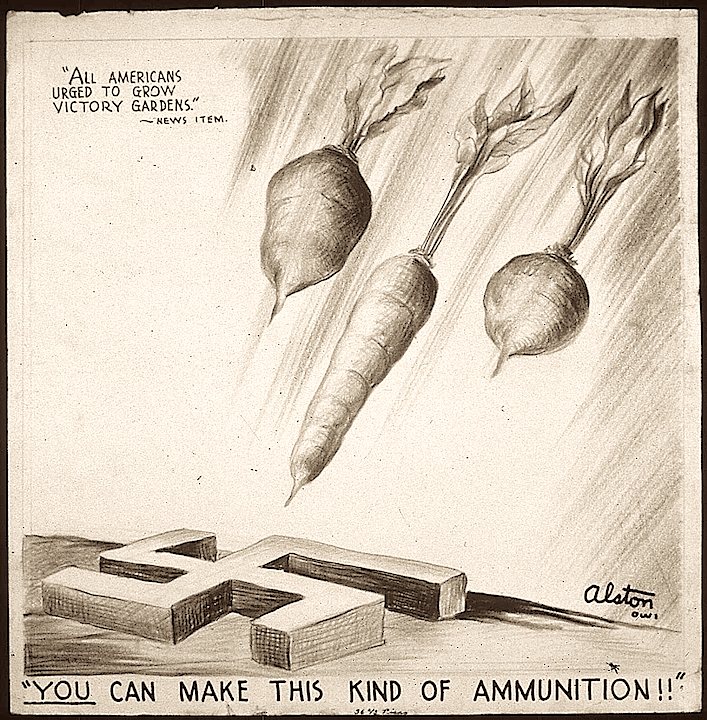
During World War I, Liberty Gardens (and later, Victory Gardens) grew out of the government’s efforts to encourage home gardening among Americans, both to express their patriotism and to aid the war effort by freeing up food production for soldiers. ~cbsnews.com
As part of the (World War II) effort, the government rationed foods like sugar, butter, milk, cheese, eggs, coffee, meat and canned goods. Labor and transportation shortages made it hard to harvest and move fruits and vegetables to market. So, the government turned to its citizens and encouraged them to plant “Victory Gardens.” They wanted individuals to provide their own fruits and vegetables. ~livinghistoryfarm.org
Americans were encouraged to grow their own to ensure everyone at home had enough to eat…There were 20 million gardens everywhere from rooftops and empty lots to backyards and schoolyards. 40% of produce, which made over 1 million tons, consumed in America was grown in victory gardens. People learned how to can and preserve so the harvests lasted all year. ~nww2m.com
(Learn more by clicking on links in the images and text)

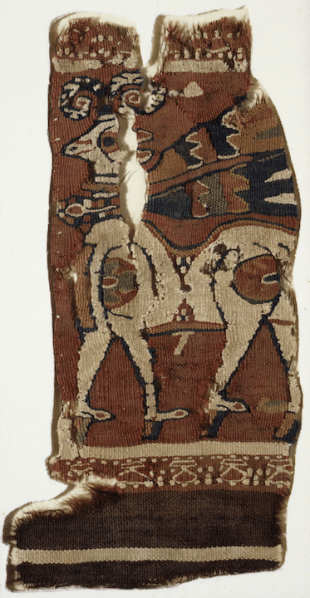 Walking Ram with a Neckband and Fluttering Ribbons / Egypt: Sasanian textile fragment








 During World War I, Liberty Gardens (and later, Victory Gardens) grew out of the government’s efforts to encourage home gardening among Americans, both to express their patriotism and to aid the war effort by freeing up food production for soldiers.
 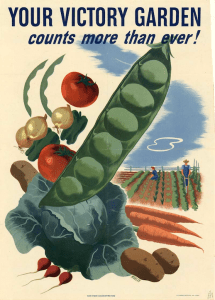 shortages made it hard to harvest and move fruits and vegetables to market. So, the government turned to its citizens and encouraged them to plant “Victory Gardens.” They wanted individuals to provide their own fruits and vegetables.
 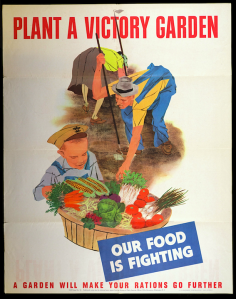 Americans were encouraged to grow their own to ensure everyone at home had enough to eat…There were 20 million gardens everywhere from rooftops and empty lots to backyards and schoolyards. 40% of produce, which made over 1 million tons,
  consumed in America was grown in victory gardens. People learned how to can and preserve so the harvests lasted all year.
  The Misty Miss Christy