Cecil B. DeMille: Born August 12, 1881

“If 1,000 years from now, archaeologists happen to dig beneath the sands of Guadalupe, I hope they will not rush into print with the amazing news that Egyptian civilization, far from being confined to the valley of the Nile, extended all the way to the Pacific coast of North America.”  ~”The Autobiography of Cecil B. DeMille,” 1959

So why did DeMille choose to bulldoze his set, rather than truck it back to Los Angeles?
“I think there were two things were going on,” Brosnan said, starting with DeMille’s pledge to leave the site as he’d found it. “Hauling away all that statuary would have been very expensive … so I think he pulled a fast one and buried it.”
In addition, he said, “(DeMille) knew that if he left it standing … the very next day somebody would be there filming a quickie on his set and they’d be on the streets with it in a few weeks. He was protecting his patent by taking it down.”
FROM http://www.kcet.org/arts/artbound/counties/santa-barbara/cecil-b-demill-ten-commandments-excavation-nipomo-dunes.html

~ California Historical Society: Stills from “The Ten Commandments” 1923
~ Cecil B. Demille’s biography
~ Special Extended Trailer, 1956, announcing the upcoming release of “The Ten Commandments”

August 9, 1945: “Fat Man” is dropped over Nagasaki

In pictures: Nagasaki bombing~ http://www.bbc.com/news/in-pictures-33769566
What Nagasaki looked like before and after the bomb~ https://www.washingtonpost.com/news/worldviews/wp/2015/08/09/what-nagasaki-looked-like-before-and-after-the-bomb/?tid=pm_world_pop_b

image2
Nagasaki Official Visitor Guide: Peace Park~ http://visit-nagasaki.com/spots/detail/209
The Art of Peace, Nagasaki~ http://nuclearfutures.org/the-art-of-peace-nagasaki/

image

August 6, 1945: Enola Gay drops 5-ton bomb over Hiroshima

Masao Ohki, Symphony No. 5 “Hiroshima”

Composed in 1953 (eight years after the city’s bombing, and coinciding with the end of the American occupation of Japan), its six inner movements were inspired by six paintings by Iri and Toshi Maruki (the score’s original title was The Hiroshima Panels ), framed by a Prelude and Elegy.   FROM https://arkivmusic.com/

hp-s08
MARUKI GALLERY FOR THE HIROSHIMA PANELS

Paintings bring Japan’s hellish aftermath into vivid focus

Against Forgetting: Three Generations of Artists in Japan in Dialogue about the Legacies of World War II

Hiroshima Peace Memorial Museum WesSite~ http://hpmmuseum.jp/?lang=eng
hp-s02

Roberta Dodd Crawford: Born August 5, 1897

CrawfordIn the 1920s and 1930s, Bonham mezzo-soprano Roberta Dodd Crawford (1897-1954) shot across the concert world like a rare comet, blazing with talent and demonstrating the power of black performers to seriously engage American and European critics and audiences. In the end, through bad luck and poor circumstance, she flamed out, dying broke and forgotten by the world she had made richer by her incandescent presence.

She came from humble circumstances, spent long years training her remarkable voice, toured extensively in the U.S. and France, socialized and worked with fellow ex-patriots in Paris during the 1920s and early 1930s, married an American World War I hero and, later, an African prince; and suffered physically and mentally while under Nazi detention during World War II.
FROM
http://ntxe-news.com/cgi-bin/artman/exec/view.cgi?archive=51&num=81273

Texas State Historical Association~
https://tshaonline.org/handbook/online/articles/fcr69

Save

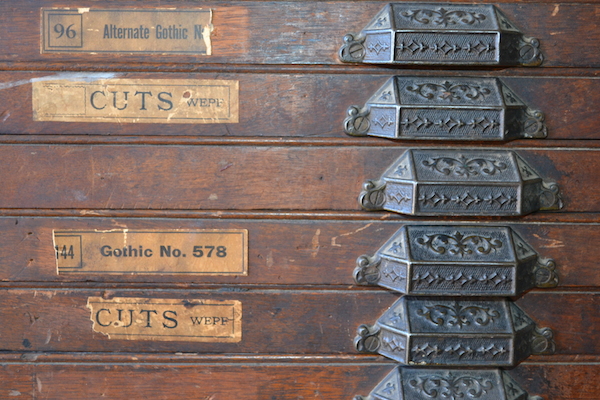
Pressing On: The Letterpress Film

The modern world was born on a printing press. Once essential to communication, the 500-year-old process is now in danger of being lost as its caretakers age. From self-proclaimed basement hoarders to the famed Hatch Show Print, Pressing On: The Letterpress Film explores the question: why has letterpress survived in a digital age?

Worlds of each character emerge as unusual narratives—joyful, mournful, reflective and visionary—are punctuated with on-screen visual poetry, every shot meticulously composed. Captivating personalities blend with wood, metal and type as young printers strive to save this historic process in a film created for the designer, type nerd, historian and collector in us all.


via Pressing On: The Letterpress Film

The Letterpress Journals: Guardians of the Craft

July 20, 1969: One Giant Leap For Mankind

https://www.nasa.gov/mission_pages/apollo/apollo11.html

Apollo 11 Image Gallery~ http://history.nasa.gov/ap11ann/kippsphotos/apollo.html

Moon Light by Edvard Munch
1895 / Oil on canvas / 36 3/5”x43 1/3” / National Museum, Oslo, Norway

The Moon in paintings and art~ http://www.popastro.com/moonwatch/moon_guide/art3.php
Moon in Painting~ http://www.artistsandart.org/2009/07/moon-in-painting.html
Moon Paintings of China and Japan~ https://owlcation.com/humanities/moon-paintings

Max Fleischer: Born July 19, 1883

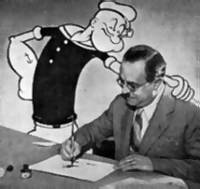
In 1900 Max began to work as an errand boy at the Brooklyn Daily Eagle. By 1904 he was a staff artist.MF2 In 1905 he married his childhood sweetheart, Essie Gold; they had two children. After he left the Eagle, Max briefly did artwork for two companies and then became art editor of Popular Science Monthly in 1914. There his childhood interest in mechanical matters was reignited.

In fact, it was a mechanical problem that pulled Max Fleischer into the field of animation. Early animation was frequently very choppy. Max theorized that if live-action footage were traced, frame by frame, fluid motion could be achieved. He enlisted the help of his brothers Dave and Joe, and the three developed the Rotoscope, a camera mounted under a piece of frosted glass with a crank to advance the film, so each frame could be traced.

MF1It took the brothers a week to build the Rotoscope, but it was a full year before they finished their first cartoon. Dave donned a clown suit, and Max and Joe filmed him. Then they traced the clown on the Rotoscope. Work on the cartoon was completed in 1916, and a patent for the Rotoscope came through a year later.
FROM http://anb.org/articles/20/20-01567.html

The Fleischers put popular, modern music at the center of many of their films, building entire cartoons around jazz legends such as Cab Calloway, Louis Armstrong and Don Redman. These cartoons often featured the Fleischers’ signature MF3combination of live action and animation; in fact the earliest known footage of Cab Calloway in performance can be seen in the Fleischer classic Minnie the Moocher.

In 1929 the Studio made a major agreement with Paramount that would allow Paramount to distribute all Fleischer films. That same year the Studio changed its name to ‘Fleischer Studios.’
FROM http://www.fleischerstudios.com/history.html


OUT OF THE INKWELL~  https://youtu.be/KHDeCkDUNlk
Max Fleischer NEWS SKETCHES compilation~ https://archive.org/details/max_fleischer_news_sketches
Lambiek Comiclopedia~  https://www.lambiek.net/artists/f/fleischer_max.htm

July 14, 1916~ The Dada Manifesto

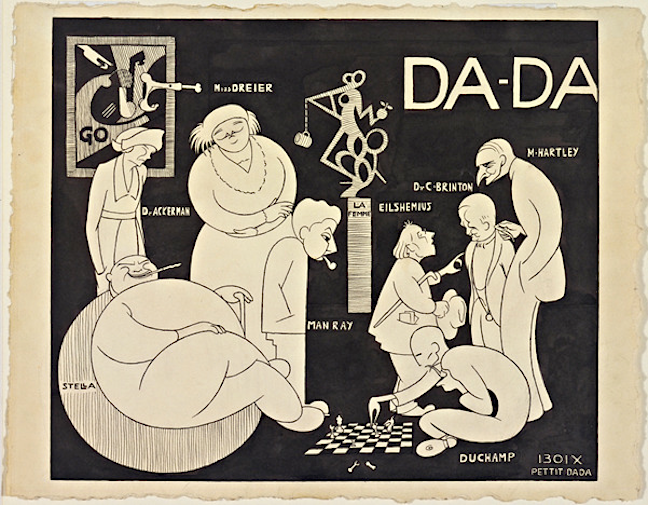
Richard Boix. Da-da (New York Dada Group). 1921. Ink on paper. 11 1/4″ x 14 1/2″ (28.6 x 36.8 cm)
Museum of Modern Art / Katherine S. Dreier Bequest

On July 14, 1916, the poet Hugo Ball proclaimed the manifesto for a new movement. Its name: Dada. Its aim: to “get rid of everything that smacks of journalism, worms, everything nice and right, blinkered, moralistic, europeanised, enervated.” This aim could be achieved simply by saying: “Dada.”
https://www.nytimes.com/2016/07/10/arts/dada-100-years-later.html

Dada~ Born February 5, 1916            100th anniversary of DADA~

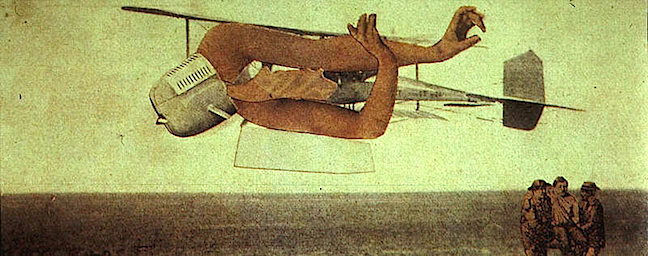
  Max Ernst. Murdering Airplane. 1920. Collage. 2 1/2” x 5 1/2” (6.35 cm × 13.97 cm). Private collection.