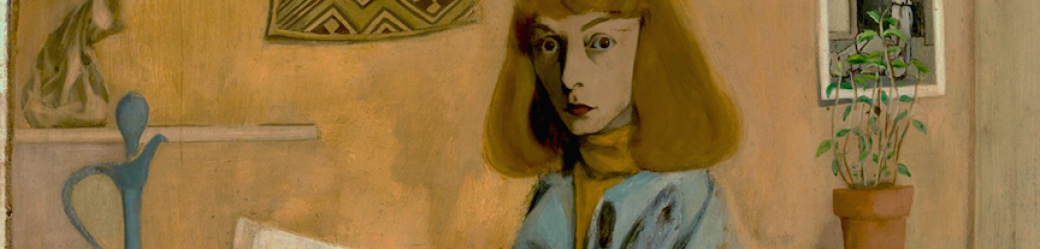
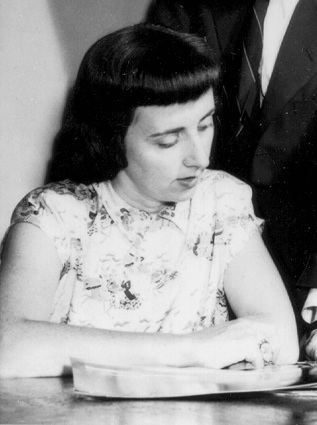
Photographer Esther Bubley: Born February 16, 1921

ebubley

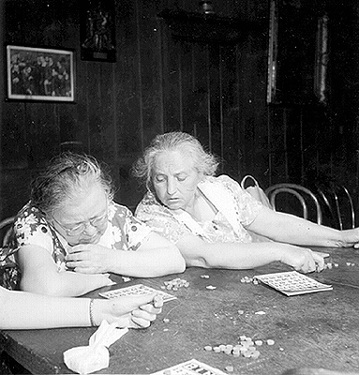
“Put me down with people, and it’s just overwhelming,” Bubley exclaimed in an interview. Like most great photojournalists, she found her art in everyday life, and she successfully balanced her artistic ambitions with the demands of commercial publishing. Edward Steichen, curator of photographs at the Museum of Modern Art and the era’s arbiter of taste, was a great supporter of Bubley, whose work embodied his aesthetic ideal that photography “explain man to man and each to himself.” She was shown in several group shows at the Museum of Modern Art and was given a one-person show at the Limelight, Helen Gee’s legendary coffee house and the only gallery specializing in photography in New York during the 1950s. Bubley worked primarily for the printed page, however, and like her colleagues, can be only partially understood in the context of today’s gallery-oriented photography world, in which photographs are shown as isolated works of art.
FROM http://www.estherbubley.com/bio_frame_set.htm

bingo

http://www.loc.gov/rr/print/coll/womphotoj/bubleyintro.html

https://www.loc.gov/exhibits/wcf/wcf0012.html

https://lens.blogs.nytimes.com/2011/08/02/tender-moments-in-the-maelstrom-of-war/

‪Renée Fleming‬: Born February 14, 1959

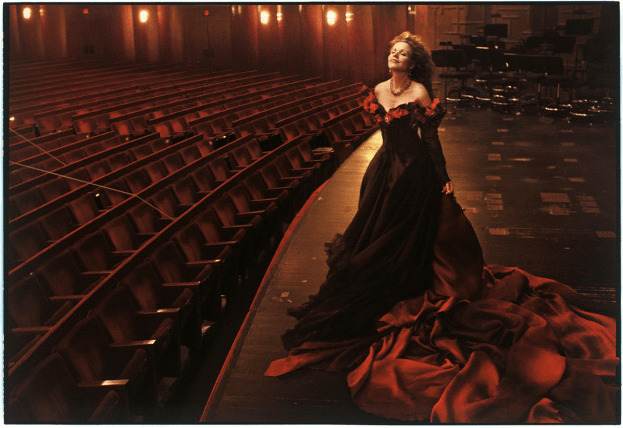
As a musical statesman, Renée Fleming has been sought after on numerous distinguished occasions, from the 2006 Nobel Peace Prize ceremony to performances in Beijing during the 2008 Olympic Games. On January 18, 2009, was featured on the televised We Are One: The Obama Inaugural Celebration at the Lincoln Memorial concert for President Obama. She has performed for the United States Supreme Court, HRH The Prince of Wales at Buckingham Palace, and, in November 2009, celebrated the 20th anniversary of the Czech Republic’s “Velvet Revolution” at the invitation of Václav Havel. An additional distinction was bestowed in 2008, when breaking a precedent, Ms. Fleming became the first woman in the 125-year history of the Metropolitan Opera to solo headline an opening night gala.
FROM https://reneefleming.com/artistry/

Renée Fleming photographed by Annie Leibovitz, 2008

American Gothic

parody2

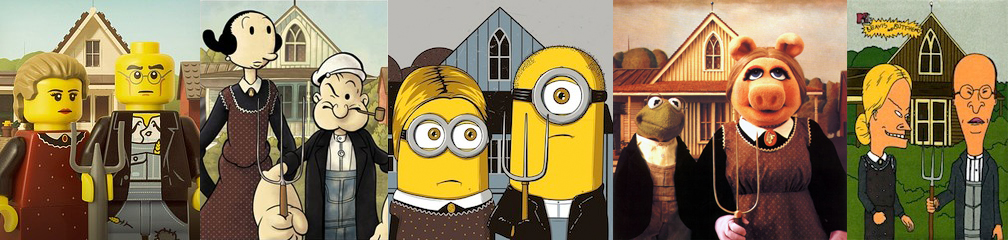
The painting endures, Biel concludes, because it is both itself and a parody of itself. Its meaning has more to do with the viewer’s perception than Wood’s intention. In this, Biel is identifying something common to all visual material. Paintings (like films) never change, but they are subject to differing responses and interpretations as times change. Those that survive cultural, aesthetic and historical shifts share the characteristics that can be seen in ”American Gothic.” It’s simple — two people and a house — and easily remembered. It’s ambiguous and thus can evoke the ambivalent. Wood’s choice of clothing, hairstyle, color and sober posture denies specifics, yet suggests a time, a place and an attitude. It opens the door to popularity (anyone can enjoy it for any reason); argument (does it criticize Middle America or affirm its values?); hatred (it’s an ugly cliché and she’s got rickrack on her dress); parody (the Barbie and Ken or Mickey and Minnie Mouse versions); rebellion (Gordon Parks’s photograph of a black cleaning woman uses the pose to remind us of its basic whiteness); commerce (Paul Newman and his daughter posing on their organic snack packages); politics (representations of a long line of American presidents and their first ladies); and endless pop cultural references (the small-town tableau of ”The Music Man” or the credits for ”Green Acres”)
http://www.nytimes.com/2005/07/10/books/review/10BASSING.html?pagewanted=all&_r=0

modelshouse

GreenAcresparody1

Thomas Edison: Born February 11, 1847

Transcript~ https://archive.org/details/edba-3756
Let us not forget—a message to the American people~ https://www.loc.gov/item/00694069/

Thomas Alva Edison Biography~ https://en.wikipedia.org/wiki/Thomas_Edison

Thomas Alva Edison by Abraham Archibald Anderson
1890 / Oil on canvas / National Portrait Gallery, Smithsonian Institution
https://npg.si.edu/object/npg_NPG.65.23

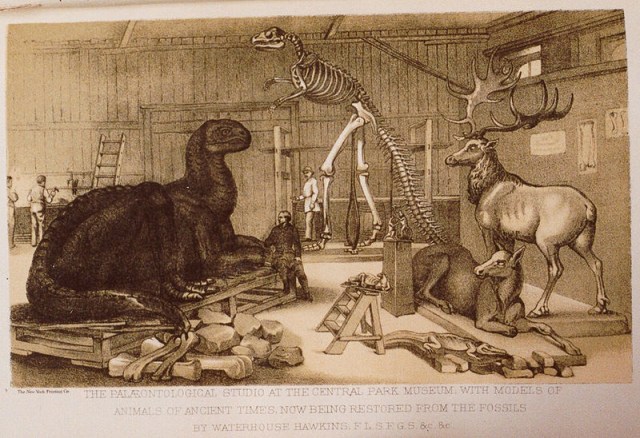
‪Benjamin Waterhouse Hawkins‬: Feb. 8, 1807 – Jan. 27, 1894

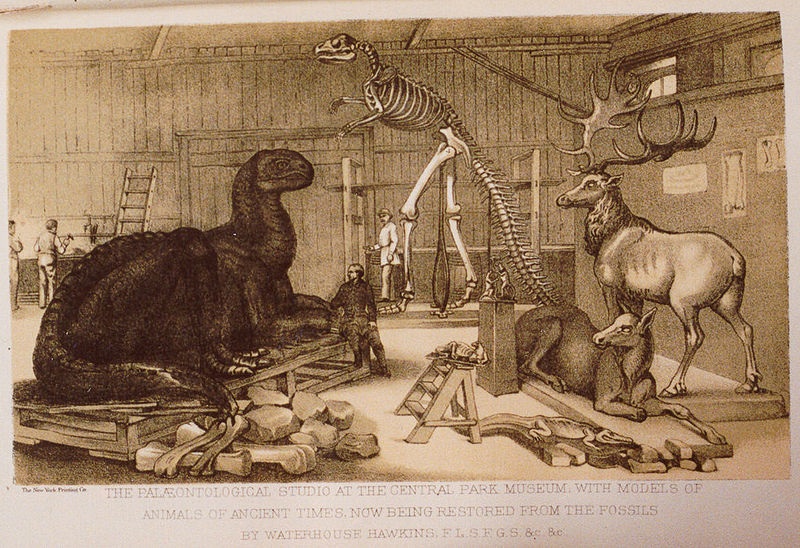
HawkinsReconstructed skeletons‪ of dinosaurs and life-size models of how they may once have appeared are now commonplace. But until the British artist Benjamin Waterhouse Hawkins created such things in the second half of the nineteenth century, dinosaurs and their kin were poorly understood and of little interest to anyone but a handful of professional paleontologists. Hawkins was responsible for designing public displays both in Great Britain and in the United States depicting prehistoric life‬…‪The beginnings of Hawkins’s lasting influence in paleontology can be traced to September 1852, when he earned an extraordinary commission: to fashion a group of life-size sculptures of “antediluvian monsters” for London’s Crystal Palace.‬
http://www.naturalhistorymag.com/htmlsite/master.html?http://www.naturalhistorymag.com/htmlsite/1208/1208_feature.html

In order to refute the nascent stirrings of evolutionary theory, Owens pressed Hawkins to transform the iguanodon from the huge, low-to-the-ground lizard that scientists had guessed at since its discovery nearly twenty years earlier into a majestic quadruped that walked rather than slithered, built like a grotesquely oversized dog or pig.

Mistakes of that sort abounded in Hawkins’s models, driven in most cases less by ideology than by understandable lack of knowledge. As any contemporary visitor to Dinosaur Court will instantly grasp, these dinosaurs are … off. Awkwardly, humorously so.
http://editions.nymoon.com/post/22591159984/wrongosaurus-dinosaurs-at-the-crystal-palace-by

Following his success with the Crystal Palace Exhibition, Hawkins came to New York City with the intent of recreating on one side of the Atlantic what had been so successful on the other…The plan was to set them up in a “Paleozoic Museum” in Central Park, which was then being landscaped under the direction of Frederick Law Olmstead, an ex-engineer officer in the Union army.

However, in 1871, before either the park or the dinosaurs were finished, New York City politics intervened. The corrupt Tammany Hall-Boss Tweed machine took control of city politics, and Hawkins and his dinosaurs were out.
http://academic.brooklyn.cuny.edu/geology/chamber/hawkins.html

The Central Park Conservancy’s historian, Sara Cedar Miller, told us this morning: “The dinosaur models were made of concrete and metal so their ‘bones’ would basically be unidentifiable if found. The remains were thrown into the Pond, not under sod…and the Pond has been dredged for restoration restored many times and it is quite unlikely that anything would be there now.”
http://gothamist.com/2014/09/23/no_there_are_no_dinosaurs_buried_in.php

The link below leads to a collection of images from an album of manuscripts, clippings, and images assembled over time by Benjamin Waterhouse Hawkins: Collection 803. Benjamin Waterhouse Hawkins Album. Academy of Natural Sciences of Philadelphia. http://www.ansp.org/research/library/archives/0800-0899/hawkins803/
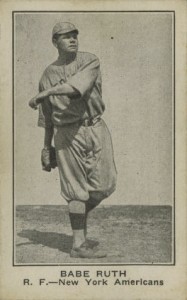
Babe Ruth, February 6, 1895 – August 16, 1948

babeTop 10 Babe Ruth Cards of All-Time

Many of the baseball cards from Babe Ruth’s playing days are obscure offerings with a limited release. However, the ones that surface in good condition generally sell for huge amounts. The following list aims to identify the ten most valuable Babe Ruth cards in existence. Because rarity and condition greatly affect value, historical significance was also factored into this list. Due to the incredible values seen by Babe Ruth cards, narrowing down the list meant that a few popular cards did not make the cut. While time may reveal other hidden gems, the following list represents the dream checklist for many Babe Ruth card collectors. All the cards are worth a small (or large) fortune, and prices generally start around $5,000, and can escalate very quickly.

Ruth

FROM http://www.cardboardconnection.com/top-10-babe-ruth-cards