Salmagundi

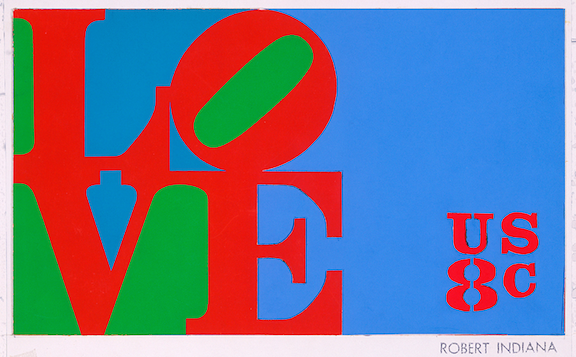
Robert Indiana’s LOVE

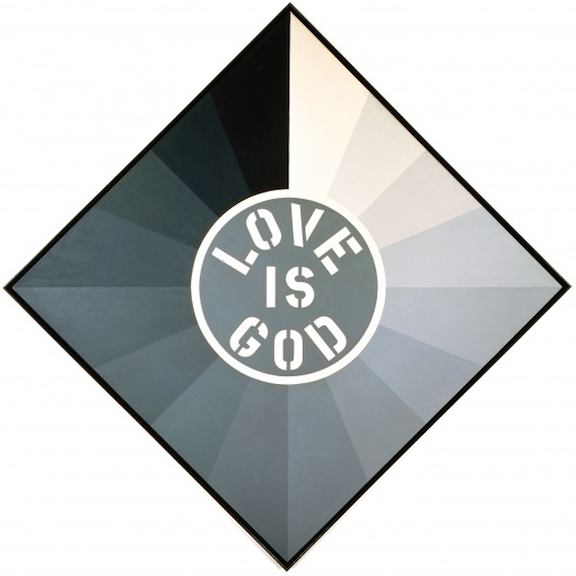
The inspiration came from his childhood as a Christian Scientist, when the phrase “God is love” was prominent. Indiana inverted the idea to suggest that “Love is God.

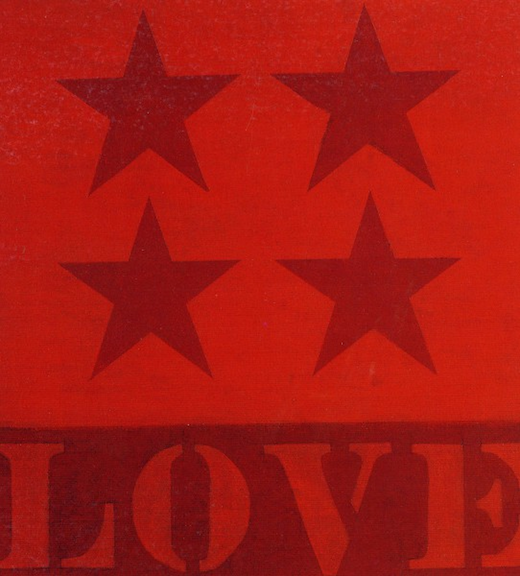
The first LOVE painting was a small canvas in 1961 called 4-Star Love, which was the word “love” with four stars stacked above it and that was really the inspiration for stacking the letters.

The motif first appeared as a series of rubbings in 1964 on his personal Christmas cards.

[In 1965] MoMA asked him to design a Christmas card. Inspired by his recent painting, he chose the single word ‘love’, the letters of which he arranged on two lines to fit the card’s square format better. To create a more interesting design he angled the ‘o’. Indiana submitted several colour variations. The museum chose the one with red letters against a blue and green background.

It was inspired by a sign at a gas station. During the Depression, my father worked for Phillips 66, which had a huge sign up in the sky. I can still see that red and green sign against the blue Indiana sky. My first ”Love” was red, green and blue.

Few Pop images are more widely recognized than Indiana’s LOVE…[it]has appeared in prints, paintings, sculptures, banners, rings, tapestries, and stamps. Full of erotic, religious, autobiographical, and political underpinnings—especially when it was co-opted as an emblem of 1960s idealism—LOVE is both accessible and complex in meaning. In printed works, Indiana has rendered LOVE in a variety of colors, compositions, and techniques. He even translated it into Hebrew for a print and a sculpture at the Israel Museum in Jerusalem
(Learn more by clicking on text-embedded hyperlinks leading to sources)

Salmagundi

Princeton Battle Monument (1922)

This limestone monument was designed by the prominent Beaux Arts sculptor Frederick MacMonnies with the help of architect Thomas Hastings. Commissioned in 1908, it was finished and dedicated in 1922, with President Harding in attendance. On the sides of the monument are the seals of the United States and the original thirteen states, including New Jersey. The creation of the monument served to commemorate the Battle of Princeton, which took place on January 3, 1777. The sculpture depicts Washington leading his troops into battle, as well as the death of General Hugh Mercer.
https://princetonhistory.org/research/historic-princeton/historic-sites/

(Learn more by clicking on embedded hyperlinks)

I Want To Hold Your Hand

February 1, 1964 was the day that a Beatles song hit Number One for the first time in the USA. The song was “I Want To Hold Your Hand”. The Beatles flew into JFK on February 7 and made their first appearance on Ed Sullivan two days later. And we all had a gear time!

https://www.rockhall.com/inductees/beatles
http://www.rollingstone.com/music/lists/100-greatest-beatles-songs-20110919/i-want-to-hold-your-hand-19691231

January First: Happy New Year!

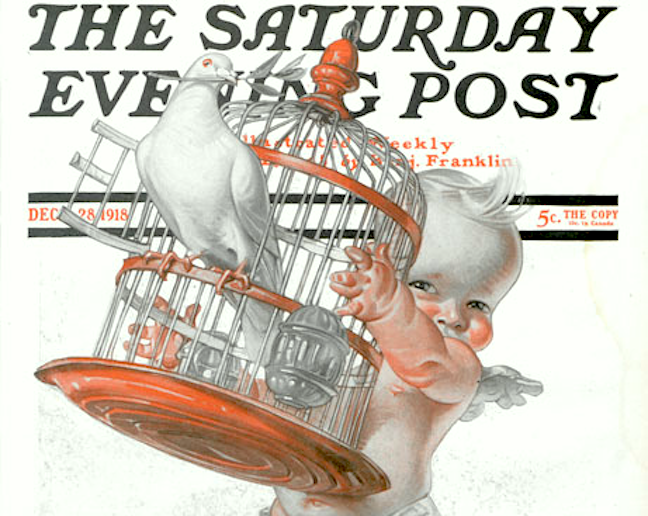
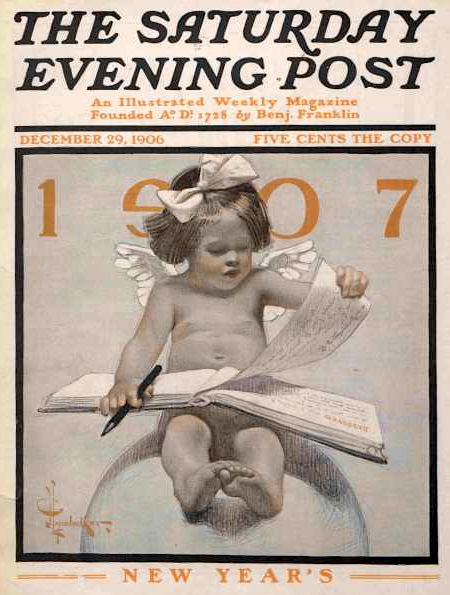
Link~ J.C. Leyendecker, Father of the New Year’s Baby

“Joseph Christian Leyendecker wasn’t the first artist to use an infant to represent the new year. But over the span of 36 years, he made the New Year’s baby as familiar to Americans as Father Time.

A consummate illustrator — and mentor to Norman Rockwell — Leyendecker was continually searching for better ways to depict the holidays. He created many fanciful covers that caught the spirit of Christmas, Fourth of July, Easter, and Thanksgiving. But the New Year’s babies are arguably his most memorable.

His first baby was delivered for the December 29, 1906, issue of the Post. It shows a cherub atop a globe, turning over a fresh page in a book of New Year’s resolutions. The series continue without interruption until 1943…”
http://www.saturdayeveningpost.com/2014/12/31/art-entertainment/art-and-artists/new-years-babies.html