“Turandot” premieres in Milan on April 25, 1926:

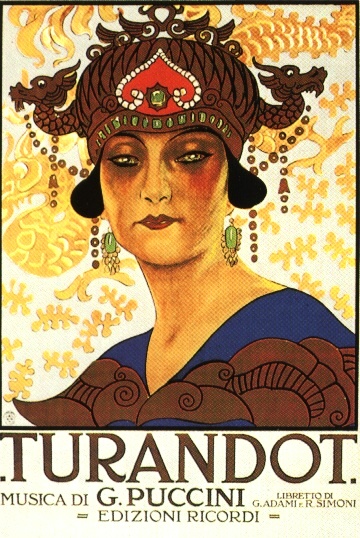
Poster

Turandot premiered at La Scala in Milan on 25 April 1926, almost a year and a half after Puccini’s death. Puccini’s friend Arturo Toscanini, who had worked on the score with the composer during the last months of Puccini’s life, conducted the premiere. As is widely recorded, when the opera reached the last note written by Puccini, Toscanini ended the performance. What he said at the time has been variously reported, from the poetic “Here death triumphed over art” to the poigniant “For me, the work ends here.” An eyewitness quoted in a recent biography puts it somewhere between the two: “Here ends the opera, because at this point the maestro was dead.”
FROM http://www.theopera101.com/operas/turandot/

April 18, 1956: The “Wedding of the Century”

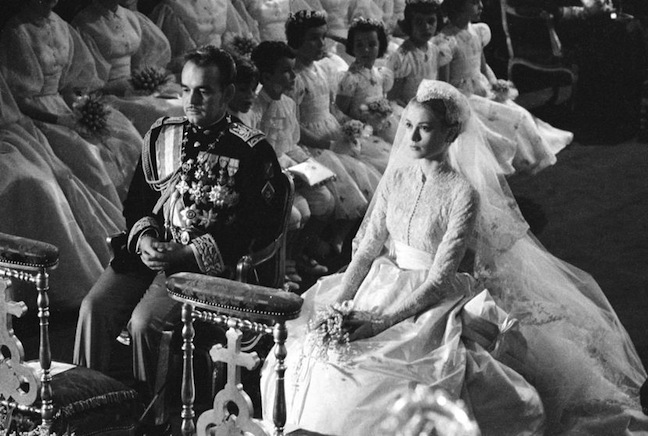
1204696.jpg

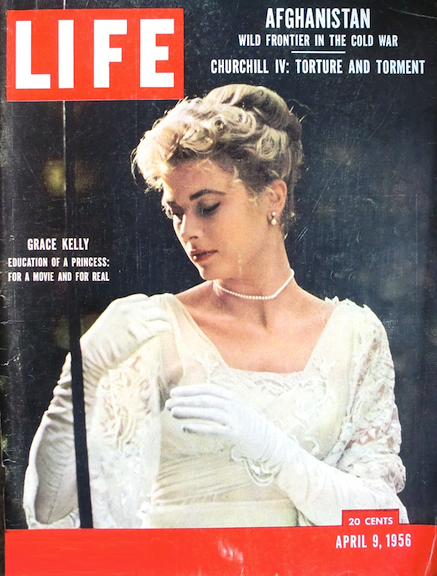
“Before William and Kate, before Charles and Di, before Liz and Dick (I and II), before any of the “storybook” weddings of the past several decades, there was the fairytale wedding of the last century: the April 1956 nuptials of Grace Kelly and Prince Rainier III of Monaco. The tale of the American movie star and Philadelphia native marrying the prince of a small, sensationally wealthy city-state was simply too perfect to ignore — and for months leading up to the event, from the time of the couple’s engagement PGKuntil the two ceremonies (civil and religious) that formalized their union, the Hollywood princess and the real-life prince were hardly ever out of the news.

Here, LIFE.com presents photos — many of which never ran in LIFE magazine — from the moment the couple announced their engagement in January 1956 until they were married three and a half months later in Monaco.”
FROM~ http://time.com/3684060/life-with-grace-kelly-and-prince-rainier-photos-from-the-wedding-of-the-century/

The Resurrection in Art

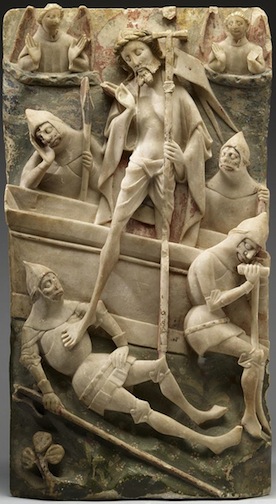
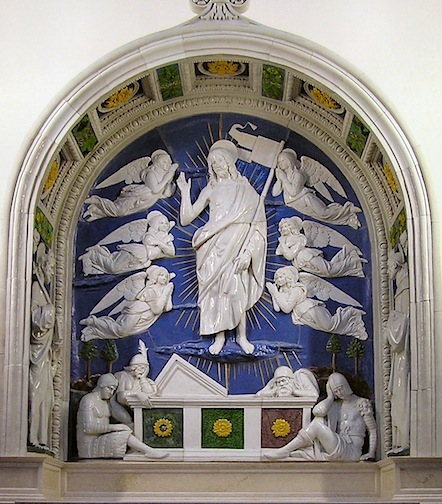
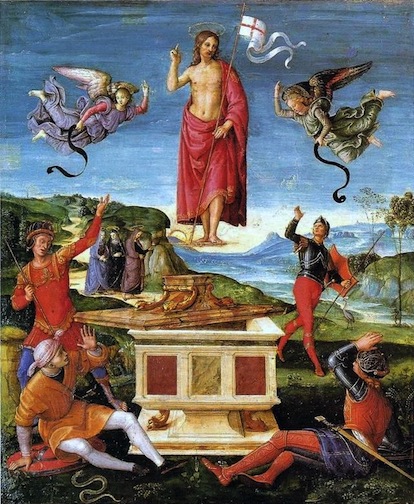
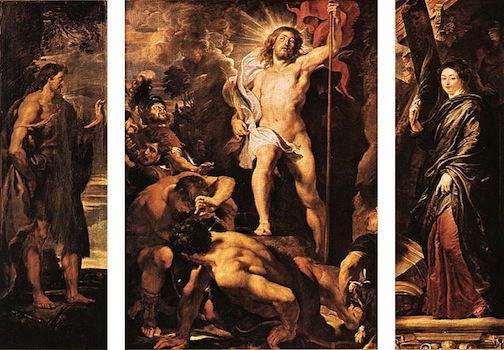
Christians celebrate the resurrection of Jesus on Easter Sunday, two days after Good Friday, the day of his crucifixion. It is the central tenet of Christian theology. The Resurrection of Christ has been portrayed by artists for 2,000 years; I thought it would be appropriate at Easter to take an (obviously lightning fast) overview of how some painters have depicted it. (Click image to enlarge).

GreekAnonymous
The Resurrection
11th century
Mosaic
Monastery of Hosios Loukas, Greece
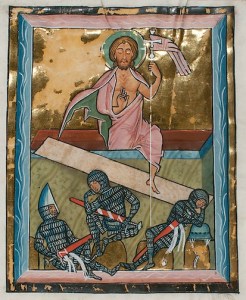
Psalter

Anonymous
Manuscript Leaf with the Resurrection, from a Psalter
13th century
Tempera, ink, gold, and silver on parchment
Metropolitan Museum of Art, New York
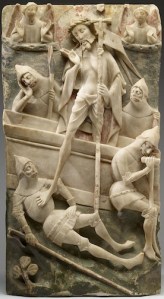
AlabasterAnonymous
Paneled altarpiece section with Resurrection of Christ
15th century
English Nottingham alabaster with remains of colour
Walters Art Museum, Baltimore, MD

Andrea della Robbia (1435–1525)OLYMPUS DIGITAL CAMERA
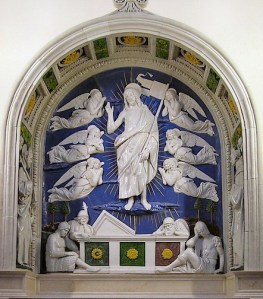
Resurrection
15th century
Enamelled Terracotta
Bode-Museum, Berlin, Germany

FrancescaPiero della Francesca (1420-1492)
The Resurrection of Jesus Christ
1463
Mural in fresco and tempera
Museo Civico, Sansepolcro, Italy

Raphael (1483-1520)Raphael
The Resurrection of Jesus Christ
1499-1502
Oil on panel
São Paulo Museum of Art, Brazil

RubensPeter Paul Rubens (1577-1640)
The Resurrection of Christ
1611-1612
Oil on panel
Antwerp Cathedral, Belgium

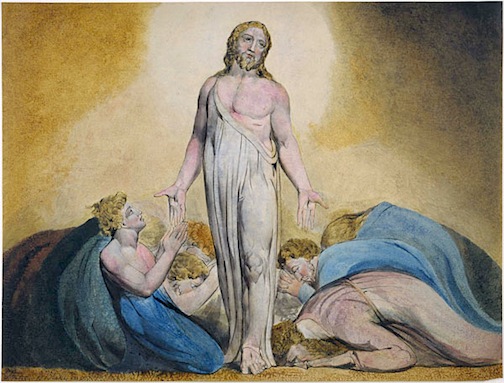
Blake

William Blake (1757-1827)
Christ Appearing to His Disciples After the Resurrection
1795
Monotype hand-colored with watercolor and tempera
National Gallery of Art, Washington DC

ManetÉdouard Manet (1832–1883)
The Dead Christ with Angels
1864
Oil on canvasMetropolitan Museum of Art, New York City

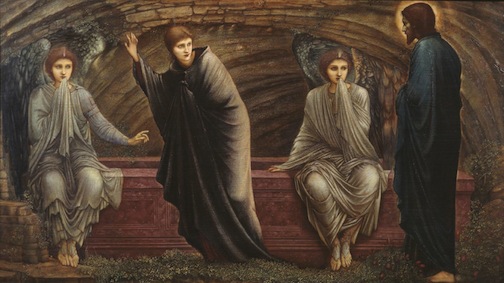
Sir Edward Coley Burne-Jones (1833–1898)
The Morning of the Resurrection
1886
Oil paint on wood
Tate Gallery, London, UKThe Morning of the Resurrection 1886 by Sir Edward Coley Burne-Jones, Bt 1833-1898

Pysanky~ Ukrainian Easter Eggs

http://www.pysanka.com/the_art.php
http://www.learnpysanky.com/designs.html

The Ukrainian pysanka (from the word pysaty, to write) was believed to possess an enormous power not only in the egg itself, which harbored the nucleus of life, but also in the symbolic designs and colors which were drawn upon the egg in a specific manner, according to prescribed rituals. The intricately colored eggs were used for various social and religious occasions and were considered to be a talisman, a protector against evil, as well as harbingers of good.
http://www.ukrainianmuseum.org/pysanky.html

Fabergé Imperial Easter Eggs

The series of Easter eggs created by Fabergé for the Russian Imperial family, from 1885 through to 1916…A centuries-old tradition of bringing hand-coloured eggs to Church to be blessed and then presented to friends and family had evolved through the years and, among the highest echelons of St Petersburg society, the custom developed of presenting valuable bejewelled Easter gifts. So it was that Emperor Alexander III had the idea of commissioning Fabergé to create a precious Easter egg as a surprise for his Empress. The first Imperial Easter egg was born…From 1887 Fabergé was given complete freedom in the design and execution, with the only prerequisite being that there had to be surprise within each creation.
http://www.faberge.com/news/49_imperial-eggs.aspx

fabergeczarevichegg

Beautiful photographs and more information here~ https://elliottingotham.wordpress.com/1301-2/

This automaton was made as the ‘surprise’ for the Diamond Trellis Egg, made by Carl Fabergé for Tsar Alexander III. The Tsar presented the egg to his wife Tsarina Marie Feodorovna for Easter 1892.
https://www.royalcollection.org.uk/collection/9268

April 9, 1939: Marian Anderson’s Easter Sunday Lincoln Memorial concert


Marian Anderson, contralto, was denied the right to perform at Constitution Hall by the DAR because of her color. Instead, and at the urging of Eleanor Roosevelt, Harold Ickes permitted her to perform at the Lincoln Memorial on April 9, 1939.

Denied A Stage, She Sang For A Nation~
https://www.npr.org/2014/04/09/298760473/denied-a-stage-she-sang-for-a-nation
Marian Anderson: Musical Icon~
https://www.pbs.org/wgbh/americanexperience/features/eleanor-anderson/
Marian Anderson Biography~https://www.biography.com/musician/marian-anderson

elvisbillboard 001Let’s be frank here: Elvis devotees are a lot like fish in a barrel. Anyone can shoot them, with reliably satisfying results. Their reverence almost invites intrusion. So the measure of a portfolio of Elvis believers is not the colorfulness of the characters – that much is a given – but the empathy of the photographer. Anyone can capture the tribe’s signature plumage. The trick is teasing out the individual humanity underneath.

“It’s like religion, where people put their trust in something,” she said. “They trust in him. He guides their lives. They wake up with Elvis, they get married with Elvis. He’s there all the time.”

Elvis Is Everywhere: http://lens.blogs.nytimes.com/2015/04/08/elvis-is-everywhere/

April 8: Hana Matsuri (Buddha’s birthday Festival in Japan)

Traditionally, Buddha’s Birthday is known as Vesak or Visakah Puja (Buddha’s Birthday Celebrations). Vesak is the major Buddhist festival of the year as it celebrates the birth, enlightenment and death of the Buddha on the one day, the first full moon day in May, except in a leap year when the festival is held in June. This celebration is called Vesak being the name of the month in the Indian calendar. In Japan, which adopted the Gregorian calendar in the 19th century, Buddha’s Birthday always falls on April 8.

How Japanese people celebrate Buddha’s Birthday~
https://touristjourney.com/hanamatsuri-festival-buddhas-birthday/
Buddhism in Japan~ http://asiasociety.org/education/buddhism-japan

Japanese Buddhist Art~
http://www.asiasocietymuseum.org/region_results.asp?RegionID=6&CountryID=14&ChapterID=38

The Eight Auspicious Symbols of Buddhism~ http://www.exoticindiaart.com/article/symbols/