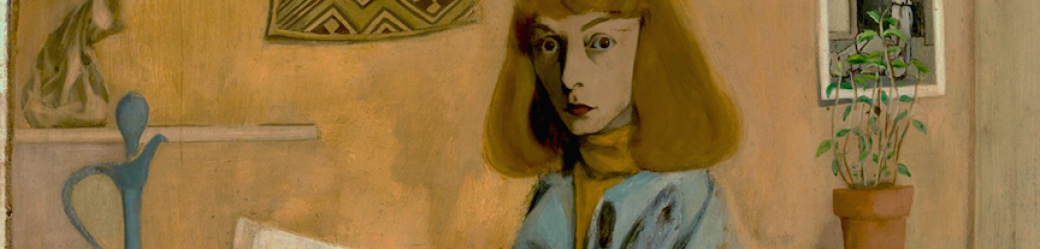
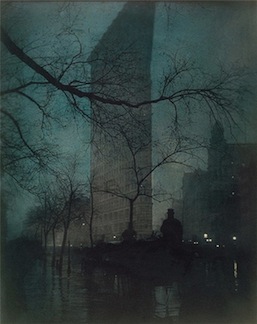
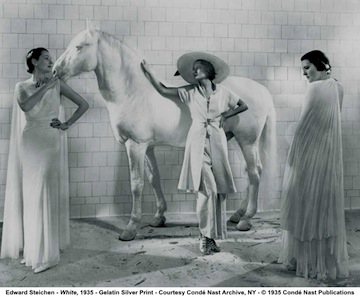
The audience for Steichen’s early photographs—readers of Camera Work, visitors to 291, and members of amateur camera clubs—were important within artistic circles, but their number was small compared to the audience he would address following the war. Indeed, Steichen’s large and painterly early prints, perhaps because of their rarity, are now far less known by the general public than his portraits of Greta Garbo, Marlene Dietrich, Gloria Swanson, and other celebrities that appeared in Condé Nast’s Vogue and Vanity Fair in the 1920s and 1930s, or his fashion and advertising photographs that shared those same pages. Moreover, while the circulation of Camera Work never topped a
thousand (and was often much less) and its intended audience was an intellectual elite, the Condé Nast publications catered to a much larger and broader readership, one hungry for just the sort of glamorous celebrity portraiture at which Steichen excelled.
FROM http://www.metmuseum.org/toah/hd/stei/hd_stei.htm
Tag Archives: Photographer
Edward Weston: Born March 24, 1886
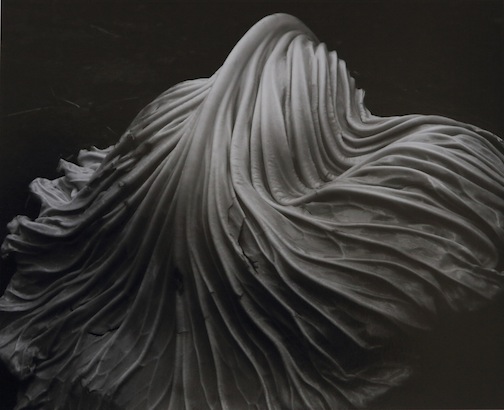
After moving back to California in 1926, Weston began his work for which he is most deservedly famous: natural forms, close-ups, nudes, and landscapes. Between 1927 and 1930, Weston made a series of monumental close-ups of seashells, peppers, and halved cabbages, bringing out the rich textures of their sculpture-like forms. Weston moved to Carmel, California in 1929 and shot the first of many photographs of rocks and trees at Point Lobos, California. Weston became one of the founding members of Group f/64 in 1932 with Ansel Adams, Willard Van Dyke, Imogen Cunningham and Sonya Noskowiak. The group chose this optical term because they habitually set their lenses to that aperture to secure maximum image sharpness of both foreground and distance. 1936 marked the start of Weston’s series of nudes and sand dunes in Oceano, California, which are often considered some of his finest work. Weston became the first photographer to receive a Guggenheim Fellowship for experimental work in 1936.
FROM https://www.edward-weston.com/edwardweston
Pattie Boyd: Born on March 17, 1944

Patricia Anne “Pattie” Boyd (born March 17, 1944) is a model, photographer and author, born in Somerset, England. She was the first wife of both George Harrison and Eric Clapton…Pattie began her modeling career in 1962 in London, and appeared on the cover of Vogue and in several advertising campaigns. She was cast in the Beatles’ first feature film A Hard Days Night in 1964, where she first met George Harrison…She married George Harrison in January, 1966 and when being a ‘Beatle wife’ made it too difficult to work, she began taking a strong interest in photography.
Pattie Boyd is sick of being called a muse: ‘What have I done to inspire George Harrison?’
https://english.elpais.com/culture/2022-10-14/pattie-boyd-is-sick-of-being-called-a-muse-what-have-i-done-to-inspire-george-harrison.html
Pattie Boyd Talks Art, Fashion, and Beatlemania
https://lithub.com/pattie-boyd-talks-art-fashion-and-beatlemania/
Pattie Boyd, often in the shadow of her famous husbands, has put a trove of mementos up for auction
https://www.pbs.org/newshour/amp/arts/pattie-boyd-often-in-the-shadow-of-her-famous-husbands-has-put-a-trove-of-mementos-up-for-auction
David Hare: March 10, 1917-December 21, 1992
 Biography~ https://www.guggenheim.org/artwork/artist/david-hare
Exhibition catalogue at Weinstein Gallery, September 2012~
https://issuu.com/weinstein_gallery/docs/david-hare-exhibit-catalogue
Tamarind lithographs~ https://tamarind.unm.edu/?s=David+Hare
New York Times obituary~
http://www.nytimes.com/1992/12/25/arts/david-hare-sculptor-and-photographer-dies-at-75.html
William Lyman Underwood (March 5, 1864-Jan. 24, 1929)
William Lyman Underwood and his brother Loring (1874–1930) were early leaders in nineteenth-century nature photography. Loring, trained as a horticulturist, focused on the cultivated landscapes of parks and estate gardens, while William preferred the wilderness of northeastern America. A renowned public speaker, William gave more than forty lectures a year about his experiences as “a camera hunter,” accompanied by a lantern slide show of his photographs. This run-of-the-century [sic] entertainment instructed audiences about an environment that Underwood feared was vanishing.
http://americanart.si.edu/collections/search/artist/?id=6755In 1895, William Lyman Underwood, director of a Massachusetts canned-food
company, came to MIT seeking the help of a scientist–any scientist–who could fix the problem of his smelly canned clams. He went straight to the biology department, asking whether anyone could “suggest a cause and, better still, a remedy.” The department chair passed Underwood off to his assistant, Samuel Cate Prescott, advising the chemist to teach the canner a bit about microbes.
…
During these experiments, Underwood indulged his passion for photography. The March 1898 Technology Quarterly featured several of his actual-size photographs of petri dishes filled with circular spidery blooms of bacillus–each like a telescopic glance at a pockmarked moon–as well as some strikingly clear slides of microörganisms at 1,000 times their actual size.
https://www.technologyreview.com/s/412221/two-happy-clams/
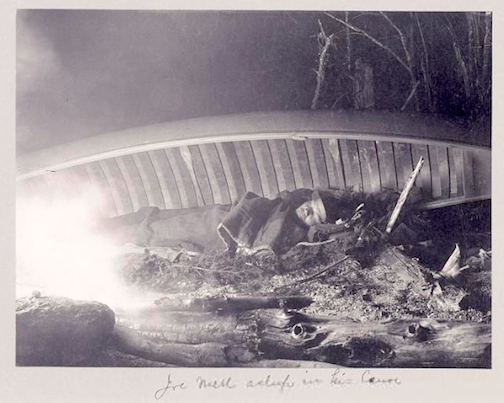
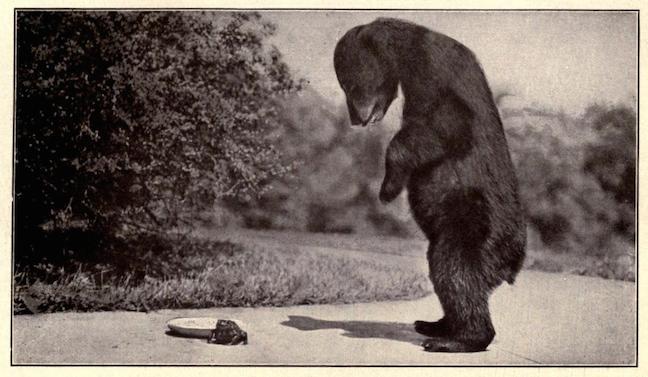 “Wild brother; strangest of true stories from the north woods”~
https://archive.org/details/wildbrotherstran00undeiala
Underwood’s Deviled Ham: The Oldest Trademark Still in Use~
http://www.smithsonianmag.com/arts-culture/underwoods-deviled-ham-the-oldest-trademark-still-in-use-119136583/
Records of the National Park Service: Ansel Adams Photographs
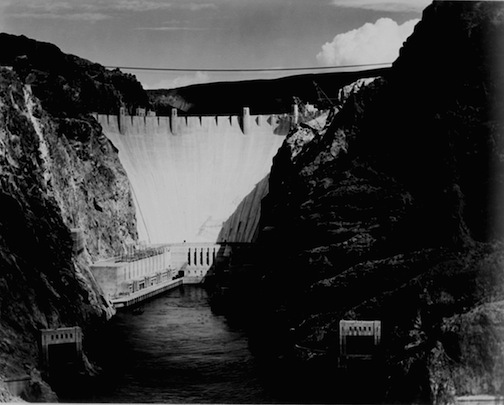
In 1941 the National Park Service commissioned noted photographer Ansel Adams to create a photo mural for the Department of the Interior Building in Washington, DC. The theme was to be nature as exemplified and protected in the U.S. National Parks. The project was halted because of World War II and never resumed.
The holdings of the National Archives Still Picture Branch include 226 photographs taken for this project, most of them signed and captioned by Adams.
Photographer Esther Bubley: Born February 16, 1921
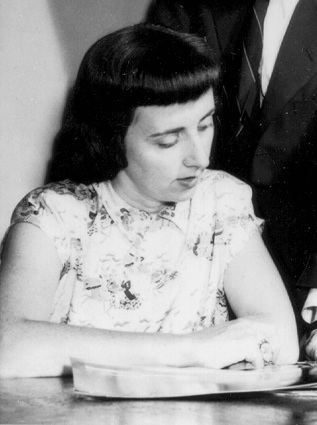
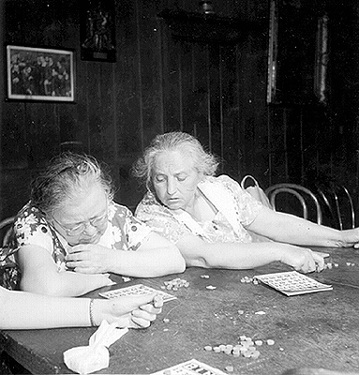
“Put me down with people, and it’s just overwhelming,” Bubley exclaimed in an interview. Like most great photojournalists, she found her art in everyday life, and she successfully balanced her artistic ambitions with the demands of commercial publishing. Edward Steichen, curator of photographs at the Museum of Modern Art and the era’s arbiter of taste, was a great supporter of Bubley, whose work embodied his aesthetic ideal that photography “explain man to man and each to himself.” She was shown in several group shows at the Museum of Modern Art and was given a one-person show at the Limelight, Helen Gee’s legendary coffee house and the only gallery specializing in photography in New York during the 1950s. Bubley worked primarily for the printed page, however, and like her colleagues, can be only partially understood in the context of today’s gallery-oriented photography world, in which photographs are shown as isolated works of art.
FROM http://www.estherbubley.com/bio_frame_set.htm
http://www.loc.gov/rr/print/coll/womphotoj/bubleyintro.html
https://www.loc.gov/exhibits/wcf/wcf0012.html
https://lens.blogs.nytimes.com/2011/08/02/tender-moments-in-the-maelstrom-of-war/
Richard Stacks~ Photographer
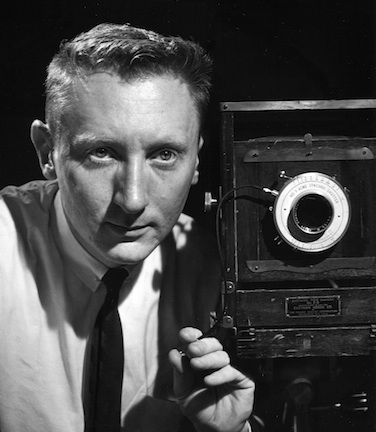
“The Baltimore Sun has a rich history of great photographers and one of my personal favorites is Richard Stacks. His images are part art and part journalism. He is a master of light and composition and is able to maximize both qualities in his images.”
http://darkroom.baltimoresun.com/2013/02/richard-stacks-award-winning-sun-photographer/#1
Frances Benjamin Johnston: Born January 15, 1864

“Frances Benjamin Johnston (1864-1952) was one of the first American women to achieve prominence as a photographer. Trained at the Académie Julian in Paris, she studied photography upon her return to Washington, D.C., in the mid-1880s and opened a professional studio circa 1890. Her family’s social position gave Johnston access to the First Family and leading Washington political figures and launched her career as a photojournalist and portrait photographer. Johnston turned to garden and estate photography in 1910s.”
~https://www.loc.gov/pictures/collection/fbj/
Frances Benjamin Johnston~ http://www.cliohistory.org/exhibits/johnston/
Photographs~ http://www.whitehousehistory.org/galleries/frances-benjamin-johnston
Library of Congress~ http://www.loc.gov/rr/print/coll/fbjchron.html
December 30~
W. Eugene Smith (1918-1978)
http://www.icp.org/browse/archive/constituents/w-eugene-smith?all/all/all/all/0
Lila Katzen (1932-1998)
http://www.groundsforsculpture.org/Artist/Lila-Katzen

 The Misty Miss Christy