Born November 5, 1783~ Caroline Tischbein

Caroline Tischbein (Wilken) ~ painter, illustrator, and writer ~ was born on this day in 1783.

Caroline Tischbein belonged to a family that produced more than 20 artists in three generations. Between 1770 and 1830, the women were well known as artists by their contemporaries. After that, the female members of the family fell into oblivion, although the male painters did not. The best known among them is Johann Heinrich Wilhelm Tischbein (1751-1829) who in 1787 shared a flat in Rome with Johann Wolfgang von Goethe, during which time Johann painted “Goethe in the Roman Campagna”.

Caroline and the other Tischbein women have been resurrected by art historian Prof. Dr. Martina Sitt, Professor of General Art History at the University of Kassel. For more than a year, under her leadership, the students at the Kunsthochschule Kassel researched these “disappeared artists” and used the results to mount an exhibition about them.

Caroline was the daughter of the Arolsen court painter Johann Friedrich August Tischbein and Sophie Tischbein. She received drawing lessons from her father, who later became director of the Academy in Leipzig (the city where Caroline would meet her future husband). Historian and professor Friedrich Wilken and Caroline met during his studies in Leipzig and married in 1806. The couple moved first to Heidelberg and later to Berlin; in both cities they traveled in intellectual and artistic circles. Caroline Tischbein died in Berlin on April 29, 1843. She left behind her memoirs which were written for her children but subsequently published.

In addition to Caroline, women painters from the Tischbein family included:
Elisabeth (Betty) Tischbein (1787-1867), another daughter of Johann Friedrich August Tischbein.
Amalie Tischbein (1756-1839), daughter of the Kassel court painter and academy professor Johann Heinrich Tischbein.
Sophia Antoinette Tischbein (1761-1826), daughter of Johann Jacob Tischbein and his wife, the painter Magdalene Gertrud Lilly.
Magdalene Margarethe Tischbein (1763-1836), sister of Sophia Antoinette

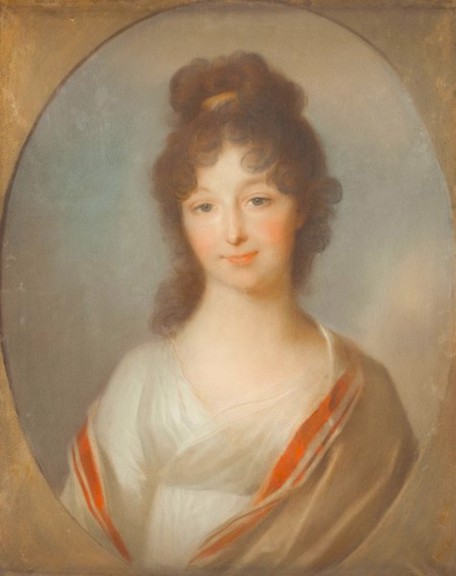
Top: portrait of Caroline Tischbein by her father Johann Friedrich August Tischbein (1750-1812)
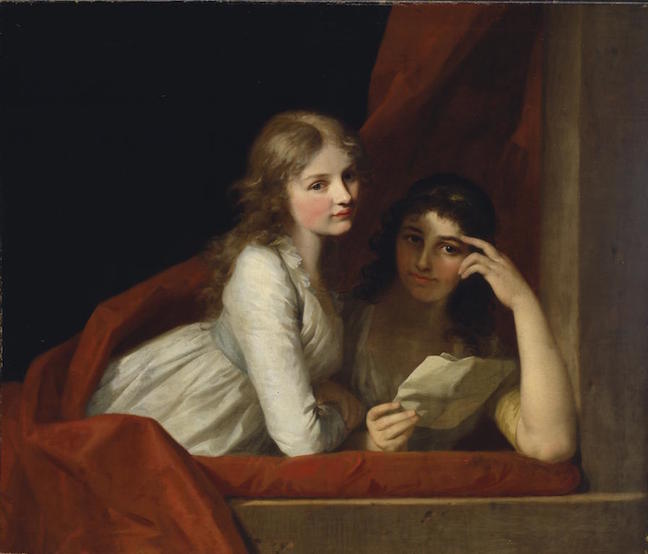
Bottom: “Two Sisters” painted by Caroline Tischbein. The picture probably shows members of the Tischbein family, but their identity is unknown.

SOURCES~
“Disappeared artists”: University of Kassel  [link has since broken]
The women of the family Tischbein
Tischbein, Caroline (5 November 1783–1843)
Robert Mapplethorpe: American Photographer (1946-1989)

youtube “Robert Mapplethorpe Portraits”~  https://youtu.be/ol0CD8gjniA

In 1973, the Light Gallery in New York City mounted his first solo gallery exhibition, “Polaroids.” Two years later he acquired a Hasselblad medium-format camera and began shooting his circle of friends and acquaintances—artists, musicians, socialites, pornographic film stars, and members of the S & M underground. He also worked on commercial projects, creating album cover art for Patti Smith and Television and a series of portraits and party pictures for Interview Magazine.
in 1986, he was diagnosed with AIDS. Despite his illness, he accelerated his creative efforts, broadened the scope of his photographic inquiry, and accepted increasingly challenging commissions. The Whitney Museum of American Art mounted his first major American museum retrospective in 1988, one year before his death in 1989.

Today Mapplethorpe is represented by galleries in North and South America and Europe and his work can be found in the collections of major museums around the world. Beyond the art historical and social significance of his work, his legacy lives on through the work of the Robert Mapplethorpe Foundation. He established the Foundation in 1988 to promote photography, support museums that exhibit photographic art, and to fund medical research in the fight against AIDS and HIV-related infection.

FROM  http://www.mapplethorpe.org/biography/

Robert Mapplethorpe’s Proud Finale
Behind rock’s finest album cover: A timeless friendship

Patti Smith 1979 Robert Mapplethorpe 1946-1989 ARTIST ROOMS Acquired jointly with the National Galleries of Scotland through The d'Offay Donation with assistance from the National Heritage Memorial Fund and the Art Fund 2008 http://www.tate.org.uk/art/work/AR00495

Patti Smith 1979 Robert Mapplethorpe 1946-1989 ARTIST ROOMS Acquired jointly with the National Galleries of Scotland through The d’Offay Donation with assistance from the National Heritage Memorial Fund and the Art Fund 2008 https://www.tate.org.uk/art/artworks/mapplethorpe-patti-smith-ar00495

Gerald Brockhurst: October 31, 1890-May 4, 1978

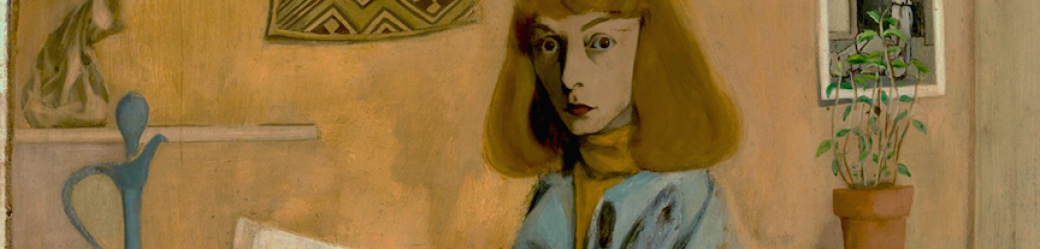
Jeunesse Dorée by Gerald Leslie Brockhurst

1934 / Oil on board / 30”x24 4/5” / Lady Lever Art Gallery, National Museums Liverpool, UK

British-born painter and etcher who became an American citizen in 1949. Precociously gifted, an excellent draughtsman, and a fine craftsman, Brockhurst won several prizes at the Royal Academy Schools and went on to have a highly successful career as a society portraitist, first in Britain and then in the USA, where he settled in 1939, working in New York and New Jersey. He is best known for his portraits of glamorous women, painted in an eye-catching, dramatically lit, formally posed style similar to that later associated with Annigoni. As an etcher Brockhurst is remembered particularly for Adolescence (1932), a powerful study of a naked girl on the verge of womanhood staring broodingly into a mirror—one of the masterpieces of 20th-century printmaking.  ~Oxford University Press

“Dorette” and Gerald Leslie Brockhurst~
https://collections.tepapa.govt.nz/object/39559
Wikipedia~ https://en.wikipedia.org/wiki/Gerald_Brockhurst
Gerald Leslie Brockhurst painting the Duchess of Windsor~
https://www.npg.org.uk/collections/search/portrait/mw233820/Gerald-Leslie-Brockhurst?LinkID=mp08078&role=sit&rNo=13

The Resurrection in Art

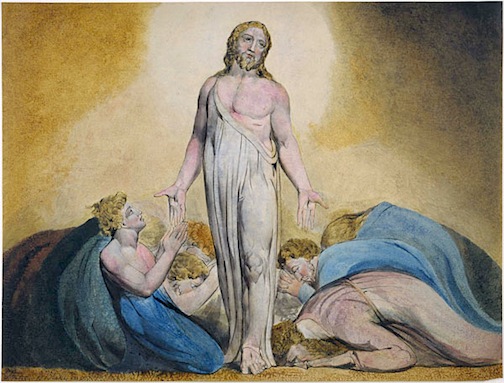
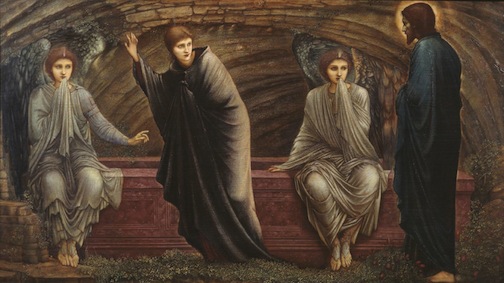
Christians celebrate the resurrection of Jesus on Easter Sunday, two days after Good Friday, the day of his crucifixion. It is the central tenet of Christian theology. The Resurrection of Christ has been portrayed by artists for 2,000 years; I thought it would be appropriate at Easter to take an (obviously lightning fast) overview of how some painters have depicted it. (Click image to enlarge).

GreekAnonymous
The Resurrection
11th century
Mosaic
Monastery of Hosios Loukas, Greece

Psalter

Anonymous
Manuscript Leaf with the Resurrection, from a Psalter
13th century
Tempera, ink, gold, and silver on parchment
Metropolitan Museum of Art, New York

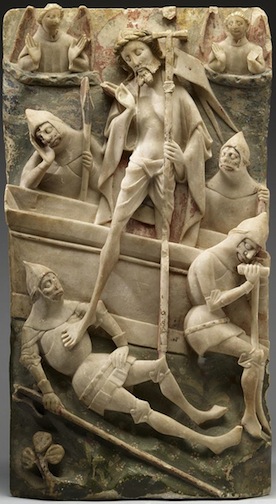
AlabasterAnonymous
Paneled altarpiece section with Resurrection of Christ
15th century
English Nottingham alabaster with remains of colour
Walters Art Museum, Baltimore, MD

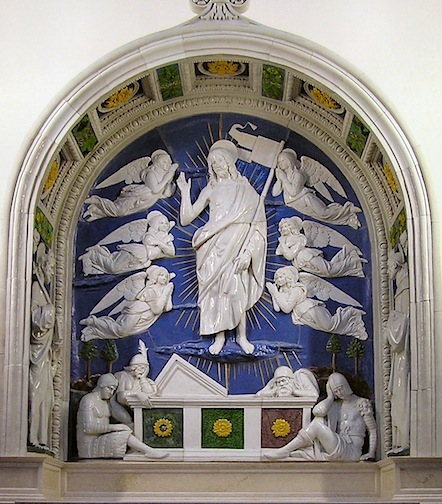
Andrea della Robbia (1435–1525)OLYMPUS DIGITAL CAMERA
Resurrection
15th century
Enamelled Terracotta
Bode-Museum, Berlin, Germany

FrancescaPiero della Francesca (1420-1492)
The Resurrection of Jesus Christ
1463
Mural in fresco and tempera
Museo Civico, Sansepolcro, Italy

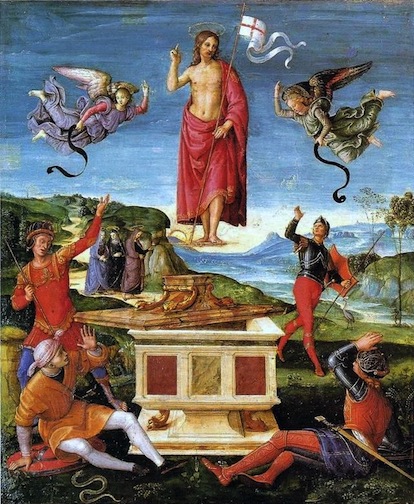
Raphael (1483-1520)Raphael
The Resurrection of Jesus Christ
1499-1502
Oil on panel
São Paulo Museum of Art, Brazil

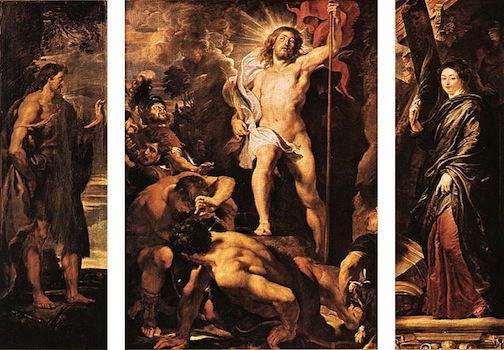
RubensPeter Paul Rubens (1577-1640)
The Resurrection of Christ
1611-1612
Oil on panel
Antwerp Cathedral, Belgium

Blake

William Blake (1757-1827)
Christ Appearing to His Disciples After the Resurrection
1795
Monotype hand-colored with watercolor and tempera
National Gallery of Art, Washington DC

ManetÉdouard Manet (1832–1883)
The Dead Christ with Angels
1864
Oil on canvasMetropolitan Museum of Art, New York City

Sir Edward Coley Burne-Jones (1833–1898)
The Morning of the Resurrection
1886
Oil paint on wood
Tate Gallery, London, UKThe Morning of the Resurrection 1886 by Sir Edward Coley Burne-Jones, Bt 1833-1898

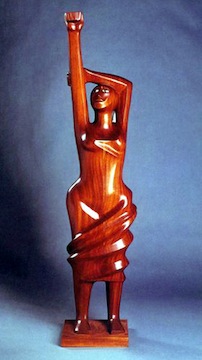
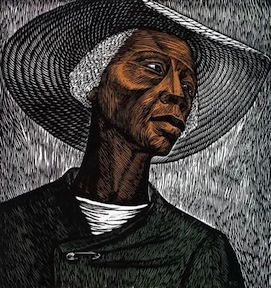
Elizabeth Catlett (April 15, 1915-April 2, 2012)

CatlettPic

Sculptor and printmaker Elizabeth Catlett used her art to advocate for social change in both the U.S. and her adopted country of Mexico for almost three-quarters of a century. The granddaughter of former slaves, Catlett was raised in Washington, D.C. Her father died before she was born and her mother held several jobs to raise three children. Refused admission to Carnegie Institute of Technology because of her race, Catlett enrolled at Howard University, where her teachers included artist Catlett1Loïs Mailou Jones and philospher Alain Locke. She graduated with honors in 1935 and went on to earn the first the first M.F.A. in sculpture at the University of Iowa five years later.
Grant Wood, her painting teacher at Iowa, encouraged students to make art about what they knew best and to experiment with different mediums, inspiring Catlett to create lithographs, linoleum cuts, and sculpture in wood, stone, clay, and bronze. She drew subjects from African American and later Mexican life.
In 1946, a grant from the Rosenwald Foundation enabled Catlett to move to Mexico City with her husband, Catlett2printmaker Charles White. There she joined the Taller de Gráfica Popular, an influential and political group of printmakers. At the Taller, Catlett met the Mexican artist Francisco Mora, whom she married after divorcing White and with whom she had three sons.

https://nmwa.org/explore/artist-profiles/elizabeth-catlett

Biography: https://www.elizabethcatlettart.com/bio
NYT~”Elizabeth Catlett, Sculptor With Eye on Social Issues, Is Dead at 96″: http://www.nytimes.com/2012/04/04/arts/design/elizabeth-catlett-sculptor-with-eye-on-social-issues-dies-at-96.html