Andy Warhol (1928-1987)

2016-02-22-warhol-e1456088647797

Andy Warhol Died 29 Years Ago Today,
Here’s a Look at One of His First Silkscreens.
artnetnews

Blake Gopnik, Monday, February 22, 2016  Andy Warhol died 29 years ago today in a hospital in New York, after a routine gallbladder operation. It seems only fitting to commemorate the end of his artmaking by revisiting its beginnings. The work I’ve chosen as today’s Daily Pic was made in the spring of 1962, as one of the very first of the silkscreened canvases that became Warhol’s signature mode for the next quarter century. It’s the titular work in a touring exhibition called “Open This End: Contemporary Art from the Collection of Blake Byrne,” curated by the art historian Joseph Wolin and now at the Wallach Art Gallery of Columbia University.
https://news.artnet.com/art-world/andy-warhol-died-29-years-ago-today-here-is-when-he-started-to-matter-431666

Andy Warhol, A Documentary Film~

Andy Warhol Biography


The Andy Warhol Museum~ http://www.warhol.org/museum/
The Andy Warhol Foundation for the Visual Arts~ http://warholfoundation.org/

Rea Irvin & The New Yorker

TNY
The New Yorker
debuted on February 21, 1925 — and its cover was graced with the first of many appearances by the magazine’s mascot Eustace Tilley. The illustration was by Rea Irvin (1881-1972), the man responsible for the eternal look of The New Yorker right down to designing the logo typeface, named “Irvin” for its creator.

Font

Irvin

In 1924, Irvin joined an advisory board to help launch The New Yorker. For the cover of the magazine’s debut issue the next year, Irvin created Eustace Tilley, a smartly attired dandy with a monocle and top hat. This amusing and worldly, yet somewhat detached, character embodied the spirit of the new publication. Tilley quickly became Irvin’s signature piece and has reappeared on the magazine’s cover every year since, with one exception–1994.

Between 1925 and 1958, Irvin’s work appeared on 169 covers of The New Yorker. Hundreds of other illustrations by Irvin were also published inside the magazine. http://www.tfaoi.com/aa/1aa/1aa398.htm (dead link)

https://en.wikipedia.org/wiki/Rea_Irvin
https://www.newyorker.com/magazine/1996/01/22/rea-irvin

Irvin had been art editor at Life, and Ross trusted
his taste, which—as others have noted—in turn shaped his
own. Ross biographer Dale Kramer describes his influence: “[Irvin]
had a quick, accurate eye for good craftsmanship. More important, he
knew what changes were necessary to make mediocre work passable and
passable work better.” Born in San Francisco, Irvin had worked as
a newspaper illustrator, stage and screen actor, comic strip artist, and
piano player before arriving at Life. Irvin’s diversity of
aesthetic experience was as essential to his invention of The New
Yorker’s visual style as Ross’s vagabond generalism was

to his conception of the subject matter. http://www.printmag.com/article/everybody_loves_rea_irvin/
Evolution illustration

Louis Comfort Tiffany: Born February 18, 1848

Since today is the birthday of Louis Comfort Tiffany, I thought it might be interesting to have a look at some of the magnificent examples of Tiffany design with which Baltimore has been favored.

Louis Comfort Tiffany’s career lasted from the 1870s through the 1920s. He was the son of Charles Lewis Tiffany who founded Tiffany & Company, but chose not to join the family business, instead embarking on a career as a painter. Although he never stopped painting, Tiffany began in the late 1870s to concentrate on the decorative arts for which we remember him today.  He and his studios worked in a vast array of mediums, including stained-glass windows, glass mosaics, lamps, ceramics, enamelwork, and jewelry.

Tiffany was appointed the first design director of Tiffany & Co. upon his father’s death in 1902. He also continued his association with Tiffany Studios, which did not cease operations until his own death in 1933.

http://www.firstunitarian.net/about-us/history/our-buildings/

unitarianunitariansanctuary

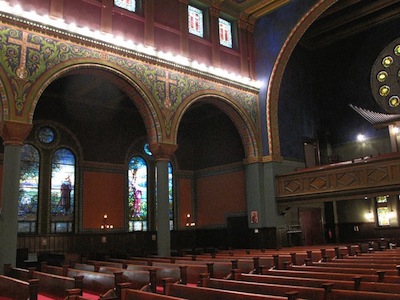
The First Unitarian Church of Baltimore has one of the only three versions of this particular Tiffany glass mosaic design for the Last Supper known to exist. It was installed in 1897 and measures 18′ wide x 9′ tall. The designer was Frederick Wilson who worked for the Tiffany Glass and Decorating Company.

http://www.browndowntown.org/index.php?s=tiffanywindows

Brownbrownsanctuary

Brown Memorial Presbyterian Church was dedicated in 1870; when it was enlarged in 1905 the church commissioned Tiffany Studios in New York City to create its stained glass windows. There are 11 documented Tiffany windows, including two transept windows which measure 40′ high by 16′ wide and dominate the interior.

http://www.stmarksbaltimore.org/st-marks-architecture.html

stmarksstmarkssanctuary

St. Mark’s Lutheran Church boasts a complete interior created by Louis Comfort Tiffany. The building was opened in 1898 and among its treasures are mosaics, lamps, and stained-glass windows. It is one of the few intact Tiffany-designed interiors left in the world.

‘What Every Young Designer Should Know, From Legendary Apple Designer Susan Kare”

If you’re reading this on a computer, you owe a debt to Susan Kare, the pioneering designer behind the original Macintosh’s icons and the first digital typefaces like Chicago, which proved that computers could have great fonts. The 60-year-old is a legend in the digital design field, but you’d never guess it from talking to her. In person, Kare is breezy and down-to-earth, just as happy to chat about how much she likes Lego, or which celebrity gossip blogs she reads, as she is about her early days at Apple. After she chatted with us about her recreation of Apple’s original Pirates of Silicon Valley flag, Kare shared with us some words of wisdom for young designers hoping to make as big of an impact as she did: fake it until you make it, and remember that what makes design great never changes.

A version of this article appeared in the February 2015 issue of Fast Company magazine.

http://www.fastcodesign.com/3038976/what-every-young-designer-should-know-from-legendary-apple-designer-susan-kare