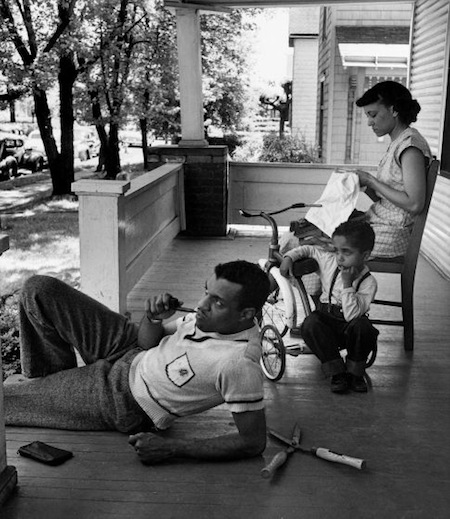
“A Lost Story of Segregated America From LIFE’s First Black Photographer”

https://schristywolfe.com/wp-content/uploads/2015/01/150112-gordon-parks-fort-scott-07.jpg

“When Gordon Parks left his hometown of Fort Scott, Kansas, at the age of 15 in 1928, it was to escape a place he would later call “the mecca of bigotry.” Parks’ mother arranged for her son, the youngest of her 15 children, to live with an older sister in Minnesota, where, she hoped, Gordon would be spared the “bitter trials of Kansas.”
At 37, Gordon Parks returned to Fort Scott, sent by LIFE to photograph the bitter trials of Kansas that his mother had wanted him to escape. But his pictures would never be published, bumped from the magazine by stories deemed more newsworthy.
Now these rarely seen photographs are making their public debut in an exhibit, Gordon Parks: Back to Fort Scott, at Boston’s Museum of Fine Arts, which opens on Saturday, Jan. 17. All but lost for more than half a century, the story behind the photographs is now being told for the first time.”

A Lost Story of Segregated America From LIFE’s First Black Photographer:
http://time.com/3664001/gordon-parks-fort-scott/

Smithsonian Collection: “Remembering Dr. Martin Luther King, Jr.”~
https://schristywolfe.com/2015/01/19/smithsonian-collection-remembering-dr-martin-luther-king-jr/
“Robert Penn Warren Civil Rights Oral History Project”~
https://schristywolfe.com/2015/01/19/robert-penn-warren-civil-rights-oral-history-project/

Frances Benjamin Johnston: Born January 15, 1864

FBJ
“Frances Benjamin Johnston (1864-1952) was one of the first American women to achieve prominence as a photographer. Trained at the Académie Julian in Paris, she studied photography upon her return to Washington, D.C., in the mid-1880s and opened a professional studio circa 1890. Her family’s social position gave Johnston access to the First Family and leading Washington political figures and launched her career as a photojournalist and portrait photographer. Johnston turned to garden and estate photography in 1910s.”
~https://www.loc.gov/pictures/collection/fbj/

Frances Benjamin Johnston~ http://www.cliohistory.org/exhibits/johnston/
Photographs~ http://www.whitehousehistory.org/galleries/frances-benjamin-johnston
Library of Congress~ http://www.loc.gov/rr/print/coll/fbjchron.html

Elizabeth Alexandra Mary: Born April 21, 1926

YoungLIz

Queen Elizabeth II turns 89 today, so I decided to have a look at how she’s been represented visually over the course of time.

She’s been pictured on stamps: http://www.stamp-exchange.co.uk/queen_elizabeth_ii.htm
coinshttps://www.royalmint.com/our-coins/ranges/historic-coins/queen-elizabeth-ii/
banknotes: http://www.pjsymes.com.au/qe2/default.htm
and in paintings: http://www.telegraph.co.uk/news/picturegalleries/royalty/10757562/In-pictures-Painted-portraits-of-Queen-Elizabeth-II.html?frame=2878348

But for me, the most interesting images are the photographs, particularly of the younger Elizabeth, perhaps because the thirties and forties are probably my favorite decades. There’s a wealth of pictures to be found on the internet of Elizabeth, at any age, should one be so inclined.

Her Majesty’s life in photos:
http://www.telegraph.co.uk/news/picturegalleries/royalty/8507797/Long-to-reign-over-us-Queen-Elizabeth-II-in-pictures.html
LIFE magazine, as one would expect, has a large archive which they dip into for their website:
http://time.com/3683145/life-with-elizabeth-ii-rare-and-classic-photos-of-the-queen/

Then of course there’s the way Andy Warhol represented her:
warhol

sexpistolsOr Jamie Reid for the Sex Pistols:

Or a British school child (as found on some random web site):child