As Long As the Waters Flow by Allan Houser
 1989 / Bronze with patina; concrete base / 173″x56″xDiameter 168″
Oklahoma State Capitol, Oklahoma City, OK
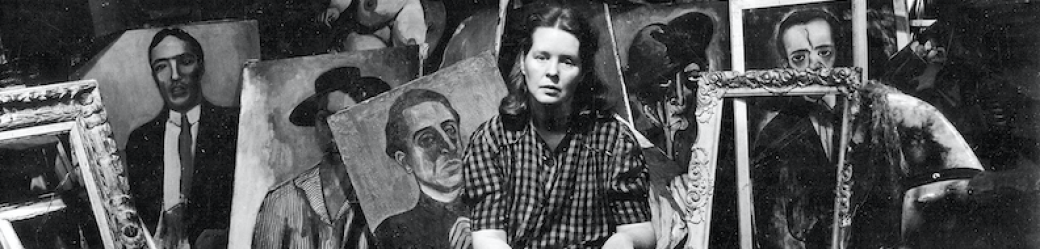
1989 / Bronze with patina; concrete base / 173″x56″xDiameter 168″
Oklahoma State Capitol, Oklahoma City, OK
Although photography was only a hobby for Poolaw, he used a secondhand Speed Graphic camera —the kind that newspapermen used throughout most of the 20th century— to journalistically capture scenes of everyday life on the reservation. His images include ordinary birthday parties and family gatherings, but also stunning portraits of returning military veterans, tribal celebrations and especially the annual American Indian Exposition that still continues in Anadarko.
It was important, [Alexandra] Harris says, that Poolaw worked not as an outsider looking in, but as part of the community.
“There were very few Native photographers in the early to mid-20th century, witnessing their communities, and the diversity of what he saw, as an insider,” she says. [i]
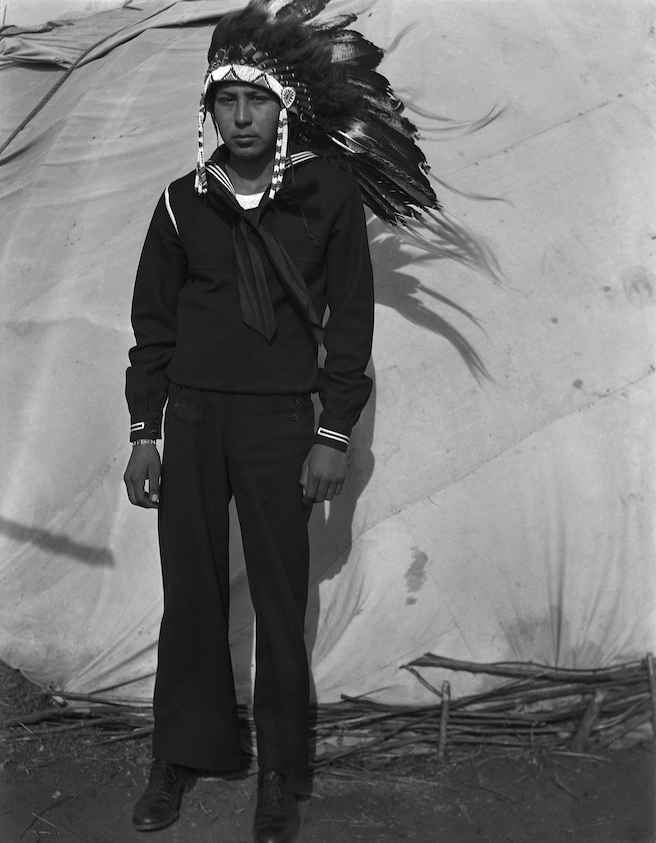 1944 / Photograph / ©Estate of Horace Poolaw
[i] Catlin, Roger. “A Rare Insider’s View of Native American Life in Mid-20th-Century Oklahoma.” Smithsonian.com, November 30, 2016.
https://www.smithsonianmag.com/smithsonian-institution/rare-insiders-view-native-life-mid-20th-century-oklahoma-180961222/
Lois Smoky (1907-1981) joined the Kiowa Six artists in 1928. She was also the only female and the youngest member of the group. Upon her return to Kiowa homelands after only a few short years of painting, she married, raised a family, and became a celebrated beadwork artist. Lois Smoky Kaulaity was often overlooked when the Kiowa Six artists were mentioned in the mid to late 20th century. On an ironic note, Lois Smoky’s art, due to its rarity, is now the most sought after of all the Kiowa Six artists. [i]
 Mid-20th century / Tempera on paper / 9 1/4″x5 11/16″ / Gilcrease Museum, Tulsa, OK
[i] “The Kiowa Six.” The Jacobson House. nd. https://www.jacobsonhouse.art/kiowasix
Tsireh, also known by his Spanish name, Alfonso Roybal, decorated pottery as a young man on the San Ildefonso Pueblo near Santa Fe, New Mexico. Later, at the encouragement of Anglo patrons, he translated the forms and symbols of his pottery designs into watercolor paintings on paper. His stylized forms echoed the Art Deco aesthetic that was so popular between the two world wars, and his linear compositions appealed to modernist sensibilities. [i]
Mystical Bird (Mythical Bird)
c.1940 / Watercolor / Herbert F. Johnson Museum of Art, Cornell University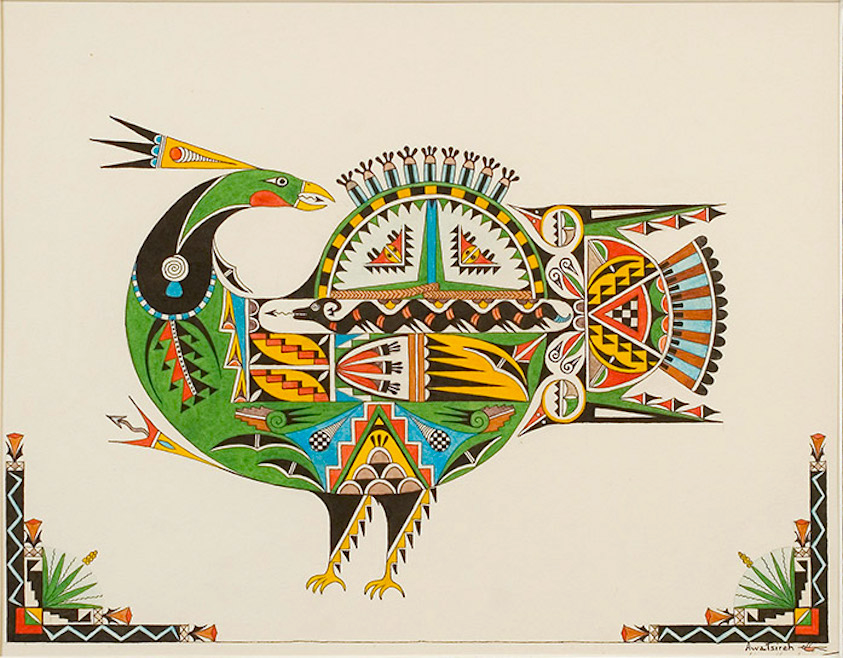
 Silver Brooch in the Form of a Skunk
1930s–40s / Private collection
[i] “The Modern Pueblo Painting of Awa Tsireh.” Smithsonian American Art Museum, 2015
https://americanart.si.edu/exhibitions/tsireh
Tonita Vigil Peña (1893-1949) Quah Ah (“White Coral”) was the only woman in the group of talented early pueblo artists referred to as The San Ildefonso Self-Taught Group. The famous group included such noted artists as Julian Martinez, Alfonso Roybal, Abel Sanchez, Crecencio Martinez, and Encarnación Peña.
By the time Tonita was 25 years old, she was a successful easel artist, and her work was being shown in museum exhibitions and in commercial art galleries in Santa Fe and Albuquerque. She painted what she knew best – scenes of life at the pueblo – mostly ceremonial dances and everyday events. She is still considered one of the best female Indian artists of all time. [i]
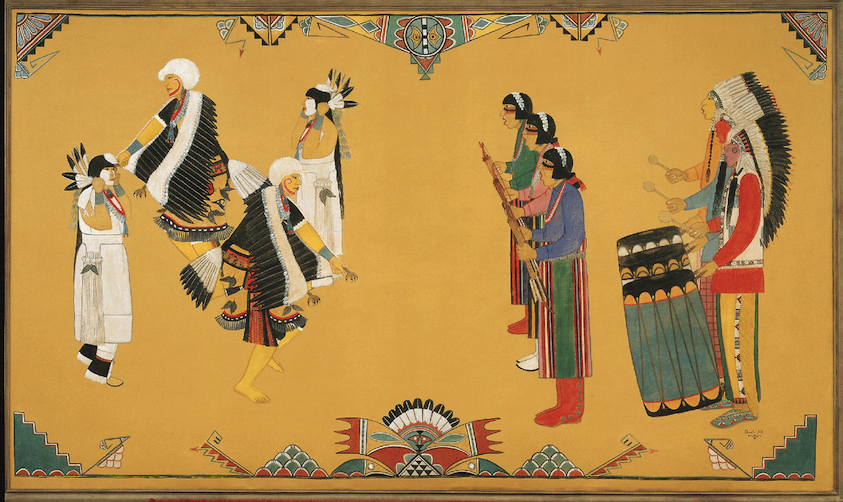 1934 / Painted mural / 70″x110″ / National Cowboy & Western Heritage Museum, Oklahoma City, OK
[i] “Tonita Vigil Peña (Quah Ah), San Ildefonso Pueblo Painter.” Adobe Gallery Art of the Southwest Indian, nd. https://www.adobegallery.com/artist/Tonita_Pea_1893-19491488218
Since there were no schools on the mesa, Lewis received no formal education or art classes. She learned pottery as a young child from her great-aunt and other Acoma Pueblo women. Lewis was instrumental in reviving eleventh-century, Mimbres-style pottery, characterized by black lines on white slip. [i]
Lewis initially produced unsigned objects with traditional Acoma designs and sold them along nearby highways like the historic Route 66. She began signing her pottery, however, as her personal style developed and she incorporated new interpretations of traditional designs and patterns. [ii]
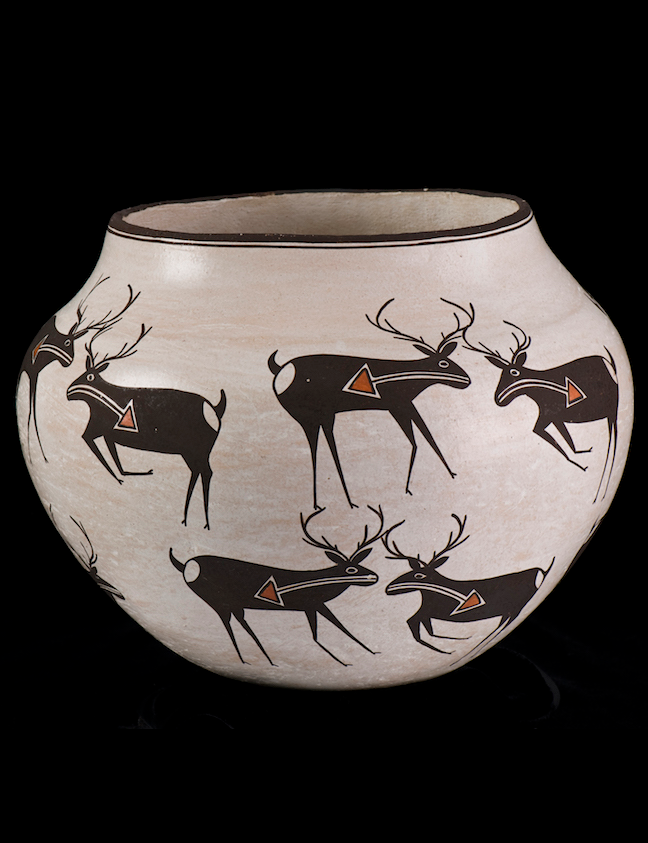 1968 / Earthenware / Dimensions not available
National Cowboy & Western Heritage Museum, Oklahoma City, OK
[i] “Lucy M. Lewis: Artist Profile.” National Museum of Women in the Arts, 2026. nmwa.org/art/artists/lucy-m-lewis/
[ii] “Lucy M. Lewis.” Smithsonian American Art Museum. https://americanart.si.edu/artist/lucy-m-lewis-2919
Typical of Native artists of his era, Spybuck used a simplified three-dimensional style, but his images were realistic and provided a central scene in perspective, with well-defined foreground and background. He did not use the flat, neutral-background style of other Indian artists. His paintings often recorded scenes he observed while attending ceremonies or social gatherings. The scenes are full of detail and portray both modern and traditional aspects of early-twentieth-century tribal life in his part of Oklahoma. [i]
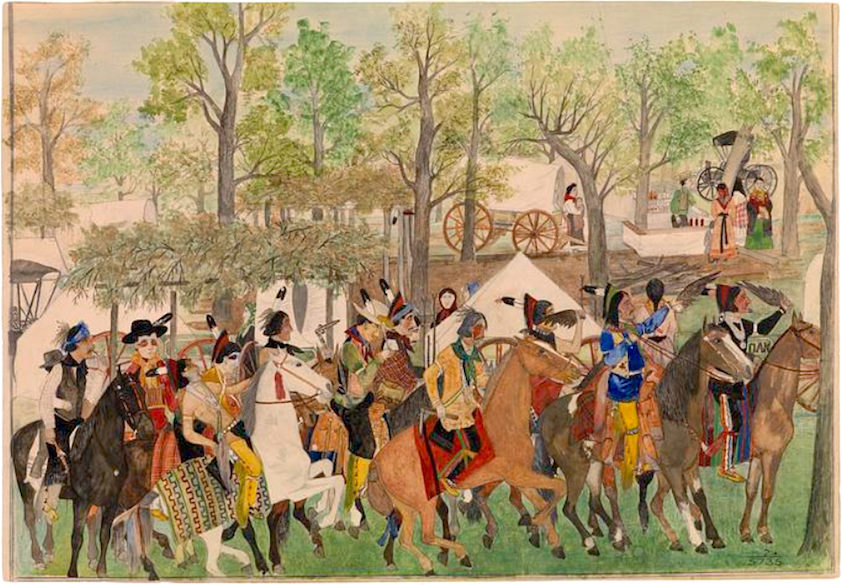 c.1908 / Graphite, watercolor, paperboard / 17 1/3″x25 1/5″
Smithsonian National Museum of the American Indian, DC
[i] Gettys, Marshall. “SPYBUCK, ERNEST (1883–1949).” The Encyclopedia of Oklahoma History and Culture, 2010 https://www.okhistory.org/publications/enc/entry?entry=SP017
Born in Marengo, Washington in 1882, Richard Throssel was of Canadian Cree, Scottish and English Heritage. He moved to the Crow Reservation in 1902 to join his brother as a clerk in the Indian Service office.
Throssel was an aspiring photographer and was influenced by several of the artists he met on the reservation, such as painter Joseph Henry Sharp and photographer Edward S. Curtis. However, unlike these other artists, Throssel was adopted into the Crow tribe in 1906. [i]
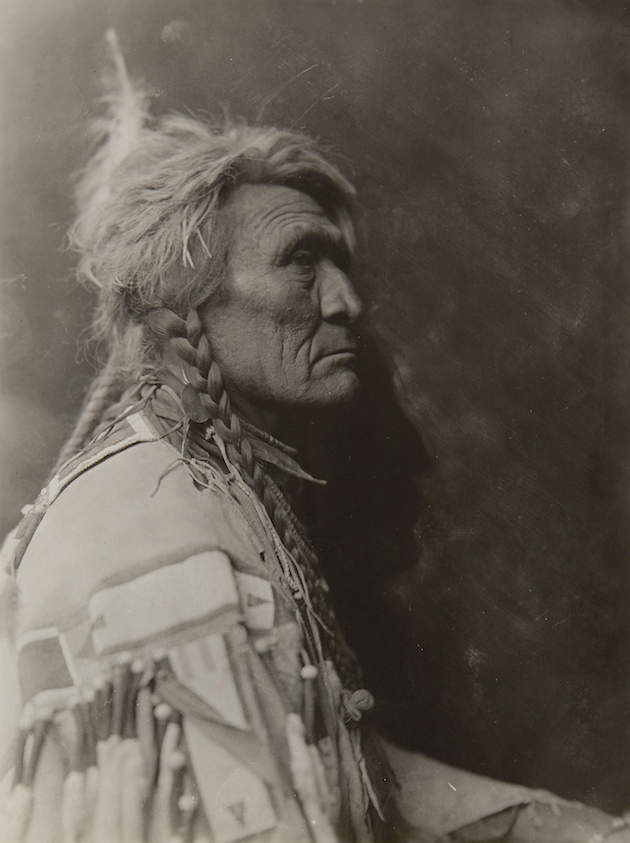 c.1910 / Gelatin silver print from 6 1/2″x8 1/2″ glass plate negative
Various collections including Museum of Photographic Arts, San Diego, CA
[i] “TBT-Richard Throssel.” Sheridan Community Land Trust, November 30, 2023.
https://sheridanclt.org/projects/tbt-richard-throssel-2/
Sweezy was a Southern Arapaho painter from Oklahoma. He painted individual portraits, but was best known for his portrayals of ceremonies and dances. His Arapaho name was Wattan, meaning “Black.”
Around 1895, when Sweezy was 14 years old, ethnographer James Mooney commissioned Sweezy to paint images of traditional Arapaho life. Later, Sweezy also worked with anthropologist George Dorsey…By the 1920s Sweezy was a full-time painter. [i]
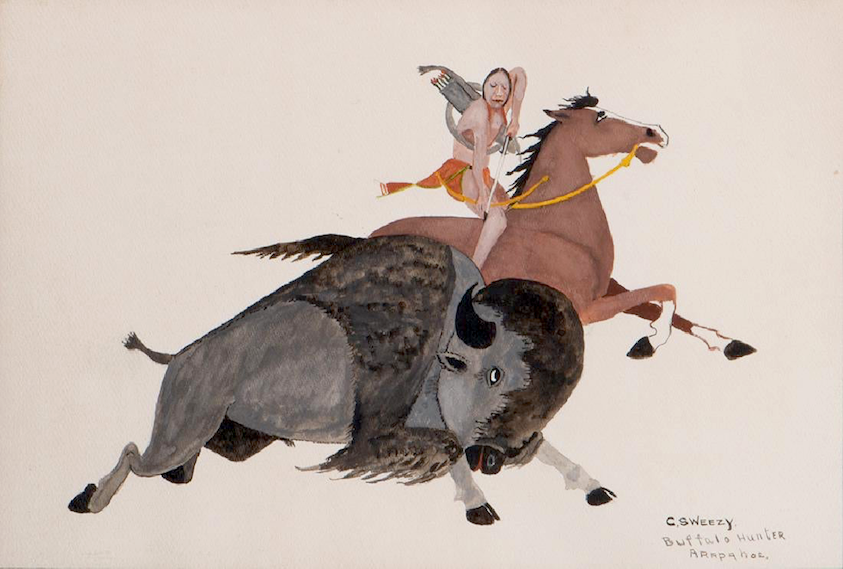 No date / Watercolor on paper / 13 1/2″x20″ / Private collection
[i] Philbrook Museum of Art. “Artist Info_Carl Sweezy,” 2026. Philbrook Museum of Art Collections.
https://philbrook.emuseum.com/people/objects/375
Cobb’s time as a photographer was brief — the majority of her work comes from a three-year period between 1902 and 1905, after which she put down her box camera to focus on her work as a teacher at Cherokee Nation public schools. Her surviving photographs have secured her reputation as the first-known female Native American photographer in Indian Territory…[i]
 c.1902 / Photograph / Dimensions not available / Oklahoma Historical Society, Oklahoma City, OK
[i] Chavez, Will. “Images from the First-Known Native American Female Photographer.” High Country News, March 25, 2022.
https://www.hcn.org/issues/54-4/indigenous-affairs-photos-images-from-the-first-known-native-american-female-photographer/

