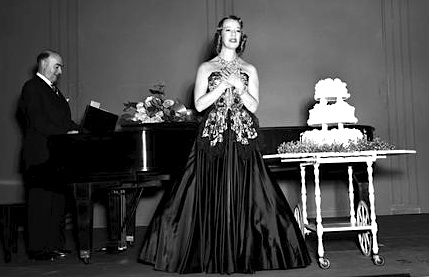
Lily Pons: Born on April 12, 1898

Few opera stars have led such an impressive career. For over a quarter of a century, her coloratura voice captured the stages of Paris, London, Buenos Aires, Mexico, and the United States. Like Mario Lanza and Luciano Pavarotti, she acted in second-rate films about opera stars, which were surprisingly well-attended.

Her sweet soprano voice had an extremely high tessitura. It was said she could hold a high D for about a minute. The Metropolitan Opera revived roles especially for her, like Delibes’ Lakmé, Donizetti’s La Fille du Regiment, and Rimsky-Korsakov’s Le Coq d’or.
FROMhttp://www.classical.net/music/recs/reviews/s/sny60655a.php

In 1932, the tiny Frederick County post office of Lilypons opened for business. “It was a dot on a map, because nobody has ever been quite sure what to call it. Lilypons, Md., was never a city, town or even a hamlet,” said The Evening Sun in 1986. “It is now what it has always been: one frame building surrounded by a small cluster of ponds nestled into a bdaycakepeaceful crook of the Monocacy River eight miles south of Frederick.” In 1963, during a period of cost cutting, the Postal Service discontinued the Lilypons postmark and combined its functions with the nearby Buckeystown post office. A plaque commemorating the tiny post office was mounted on the building in 1986. ~Fred Rasmussen FROMhttps://www.baltimoresun.com/
Eadweard Muybridge: Born April 9, 1830

Yosemite

Photographs of Yosemite~
http://www.yosemite.ca.us/library/yosemite_its_wonders_and_its_beauties/list_of_photographs.html
Biography~ http://www.iphf.org/hall-of-fame/eadweard-muybridge/
BBC Documentary~ https://youtu.be/5Awo-P3t4Ho

Before his death in 1903, Muybridge would emigrate to America, change his name three times, come close to death and suffer brain damage in a carriage accident. Perhaps most sensationally, he would also be acquitted for the murder of Major Harry Larkyns, his wife’s lover, and the true father of his presumed son Floredo Helios Muybridge.
In fact, Muybridge enjoyed a professional life which may even have surpassed his sensational personal biography. He gained fame through adventurous and progressive landscape photography before working as a war and official government photographer; something which took him from the Lava beds of California during the Modoc War to Alaska and Central America.
Furthermore, Muybridge was instrumental in the development of instantaneous photography. To accomplish his famous motion sequence photography, Muybridge even designed his own high speed electronic shutter and electro-timer, to be used alongside a battery of up to twenty-four cameras!
While Muybridge’s motion sequences helped revolutionise still photography, the resultant photographs also punctuated the history of the motion picture. Muybridge actually came tantalisingly close to producing cinema himself with his projection device the ‘Zoöpraxiscope’.
Research resource~ http://www.eadweardmuybridge.co.uk/

April 9, 1939: Marian Anderson’s Easter Sunday Lincoln Memorial concert


Marian Anderson, contralto, was denied the right to perform at Constitution Hall by the DAR because of her color. Instead, and at the urging of Eleanor Roosevelt, Harold Ickes permitted her to perform at the Lincoln Memorial on April 9, 1939.

Denied A Stage, She Sang For A Nation~
https://www.npr.org/2014/04/09/298760473/denied-a-stage-she-sang-for-a-nation
Marian Anderson: Musical Icon~
https://www.pbs.org/wgbh/americanexperience/features/eleanor-anderson/
Marian Anderson Biography~https://www.biography.com/musician/marian-anderson

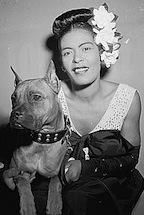
Billie Holiday: April 7, 1915-July 17, 1959

withDog“Billie Holiday was the daughter of Clarence Holiday. Her early life is obscure, as the account given in her autobiography, Lady Sings the Blues, is self-serving and inaccurate.

At some point after 1930, she began singing at a small club in Brooklyn, and in a year or so moved to Pods’ and Jerry’s, a Harlem club well known to jazz enthusiasts. In 1933, she was working in another Harlem club, Monette’s, where she was discovered by the producer and talent scout John Hammond. Hammond immediately arranged three recording sessions for her with Benny Goodman and found engagements for her in New York clubs.
FROM~ http://www.pbs.org/jazz/biography/artist_id_holiday_billie.htm

BHolidayStrange Fruit: the first great protest song~ http://www.theguardian.com/music/2011/feb/16/protest-songs-billie-holiday-strange-fruit

The Guardian~“Billie Holiday’s centenary: a life in pictures”
http://www.theguardian.com/music/gallery/2015/apr/07/billie-holidays-centenary-a-life-in-pictures

SFGate~“Billie Holiday at 100: Artists reflect on jazz singer’s legacy”
http://www.sfgate.com/music/article/Billie-Holiday-at-100-Artists-reflect-on-jazz-6177350.php

Looking For Lady Day’s Resting Place? Detour Ahead~ http://www.npr.org/2012/07/17/156686608/looking-for-lady-days-resting-place-detour-ahead

Arturo Toscanini: Born on March 25, 1867

https://www.gramophone.co.uk/musicians/artist/arturo-toscanini-47225

Perhaps the most internationally famous conductor ever, Toscanini rose to instant stardom when he put down his cello and jumped up to the podium to fill in for the conductor during a performance of Verdi’s opera Aida. It was 1886; he was 19, and it was the first time he’d ever conducted.

The last time he’d conduct a live performance was in 1954, 68 years later. By then, he was the first conductor to have appeared regularly on television, and was certainly considered the first true media star of the conducting world.
http://www.npr.org/templates/story/story.php?storyId=89059352

March 17: National Gallery of Art in Washington, D.C.

The National Gallery of Art was created by a joint resolution of
Congress on March 17, 1937, and dedicated on March 17, 1941

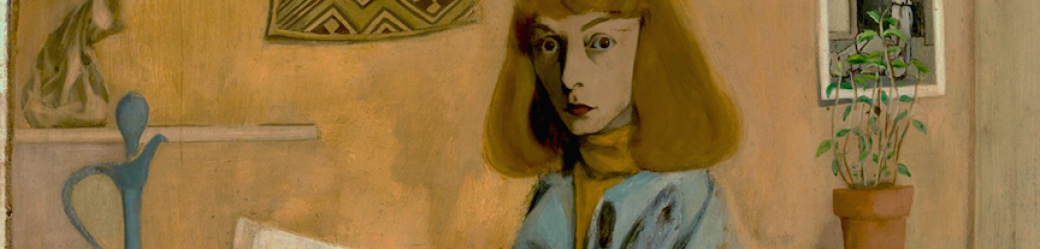
Leonardo da Vinci_Ginevra deBenciThe National Gallery of Art was conceived and given to the people of the United States by Andrew W. Mellon (1855–1937). Mellon was a financier and art collector from Pittsburgh who came to Washington in 1921 to serve as secretary of the treasury. During his years of public service he came to believe that the United StatesJames McNeill Whistler_Symphony in White No1 should have a national art museum equal to those of other great nations.
In 1936 Mellon wrote to President Franklin D. Roosevelt offering to donate his superb art collection for a new museum and to use his own funds to construct a building for its Duccio di Buoninsegna_The Nativity with the Prophets Isaiah and Ezekieluse. With the president’s support, Congress accepted Mellon’s gift, which included a sizable endowment, and established the National Gallery of Art in March 1937. Construction began that year at a site on the National Mall along Constitution Avenue between Fourth and Seventh Street NW, near the foot of Capitol Hill.Arshile Gorky_The Artist and His Mother


Construction was completed by December 1940, and works of art were installed in the new galleries over the following months. The National Gallery of Art was dedicated on March 17, 1941, with Paul Mellon presenting the museum on behalf of his father, and President Franklin D. Roosevelt accepting the gift for the nation.
FROM http://www.nga.gov/content/ngaweb/about.html

dedicationFDR’s Speech on the Dedication of the National Gallery of Art~
http://www.nga.gov/content/ngaweb/audio-video/audio/west-building-dedication-president-fdr.html

Highlights from the collection~
http://www.nga.gov/content/ngaweb/Collection/highlights.html
75th anniversary programs~
http://www.nga.gov/content/ngaweb/about/seventy-fifth-anniversary.html

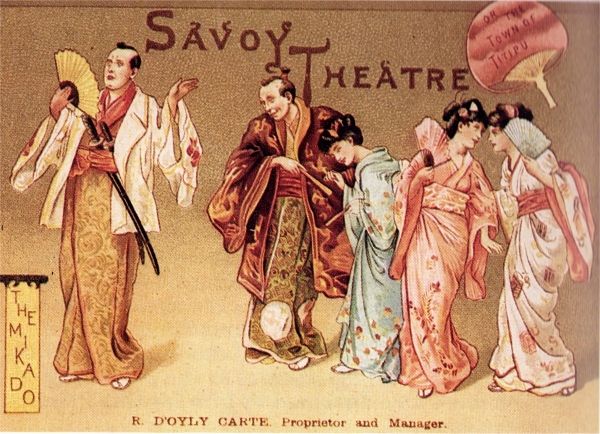
Premiered March 14, 1885: “The Mikado”

Mikado-Savoy-1885“Yes, as we said to begin with, “The Mikado” is a frank success. It is great nonsense, no doubt; but then it is the very funniest fooling to be seen. And so pretty, too!”  ~unsigned review from “The Academy”, March 28 1885  http://www.savoyoperas.org.uk/mikado/mik3.html

“Mr. Gilbert has once more exhibited his facility for seizing upon a subject occupying a considerable share of public attention, and turning it to humorous account. Japanese art is extremely fashionable just at present, and the manners and customs of this strange race may be studied with advantage at Knightsbridge. But it is our home political and social life that is principally caricatured in ‘The Mikado,’ and amid much that is incisive and telling we find obvious reminiscences of earlier productions by the same hand.”
~unsigned review from “The Athenæum”, March 21 1885
http://www.savoyoperas.org.uk/mikado/mik2.html