Salmagundi

Lovers Walking in the Snow (Crow and Heron) by Suzuki Harunobu

1764–72 / Polychrome woodblock print; ink and color on paper, with embossing / 11 1/4”x8 1/8” / The Met

Courtesan Senri Receiving a Love Letter

Suzuki Harunobu (1725?-1770) “played a pivotal role in the evolution of Japanese printmaking during its great period — the last half of the i8th and the first years of the 19th century. In the final years of his relatively brief life, he opened up a new dimension of expression in that tradition of graphics by introducing many colors to what had essentially been a mono-chromatic art form”. ~archive.org

A Woman Sweeping up Her Love Letters

“Just 20 years previously, the invention of benizuri-e had made it possible to print in three or four colors; Harunobu applied tis new technique to ukiyo-e prints using up to ten different colors on a single sheet of paper. Harunobu was the first ukiyo-e artist to consistently use more than three colors in each print.” ~Wikipedia

A Caged Bird and a Love Letter

“Harunobu died in 1770, only five years after introducing the nishiki-e print. However, in those last few years of his life, he produced over one thousand print designs, chiefly depictions of willowy young girls, and also a fair percentage of shunga (erotic prints), as most ukiyo-e artists did. He is known to have produced at least seven shunga volumes.”~samuraipodcast.com
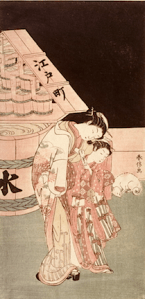
Suzuki Harunobu / ukiyo-e.org
_________________________________

(Learn more by clicking on hyperlinks embedded in text)

Salmagundi

Dorothea Lange [War]Lange

Mules

Biographies:
International Photography Hall of Fame and Museum~ http://www.iphf.org/hall-of-fame/dorothea-lange/
PBS~ http://www.pbs.org/video/2365971488/

Three months after Pearl Harbor, President Franklin Roosevelt ordered the relocation of Japanese-Americans into armed camps in the West. Soon after, the War Relocation Authority hired [Dorothea Lange (1895-1965)] to photograph Japanese neighborhoods, processing centers, and camp facilities.

To capture the spirit of the camps, Lange created images that frequently juxtapose signs of human courage and dignity with physical evidence of the indignities of incarceration. Not surprisingly, many of Lange’s photographs were censored by the federal government, itself conflicted by the existence of the camps.

The true impact of Lange’s work was not felt until 1972, when the Whitney Museum incorporated twenty-seven of her photographs into Executive Order 9066, an exhibit about the Japanese internment. New York Times critic A.D. Coleman called Lange’s photographs “documents of such a high order that they convey the feelings of the victims as well as the facts of the crime.”
FROM http://www.loc.gov/exhibits/wcf/wcf0013.html

FatherSonNational Archives~ https://www.archives.gov/news/articles/japanese-internment-75th-anniversary
National Park Service~ https://www.nps.gov/manz/learn/photosmultimedia/dorothea-lange-gallery.htm

(Learn more by clicking on embedded hyperlinks)

Salmagundi

Victory Gardens [War]

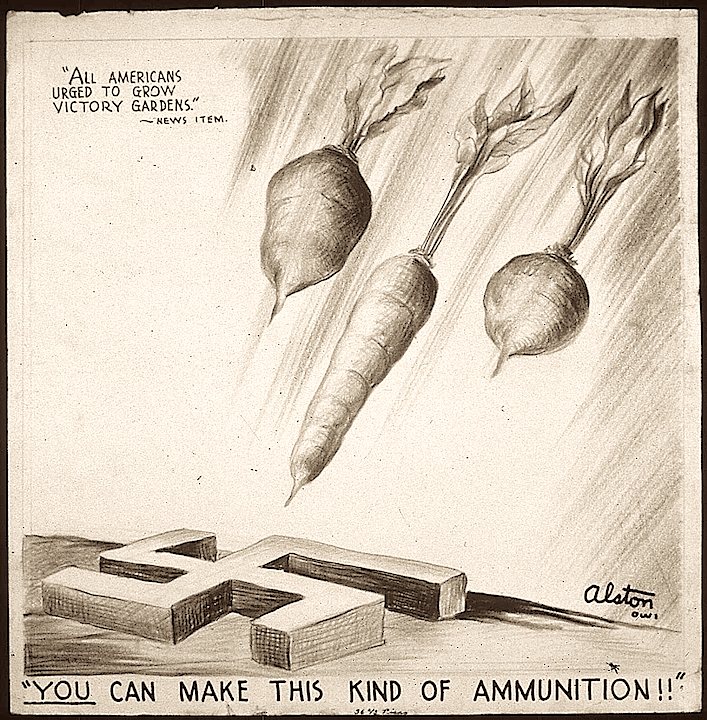
During World War I, Liberty Gardens (and later, Victory Gardens) grew out of the government’s efforts to encourage home gardening among Americans, both to express their patriotism and to aid the war effort by freeing up food production for soldiers. ~cbsnews.com
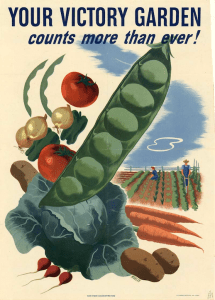
As part of the (World War II) effort, the government rationed foods like sugar, butter, milk, cheese, eggs, coffee, meat and canned goods. Labor and transportation shortages made it hard to harvest and move fruits and vegetables to market. So, the government turned to its citizens and encouraged them to plant “Victory Gardens.” They wanted individuals to provide their own fruits and vegetables. ~livinghistoryfarm.org
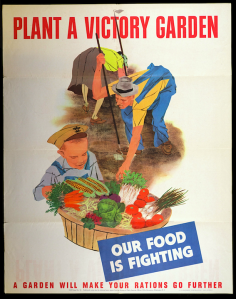
Americans were encouraged to grow their own to ensure everyone at home had enough to eat…There were 20 million gardens everywhere from rooftops and empty lots to backyards and schoolyards. 40% of produce, which made over 1 million tons, consumed in America was grown in victory gardens. People learned how to can and preserve so the harvests lasted all year. ~nww2m.com

(Learn more by clicking on links in the images and text)

Salmagundi

Weddings in the Renaissance

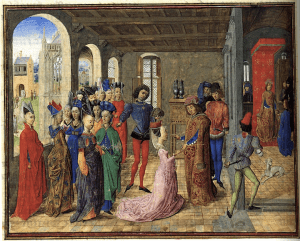
The scholars Silvana Seidel Menchi and Diego Quaglion…provide startling information demonstrating just how informal the act of marriage could be and how it could take place in almost any location. “With the assistance of a ladder, the groom, flanked by witnesses, reached the bride, and facing each other they pronounced the formula of the ritual, balanced in an equilibrium as unstable as the tie that thus bound them.” Indeed, before the edicts of The Council of Trent systematized the requirements of a proper wedding in 1563, only mutual consent was an absolute necessity for marriage. FROM Art and Love in Renaissance Italy / MetPublications /
The Metropolitan Museum of Art

(Learn more by clicking on hyperlinks embedded in text)

Salmagundi

Sir Winston Churchill by Ernest Hamlin Baker
[War]

1949 / Gouache, ink and graphite pencil on paperboard / 11 3/4”x10 1/2″

Ernest Baker, born in 1889 in Rhode Island, was a self-taught illustrator. Most of his works were covers for Time magazine, although he was responsible for eleven covers for Fortune magazine between 1929 and 1941.

Beginning in 1939, Baker produced over 300 covers for Time during his seventeen-year tenure with the magazine. He was described by Time publisher, Ralph Ingersoll, as an artist who could do anything.
http://www.askart.com/artist_bio/Ernest_Hamlin_Baker/28830/Ernest_Hamlin_Baker.aspx

In December of 1949, Winston Churchill was chosen by Time magazine as the “Man of the Half-Century”, celebrated in a 16-page supplement which was contained in the January 2nd issue of 1950. Baker did the cover illustration for that issue.

This slideshow requires JavaScript.

(Learn more by clicking on embedded hyperlinks)

Salmagundi

Hannah Höch: Love

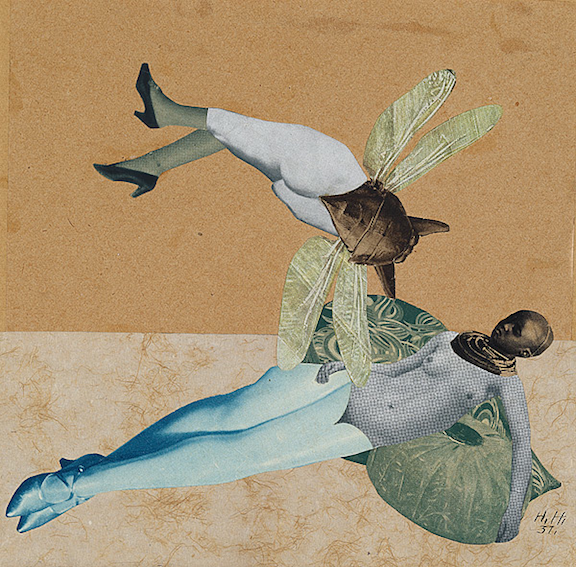
Liebe [Love] / 1931 / Drawing, collage / 8.5”x8.25” / National Gallery of Australia

Hannah Höch was a German Dada artist. She is best known for her work of the Weimar period, when she was one of the originators of photomontage.  FROM monoskop.org

While she may have been remembered by her bombastic Dada colleagues for her “sandwiches, beer and coffee”, her lifetime of artistic practice reveals a vital and critical woman who could magically collide disparate reproductions of needlepoint patterns, political figures, film stars, animal life and non-Western artifacts into explorations of androgyny, Aryan activity, gender roles, imperialism, race and lesbianism.  FROM frieze.com

The Coquette I (1923-1925)

Hoch began the Love series as early as 1923, and worked on it intermittently through about 1931. Each of the six or seven works in this series depict sexuality in some way. My understanding is that the following pieces were in this series:

Love in the Bush (1925)
Peasant Wedding Couple (1931)
Love (1926)
Love (1931)
The Coquette I (1923-1925)
The Coquette II (c.1925)
The Large Step (1931)

MoMA’s catalog for their 1997 exhibition “The photomontages of Hannah Höch” is available to download in pdf format~
https://www.moma.org/calendar/exhibitions/241

Love (1926)

(Learn more by clicking on embedded hyperlinks)

Salmagundi

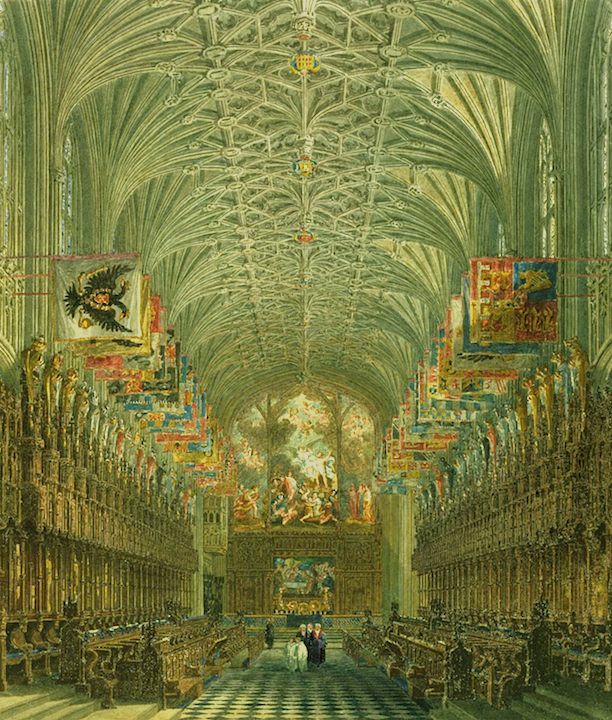
Windsor Castle: The Quire of St George’s Chapel by Charles Wild

1818 / Watercolor and bodycolour over pencil / 9.8”x8.3” / Royal Collection

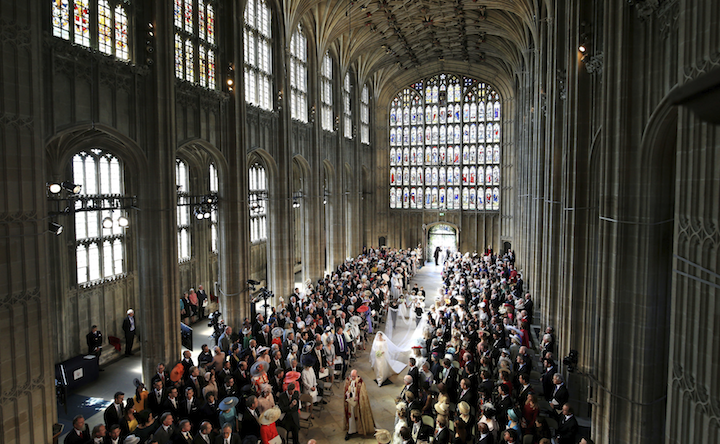
Prince Harry and Meghan Markle at St. George’s Chapel in Windsor Castle in Windsor, near London, England, Saturday, May 19, 2018. (Danny Lawson/pool photo via AP)

On May 19, 2018, Prince Harry and Meghan Markle’s wedding took place in St George’s Chapel, Windsor Castle. Prince Harry was baptised in St George’s Chapel in December, 1984.
FROM https://www.stgeorges-windsor.org/news/royal-wedding-2/

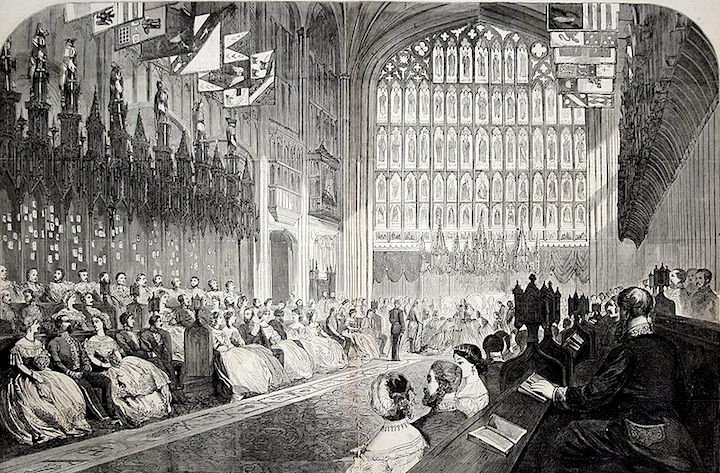
Engraved illustration from Harper’s Weekly newspaper of the wedding of the Prince of Wales (later King Edward VII) and Alexandra of Denmark / Harper’s Weekly newspaper dated 11 April 1863 / Artist unknown

St. George’s Chapel was built in the 15th century and is a towering piece of Gothic architecture. It is lauded for its stone fan-vault ceilings, but the intricate stained glasswork along each of its walls, and the tall arched windows, intricate woodwork, and ironwork doorframes add to the historic feel of the grand room. The tombs of ten sovereigns also lie within the chapel, including Henry VIII and Charles I. FROM https://www.architecturaldigest.com/story/prince-harry-and-meghan-markle-will-marry-at-st-georges-chapel-at-windsor-castle-this-may

(Learn more by clicking on hyperlinks embedded in text)

Salmagundi

Mathew Brady [War]

Mathew Brady is often referred to as the father of photojournalism and is most well known for his documentation of the Civil War. His photographs, and those he commissioned, had a tremendous impact on society at the time of the war, and continue to do so today. He and his employees photographed thousands of images including battlefields, camp life, and portraits of some of the most famous citizens of his time including Abraham Lincoln and Robert E. Lee.
https://www.battlefields.org/learn/biographies/mathew-brady

The Civil War as Photographed by Mathew Brady~
http://www.archives.gov/education/lessons/brady-photos/


(Learn more by clicking on embedded hyperlinks)

Salmagundi

Frida Kahlo and Diego Rivera: Love and War

Two years after [her] accident, in 1927, [Kahlo] met the painter Diego Rivera, whose work she’d come to admire and who became her mentor. In 1929, despite the vocal protestations of Kahlo’s mother, Frida and Diego were wedded and one of art history’s most notoriously tumultuous marriages commenced. 
FROM https://www.brainpickings.org/2013/04/19/frida-kahlo-diary-love-letters/

Kahlo…believed that her relationship with Rivera transcended the bodily, physical, even painterly world. “It’s not love, or tenderness, or affection, it’s life itself, my life, that I found when I saw it in your hands, in your mouth and in your breasts,” she [wrote] to him. “I have the taste of almonds from your lips in my mouth. Our worlds have never gone outside. Only one mountain can know the core of another mountain.”
FROM https://www.artsy.net/article/artsy-editorial-frida-kahlos-love-letters-diego-rivera-reveal-volatile-relationship

(Learn more by clicking on the embedded hyperlinks above)

This slideshow requires JavaScript.

Salmagundi

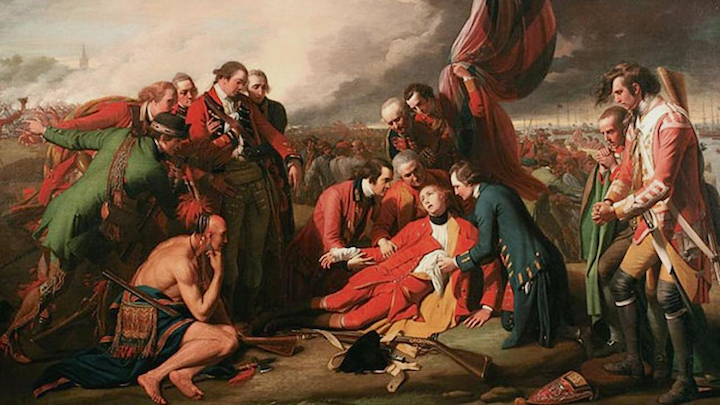
The Death of General Wolfe by Benjamin West

On September 13, 1759, during the Seven Years’ War (1756-63) [known in the United States as the French and Indian War], the British General James Wolfe achieved a dramatic victory; Wolfe was fatally wounded during the battle, but his victory ensured British supremacy in Canada.
https://www.history.com/topics/native-american-history/battle-of-quebec-1759

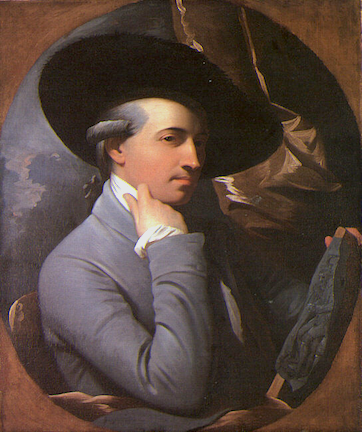
Benjamin West, Self-portrait 1770

Besides the original, at least four other additional versions of The Death of General Wolfe were also produced by West. The primary copy of The Death of General Wolfe is currently in the collection of the National Gallery of Canada, with further examples at the Royal Ontario Museum (Canadiana art collection), as well as the University of Michigan Museum of Art. The fourth copy produced resides at Ickworth House, Suffolk, England. Each reproduction had its own variation in the depiction of Wolfe’s death. A fifth autograph copy was commissioned by George III in 1771 and is still in the Royal Collection.
FROM https://en.wikipedia.org/wiki/The_Death_of_General_Wolfe

(Learn more by clicking on embedded hyperlinks)