Ringo Starr: Born on July 7, 1940

youngRingo

While some accused Ringo Starr of being a clumsy drummer, many more agreed with George Harrison’s assessment: “Ringo’s the best backbeat in the business.” And while many in the wake of the youngerRingoBeatles’ breakup predicted that Starr would be the one without a solo career, he proved them wrong. Not only has he released several LPs (the first came out before the Beatles disbanded) and hit singles, but he’s also the only Beatle to establish a film-acting career for himself outside of the band’s mid-’60s movies.
http://www.rollingstone.com/music/artists/ringo-starr

Anybody who knows the Beatles’ music intimately knows the tympanic accents and fills as clearly today as when they were recorded: the famous drum roll that launches into “She Loves You”; the shimmering incandescence of his cymbal work on so many of those early hits; the impressionistic free-form of “Rain”; the loping cadence and crispy snare of “Sexy Sadie”; the haunting, almost cinematic drama and rich texture behind “Long, Long”; the building, tour-de-force crescendo that leads up to the “The End” on “Abbey Road.”

“Here’s what I discovered in the very first session that I did with him,” recalls Walsh. “He came in and I oldRingosaid, ‘You want to see a chart on the song?’ And he said, ‘No, give me the lyrics.’ He responds to the singer. A great example of that is when he plays on the Beatles’ ‘Something’ and he does that fill that’s such a musical response it’s almost like a guitar player; there’s notes to it.”
http://variety.com/2014/music/news/ringo-starr-paul-mccartney-beatles-1201073353/

olderRingo

The United States of America: Born July 4, 1776

painting

This painting depicts the moment on June 28, 1776, when the first draft of the Declaration of Independence was presented to the Second Continental Congress.

This is the first completed painting of four Revolutionary-era scenes that the U.S. Congress commissioned from John Trumbull (1756–1843) in 1817. It is an enlarged version of a smaller painting (approximately 21 inches by 31 inches) that the artist had created as part of a series to document the events of the American revolution.

When Trumbull was planning the smaller painting in 1786, he decided not to attempt a wholly accurate rendering of the scene; rather, he made his goal the preservation of the images of the Nation’s founders. He excluded those for whom no authoritative image could be found or created, and he included delegates who were not in attendance at the time of the event. In all, 47 individuals (42 of the 56 signers and 5 other patriots) are depicted, all painted from life or life portraits. Some of the room’s architectural features (e.g., the number and placement of doors and windows) differ from historical fact, having been based on an inaccurate sketch that Thomas Jefferson produced from memory in Paris. Trumbull also painted more elegant furniture, covered the windows with heavy draperies rather than venetian blinds, and decorated the room’s rear wall with captured British military flags, believing that such trophies were probably displayed there.
http://www.aoc.gov/capitol-hill/historic-rotunda-paintings/declaration-independence

Anne Frank: Born June 12, 1929

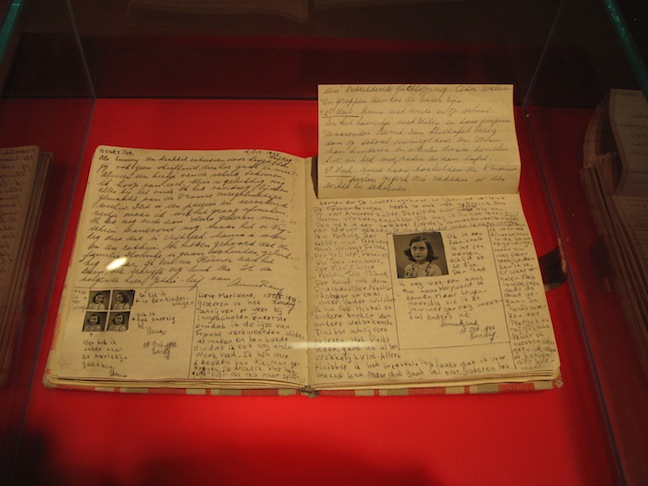
Anne_Frank_Diary_at_Anne_Frank_Museum_in_Berlin-pages-92-93Photograph: Anne_Frank_Diary_at_Anne_Frank_Museum_in_Berlin-pages-92-93.jpg
Source: http://www.heatheronhertravels.com/inspired-by-the-anne-frank-museum-in-berlin/

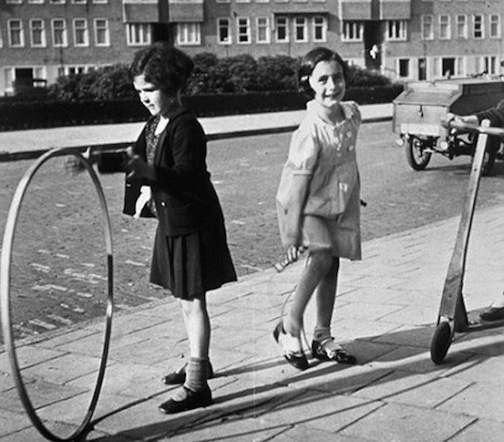
hoopSince it was first published in 1947, Anne Frank’s diary has become one of the most powerful memoirs of the Holocaust. Its message of courage and hope in the face of adversity has reached millions. The diary has been translated into 67 languages with over 30 million copies sold. Anne Frank’s story is especially meaningful to young people today. For many she is their first, if not their only exposure to the history of the Holocaust. https://annefrank.com/about-afc/about-anne-frank/

© Anne Frank Haus / Anne Frank Fonds

© Anne Frank Haus / Anne Frank Fonds

Anne Frank and Her Family~ http://www.holocaustresearchproject.org/nazioccupation/annefrank.html

The Secret Annex Online~ http://www.annefrank.org/en/Subsites/Home/Enter-the-3D-house/#/house/20/help/

George Szell: Born June 7, 1897

1978 SPECIAL CITATION for distinguished service to the arts (Posthumous)~
http://clevelandartsprize.org/awardees/george_szell.html

NAXOS: George Szell~ http://www.naxos.com/person/George_Szell_38224/38224.htm

Born: June 7, 1897 – Budapest, Hungary
Died: July 30, 1970 – Cleveland, Ohio, USA

Part of the wave of great Hungarian conductors who took over American musical life just before and after World War II — the others included Fritz Reiner, Antal Dorati, and Eugene Ormandy — George Szell quickly transformed a middling Midwestern orchestra into one of the nation’s Big Five. His cultivation of the Cleveland Orchestra set an example of discipline and hard work that gradually helped raise the standards of orchestras across America.
FROM https://www.allmusic.com/artist/george-szell-mn0000366341/biography

Benny Goodman: Born May 30, 1909

AlbumCover

YoungBGBefore he was in his teens, Goodman had begun performing in public…Goodman’s precocious talent allowed him to become a member of the American Federation of Musicians at the age of 14 and that same year he played with Bix Beiderbecke. By his mid-teens Goodman was already established as a leading musician, working on numerous engagements with many bands to the detriment of his formal education.
FROM http://biography.just-the-swing.com/benny-goodmanOrchestra

The second band that he formed (in 1934) got a job at Billy Rose’s Music Hall. This band made some great recordings and began appearing on the 3-hour NBC radio program called “Let’s Dance.”

After this, the Benny Goodman Orchestra began touring (with not so fantastic results) until August 21, 1935, when the Benny Goodman Orchestra opened in the Palomar Ballroom in Los Angeles. After playing a few dance tunes, he told the band to play some Fletcher Henderson arrangements. The mostly young crowd promptly started something of a riot. After this public approval of the music – this thing called “Swing” – there was no looking back!
FROM http://www.touchoftonga.com/DavidMulliss/benny-goodman.html

OlderBGBenny did for clarinet what Louis Armstrong had done for the trumpet.  He gave it a newly assertive leadership role in the jazz ensemble.
FROM http://jazzhotbigstep.com/45801.html

Benny Goodman Discography: http://www.discogs.com/artist/254768-Benny-Goodman

Bill “Bojangles” Robinson: Born May 25, 1878

“Bill “Bojangles” Robinson (May 25, 1878-November 25, 1949), was a pioneer and pre-eminent African-American tap dance performer since his childhood.”
https://www.harlemworldmagazine.com/bill-bojangles-robinson/

SundayNews

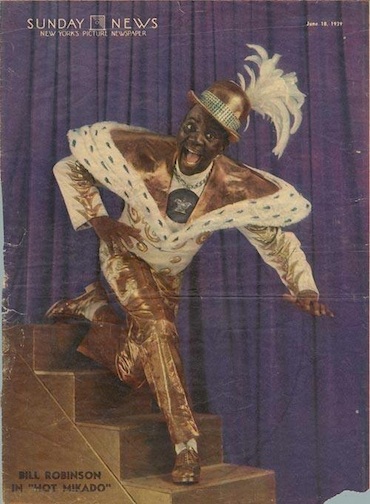
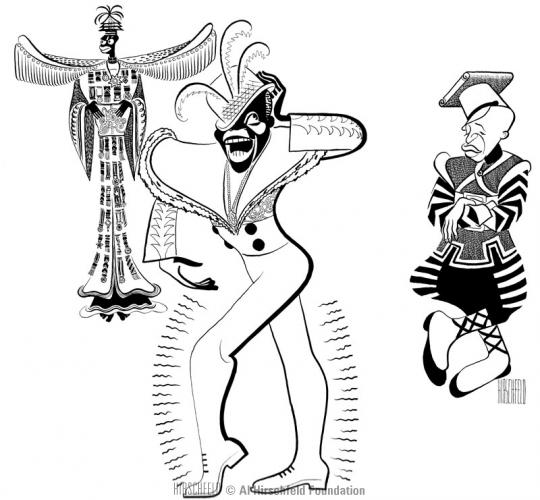
“The Hot Mikado,” starring Bill “Bojangles” Robinson, was a big Broadway hit. It was noted for its wild costuming and all black cast. It ran at the Broadhurst Theater, in Manhattan, from March 23 to June 3, 1939.
Producer Mike Todd announced he was moving the show to the New York World’s Fair. The show became one of the biggest hits at the fair and opened at the Hall of Music on June 22, 1939.
FROM http://www.qchron.com/qboro/i_have_often_walked/bill-bojangles-robinson/article_81b0281a-c1ee-5853-ae31-f810fb8b92a7.html

Silent movie film footage of the Michael Todd production at the New York World’s Fair 1939-1940:

Erskine Hawkins Orchestra – Two Selections from “Hot Mikado”~
https://archive.org/details/ErskineHawkinsOrchestra-TwoSelectionsFromhotMikado

HotMikado

Bill Robinson:
https://artsedge.kennedy-center.org/interactives/harlem/faces/bill_robinson.html

 https://www.pbs.org/wnet/broadway/stars/bill-bojangles-robinson/

https://en.wikipedia.org/wiki/Bill_Robinson

Bob Dylan: Born May 24, 1941

Bob Dylan Through The Years~
http://www.rollingstone.com/music/pictures/photos-70-photos-of-bob-dylan-on-his-70th-birthday-20110524

 Bob Dylan: Official Site~ http://www.bobdylan.com/us/home

Bob Dylan: Halcyon Gallery~ https://www.halcyongallery.com/bob-dylan/

Bob Dylan: Castle Fine Art~ https://www.castlefineart.com/artists/bob-dylan

Margaret Wise Brown: Born May 23, 1910

5 Fascinating Facts About Margaret Wise Brown
https://mymodernmet.com/margaret-wise-brown-facts/


Margaret Wise Brown’s life was full of what her admirers like to call whimsy and other people might call childlike behavior. She spent her first royalty check on an entire flower cart full of flowers. At her house in Maine, which she called “The Only House,” she had an outdoor boudoir with a table and nightstand and a mirror nailed to a tree, along with an outside well that held butter and eggs, and wine bottles kept cold in a stream; one could easily imagine a little fur family living in “The Only House,” but it was just her friends, associates, editors, and lovers passing through. She was once chastised by a hotel owner in Paris because she had brought giant orange trees and live birds into her room. The orange trees might have been OK, the owner thought, but the live birds were a little de trop.

FROM The Restless Life of Margaret Wise Brown

Richard Wagner~ Born May 22, 1813

Early in his career, Wagner learned both the elements and the practical, political realities of his craft by writing a handful of operas which were unenthusiastically, even angrily, received. Beginning with Rienzi (1838-40) and The Flying Dutchman (1841), however, he enjoyed a string of successes that propelled him to immortality and changed the face of music. His monumental Ring cycle of four operas — Das Rheingold (1853-54), Die Walküre (1854-56), Siegfried (1856-71) and Götterdämmerung (1869-74) — remains the most ambitious and influential contribution by any composer to the opera literature.
http://www.allmusic.com/artist/richard-wagner-mn0000958980/biography

“The Brilliant, Troubled Legacy of Richard Wagner”
https://www.smithsonianmag.com/arts-culture/the-brilliant-troubled-legacy-of-richard-wagner-16686821/

A great music lover, Renoir was one of the first admirers of Wagner in France. At the beginning of 1882, when the painter was travelling in the south of Italy, he had the opportunity to visit Palermo where Wagner was staying. After two fruitless attempts, Renoir was finally introduced to the “maestro” who, the day before, had put the final notes to Parsifal.
The course of this meeting is well known thanks to a letter from Renoir to one of his friends, dated 15 January 1882:
https://www.musee-orsay.fr/en/artworks/richard-wagner-1159

Richard Wagner by Auguste Renoir, 1882
Oil on canvas / Musee d’Orsay, Paris, France

[4 embedded links above]

Fats Waller: Born May 21, 1904

Fats Waller (May 21, 1904-December 15, 1943), jazz and popular pianist, singer, and songwriter, was born Thomas Wright Waller in New York City, the son of Edward Martin Waller, a Baptist preacher, and Adeline Lockett. From age six Waller was devoted to the piano but initially failed to practice properly or learn to read music well, because he could memorize lessons immediately. In his youth he also played reed organ in church. He studied piano, string bass, and violin at P.S. 89, which he attended to about age fourteen or fifteen. Although his girth had earned him a nickname by this time, the names Thomas and Fats appeared interchangeably (and sometimes together, as Thomas “Fats” Waller) in his professional work until at least 1931. Later in his career, and posthumously, the nickname prevailed.
http://www.anb.org/articles/18/18-01201.html