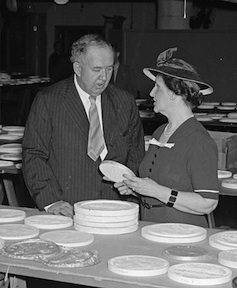
Edward Bruce: Born April 13, 1879

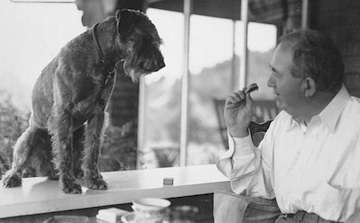
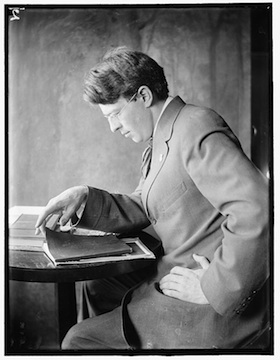
Bruce1Edward Bruce was born in 1879 in Dover Plains, New York. Though he enjoyed painting at a young age, he pursued a career in law and graduated from Columbia Law School in 1904. He practiced law in New York and in Manila, Philippines and was actively involved in international issues.SH143
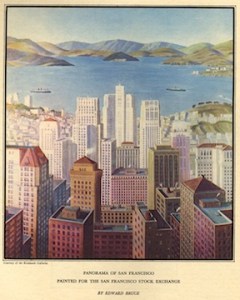
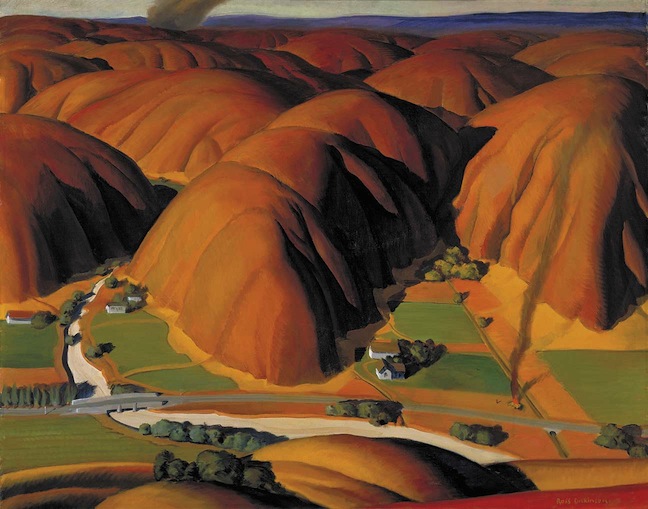
In 1923 Bruce gave up his career in law and business and began to paint, particularly landscapes. He and his wife Peggy spent the next six years in Anticoli Carrado, Italy where he studied painting from his friend and fellow artist Maurice Sterne. Bruce returned to the United States in 1929 and settled in California, exhibiting his artwork to much public and critical praise. In addition, Bruce was an avid collector of Chinese art.
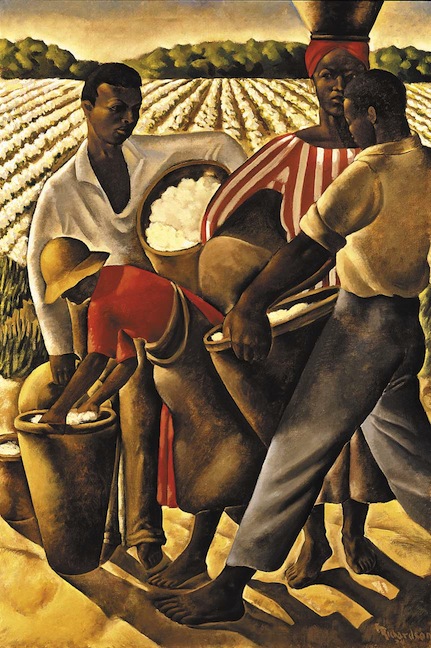
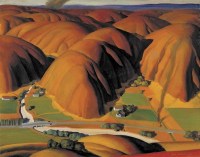
In 1933 Bruce was appointed Chief of the newly established Public Works of Art Project, a federal government New Deal program within the U.S. Treasury Department, that employed artists to decorate numerous public buildings and parks…In 1940 he was appointed to the Commission of Fine Arts by President Franklin Delano Roosevelt.
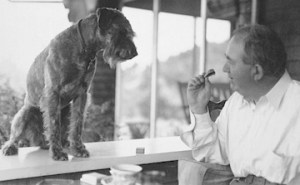
Bruce2Bruce received many honors and awards during his lifetime both for his work as an artist and for his capable and dedicated administration of federal arts programs. Despite poor health, he continued his work for the Section of Fine Arts until shortly before his death in 1943.
http://www.aaa.si.edu/collections/edward-bruce-papers-7264/more

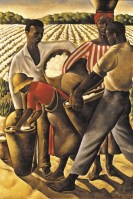
On December 8, 1933, the Advisory Committee to the Treasury on Fine Arts met to decide the newdealartdetails of the Public Works of Art Project (PWAP), the first of the New Deal art programs. The PWAP came at a crucial moment for federal support of the arts during the Great Depression. As artist Olin Dows (1904–1981) recalled, “If the first crash [i.e. Depression] art program had not been so carefully newdealarttoothought out and expertly organized, I doubt that other programs would have been undertaken. The man mainly responsible was Edward Bruce.” Bruce, an advisor to the Treasury Department, hosted the meeting at his home. First Lady Eleanor Roosevelt was present as were such arts leaders as Juliana Force and Forbes Watson, who worked with Bruce to organize the Public Works of Art Project.
https://www.incollect.com/articles/1934-a-new-deal-for-artists

History of the New Deal Art Projects~ http://wpamurals.org/history.html
The New Deal Art Registry~ http://www.newdealartregistry.org/Home.html
Louis-Ernest Barrias (April 13, 1841-February 4, 1905)

NatureThe figure first appeared in white marble at the Paris Salon of 1893 as ‘La Nature mystérieuse et voilée se découvre devant la Science’ and was acquired by the faculty at l’Ecole de Médecine in Bordeaux. Barrias returned to the theme a few years later exhibiting a related sculpture at the 1899 Salon, simply titled ‘La Nature se dévoilant’. Following in the spirit of pioneers of polychromy such as Charles-Henri-Joseph Cordier and Eugène Cornu this figure was carved using expensive and luxurious materials such as Algerian onyx for the drapery, lapis lazuli for the ribbon and malachite for the scarab. This figure is now in the collection of the Muse d’Orsay. A final version in white marble was made in 1902 and acquired by the École de Medicine in Paris.   https://lapada.org/

Nature Revealing Herself To Science~
http://www.sinaiandsons.com/catalogue/20th%20Century/Bronze/Barrias%20Figures.php
Biography~ https://en.wikipedia.org/wiki/Louis-Ernest_Barrias#Biography

Hardie Gramatky: Born on April 12, 1907

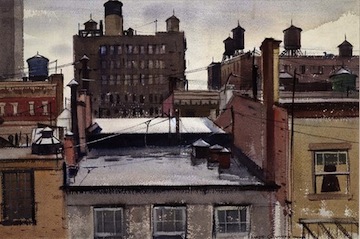
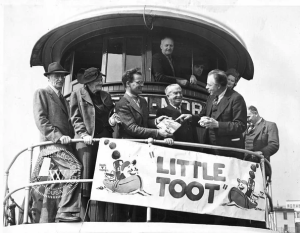
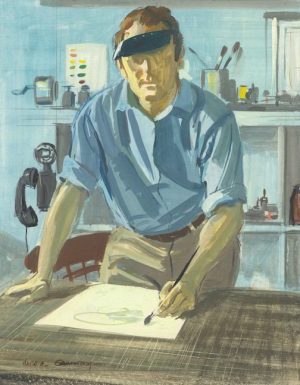
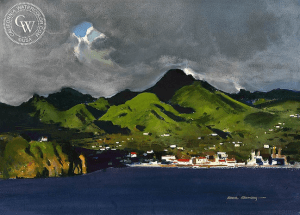
Bernhard August “Hardie” Gramatky, Jr. (April 12, 1907-April 29, 1979) was an American painter, writer, animator, and illustrator. In a 2006 article in Watercolor Magazine, Andrew Wyeth named him as one of America’s 20 greatest watercolorists. He wrote and illustrated several children’s books, most notably Little Toot.
FROM https://en.wikipedia.org/wiki/Hardie_Gramatky

ROOF

http://www.californiawatercolor.com/pages/hardie-gramatky-biography

https://www.mazzamuseum.org/project/miles-gallery/

https://www.lambiek.net/artists/g/gramatky_hardie.htm

Lily Pons: Born on April 12, 1898

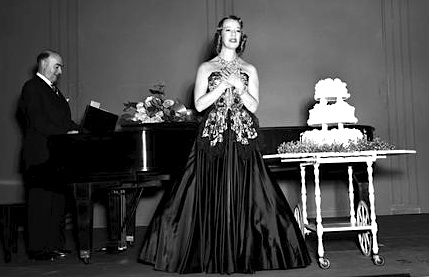
Few opera stars have led such an impressive career. For over a quarter of a century, her coloratura voice captured the stages of Paris, London, Buenos Aires, Mexico, and the United States. Like Mario Lanza and Luciano Pavarotti, she acted in second-rate films about opera stars, which were surprisingly well-attended.

Her sweet soprano voice had an extremely high tessitura. It was said she could hold a high D for about a minute. The Metropolitan Opera revived roles especially for her, like Delibes’ Lakmé, Donizetti’s La Fille du Regiment, and Rimsky-Korsakov’s Le Coq d’or.
FROMhttp://www.classical.net/music/recs/reviews/s/sny60655a.php

In 1932, the tiny Frederick County post office of Lilypons opened for business. “It was a dot on a map, because nobody has ever been quite sure what to call it. Lilypons, Md., was never a city, town or even a hamlet,” said The Evening Sun in 1986. “It is now what it has always been: one frame building surrounded by a small cluster of ponds nestled into a bdaycakepeaceful crook of the Monocacy River eight miles south of Frederick.” In 1963, during a period of cost cutting, the Postal Service discontinued the Lilypons postmark and combined its functions with the nearby Buckeystown post office. A plaque commemorating the tiny post office was mounted on the building in 1986. ~Fred Rasmussen FROMhttps://www.baltimoresun.com/

Tom Lehrer: Born April 9, 1928

Thomas Andrew “Tom” Lehrer is a retired American singer-songwriter, satirist, and mathematician. He has lectured on mathematics and musical theater. He is best known for the pithy, humorous songs he recorded in the 1950s and ’60s. ~Wikipedia

Biography~ http://www.allmusic.com/artist/tom-lehrer-mn0000611877/biography

“Looking For Tom Lehrer”~
https://www.buzzfeed.com/bensmith/tom-lehrer?utm_term=.ruJ6aPBRrd#.xq4Xe2dq4w

Eadweard Muybridge: Born April 9, 1830

Yosemite

Photographs of Yosemite~
http://www.yosemite.ca.us/library/yosemite_its_wonders_and_its_beauties/list_of_photographs.html
Biography~ http://www.iphf.org/hall-of-fame/eadweard-muybridge/
BBC Documentary~ https://youtu.be/5Awo-P3t4Ho

Before his death in 1903, Muybridge would emigrate to America, change his name three times, come close to death and suffer brain damage in a carriage accident. Perhaps most sensationally, he would also be acquitted for the murder of Major Harry Larkyns, his wife’s lover, and the true father of his presumed son Floredo Helios Muybridge.
In fact, Muybridge enjoyed a professional life which may even have surpassed his sensational personal biography. He gained fame through adventurous and progressive landscape photography before working as a war and official government photographer; something which took him from the Lava beds of California during the Modoc War to Alaska and Central America.
Furthermore, Muybridge was instrumental in the development of instantaneous photography. To accomplish his famous motion sequence photography, Muybridge even designed his own high speed electronic shutter and electro-timer, to be used alongside a battery of up to twenty-four cameras!
While Muybridge’s motion sequences helped revolutionise still photography, the resultant photographs also punctuated the history of the motion picture. Muybridge actually came tantalisingly close to producing cinema himself with his projection device the ‘Zoöpraxiscope’.
Research resource~ http://www.eadweardmuybridge.co.uk/

Clarence Hudson White: Born on April 8, 1871

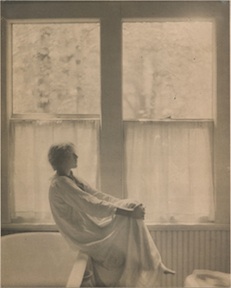
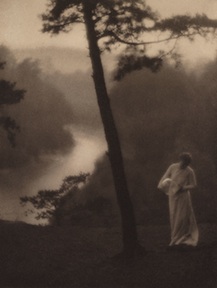
white1“Before White was able to become a full-time artist and teacher, he worked for nearly a decade in Newark, Ohio, balancing a bookkeeping job with his avocation as a photographer. Featured in the third issue of Camera Work, White received international recognition for his work…In 1906 he moved to New York and assisted Alfred Stieglitz in the operation of his newly opened gallery.”
FROM http://americanart.si.edu/collections/search/artist/?id=6761

white2

“When White first began teaching, the medium of photography was coming into its own as a means of artistic expression, and its advantages for communication had been acknowledged. Photographs were preferred over wood engravings and often over drawings for illustration in newspapers and magazines. The use of photographs in advertisements was on the rise. But no place existed for people to learn how to use the camera in the art of seeing.

white3Charismatic amateur photographer and teacher Clarence H. White was inspired to found a school that would advocate applying art principles to professional and commercial as well as art photography.”
FROM http://www.loc.gov/loc/lcib/0112/white.html

Clarence H. White: https://media.artic.edu/stieglitz/clarence-h-white/
Wikipedia entry: https://en.wikipedia.org/wiki/Clarence_Hudson_White

Billie Holiday: April 7, 1915-July 17, 1959

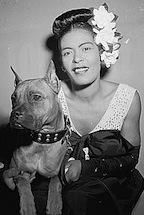
withDog“Billie Holiday was the daughter of Clarence Holiday. Her early life is obscure, as the account given in her autobiography, Lady Sings the Blues, is self-serving and inaccurate.

At some point after 1930, she began singing at a small club in Brooklyn, and in a year or so moved to Pods’ and Jerry’s, a Harlem club well known to jazz enthusiasts. In 1933, she was working in another Harlem club, Monette’s, where she was discovered by the producer and talent scout John Hammond. Hammond immediately arranged three recording sessions for her with Benny Goodman and found engagements for her in New York clubs.
FROM~ http://www.pbs.org/jazz/biography/artist_id_holiday_billie.htm

BHolidayStrange Fruit: the first great protest song~ http://www.theguardian.com/music/2011/feb/16/protest-songs-billie-holiday-strange-fruit

The Guardian~“Billie Holiday’s centenary: a life in pictures”
http://www.theguardian.com/music/gallery/2015/apr/07/billie-holidays-centenary-a-life-in-pictures

SFGate~“Billie Holiday at 100: Artists reflect on jazz singer’s legacy”
http://www.sfgate.com/music/article/Billie-Holiday-at-100-Artists-reflect-on-jazz-6177350.php

Looking For Lady Day’s Resting Place? Detour Ahead~ http://www.npr.org/2012/07/17/156686608/looking-for-lady-days-resting-place-detour-ahead

Herbert Bayer: Born April 5, 1900

HerbertBayerStadelwand1936© M.T. Abraham Center© M.T. Abraham Center – Provided by copyright owner of both photograph and artwork, CC BY 3.0
https://commons.wikimedia.org/w/index.php?curid=24556654

Herbert Bayer (1900-1985) is one of the individuals most closely identified with the famous Bauhaus program in Weimar, Germany. Together with Walter Gropius, Laszlo Moholy-Nagy, and Wassily Kandinsky, Bayer helped shape a philosophy of functional design that extended across disciplines ranging from architecture to typography and graphic design. Endowed with enormous talent and energy, Bayer went on to produce an impressive body of work, including freelance graphics commissions, Modernist exhibition design, corporate identity programs, and architecture and environmental design…Though Bayer came to the Bauhaus as a student, he stayed on to become one of its most prominent faculty members.
FROM https://library.rit.edu/gda/designers/herbert-bayer

Collection at MoMA~ http://www.moma.org/collection/artists/399
New York Times Obituary~
http://www.nytimes.com/1985/10/01/arts/herbert-bayer-85-a-designer-and-artist-of-bauhaus-school.html

This slideshow requires JavaScript.