National Native American Heritage Month~ November 3

Drawing of Artist’s World attributed to Wacochachi
of the
Meskwaki Nation

The Meskwaki people are likely the first and perhaps only tribal nation in the U.S. to purchase land rather than rely on a reservation. An important pen-and-ink drawn by Meskwaki elder Wacochachi documents the relationship between the Meskwaki and Euro-Americans and is believed to be a gift to a trader named George Davenport. The drawing depicts important events in Wacochachi’s life, including two scenes of warfare, as well as creatures that are sacred to the Meskwaki.[i]
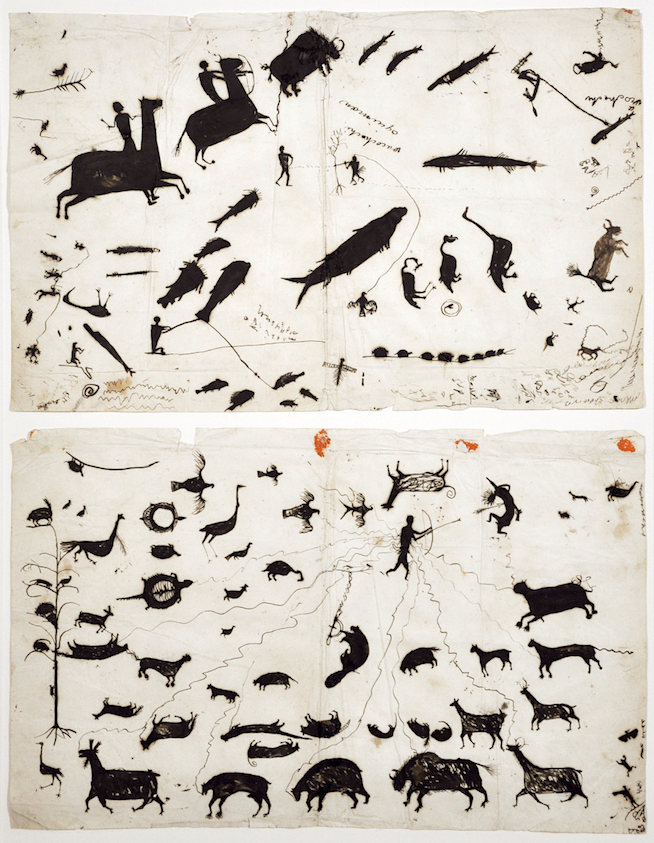
c.1830 / Paper, ink, sealing wax / Each sheet 9 3/4″x15 1/2″ / State Historical Museum of Iowa, Des Moines, IA

[There are four embedded links above]

[i]“IHJ Exploring History: Celebrating 175 Years of Statehood — State Historical Museum of Iowa’s Newest Exhibit ‘Iowa’s People and Places’ Marks Milestones in Iowa’s History -.” 2025. August 15, 2025.
https://iowahistoryjournal.com/ihj-exploring-history-celebrating-175-years-of-statehood-state-historical-museum-of-iowas-newest-exhibit-iowas-people-and-places-marks-milestones-in-iowa/

National Native American Heritage Month~ November 2

The Christening of Asa Thompson  by Dennis Cusick

Dennis Cusick (c. 1800–1824) was a Tuscarora painter from New York and one of the founders of the Iroquois Realist Style of painting.[i] Dennis’ older brother, David Cusick, wrote and illustrated David Cusick’s Sketches of Ancient History of the Six Nations (see November 1).

1821 / Watercolor / 6 3/4″x7 1/3″ / National Museum of the American Indian, Washington, DC

[There are four embedded links above]

[i] Wikipedia contributors. “Dennis Cusick.” Wikipedia, 2026.
https://en.wikipedia.org/wiki/Dennis_Cusick

National Native American Heritage Month~ November 1

Iroquois Mythological Giant Hunter Holding Weapons,
with a Deer and Bear under His Belt  by David Cusick

David Cusick (c. 1780 – 1840) was a Tuscarora artist and the author of David Cusick’s Sketches of Ancient History of the Six Nations (1827).[i] First published in 1826 or 1827, it is likely the earliest account of Native American folklore to be written and published in English by a Native American author.[ii]

c.1827 / Watercolor, brown ink, and brown gouache over graphite on beige paper, laid on canvas
15 1/4”x11 7/8” / New-York Historical Society, NY, NY

[There are three embedded links above]

[i] Wikipedia contributors. “David Cusick.” Wikipedia, September 10, 2026.
https://en.wikipedia.org/wiki/David_Cusick
[ii] Early American Collections at Princeton. “David Cusick’s Sketches of Ancient History of the Six Nations,” November 26, 2013.
https://americana.princeton.edu/2013/11/25/david-cusicks-sketches-of-ancient-history-of-the-six-nations/

National Arts and Humanities Month~ October 28

Lee Krasner, Springs, New York by Irving Penn

1972 / Gelatin silver print / Paper: 9 15/16″x8 1/16″ / ©The Irving Penn Foundation
From the exhibition “PROOF: Photography in the Era of the Contact Sheet”

[There are five embedded links above]

CONTACT SHEET: After a roll of film was developed, the negatives were cut into strips and printed by contact. The 36 exposures of a roll of 35 mm film or the 12 exposures of 2¼ inch film fit comfortably on an 8 x 10 inch sheet of paper. With an 8 x 10 inch enlarger, the same array of negatives could produce a so-called enlarged contact, often measuring 16 x 20 or 20 x 24 inches.
~ https://www.clevelandart.org/exhibitions/proof-photography-era-contact-sheet-collection-mark-schwartz-and-bettina-katz

National Arts and Humanities Month~ October 27

Knitting in the Library by Mary Cassatt

c.1881 / Softground etching and aquatint / Various collections, incl. Cleveland Museum of Art, OH

[There are three embedded links above]

Working drawing for the print, from the Cleveland Museum of Art:
https://www.clevelandart.org/art/1941.85.a
https://www.clevelandart.org/art/1941.85.b