Awa Tsireh, Painter and Metalsmith
Mythical Bird
c.1940 / Watercolor / Private collection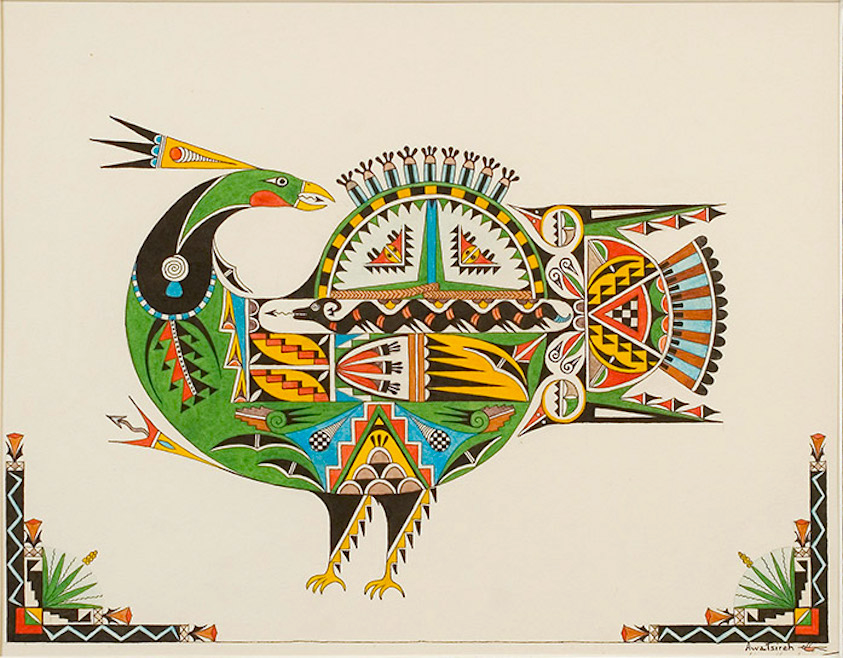
 Silver Brooch in the Form of a Skunk
1930s–40s / Private collection
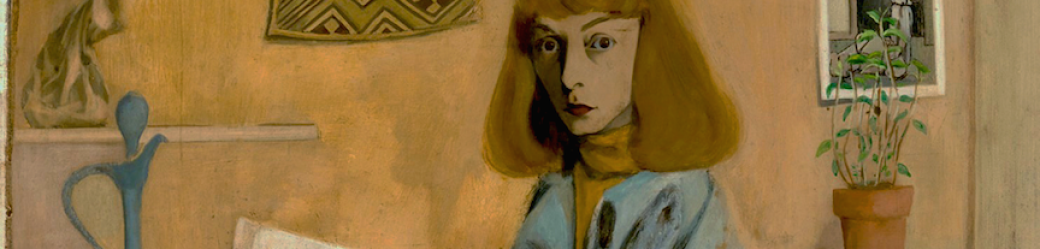
Mythical Bird
c.1940 / Watercolor / Private collection Silver Brooch in the Form of a Skunk
1930s–40s / Private collection
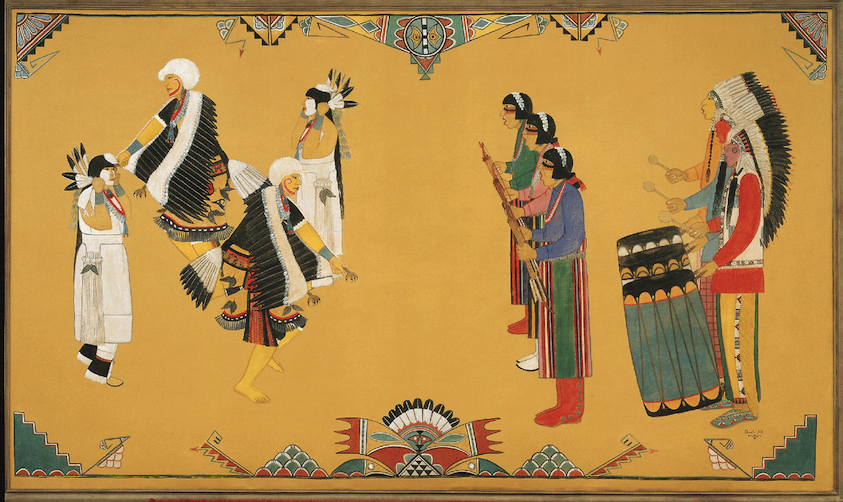 1934 / Painted mural / 70″x110″ / National Cowboy & Western Heritage Museum, Oklahoma City, OK
Native American Murals~ https://oklahoman.com/gallery/500312/indian-mural-exhibit
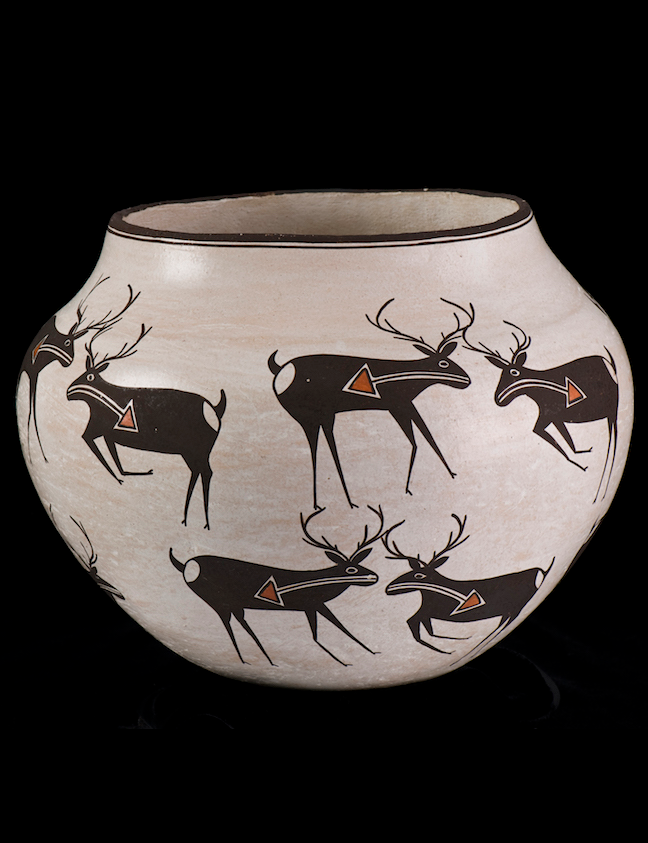 1968 / Earthenware / Dimensions not available
National Cowboy & Western Heritage Museum, Oklahoma City, OK
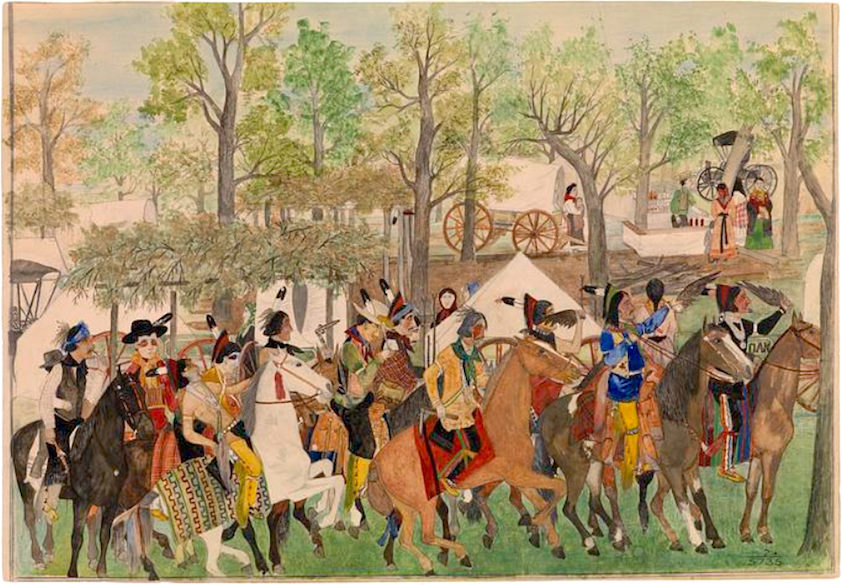 c.1908 / Graphite, watercolor, paperboard / 17 1/3″x25 1/5″
Smithsonian National Museum of the American Indian, DC
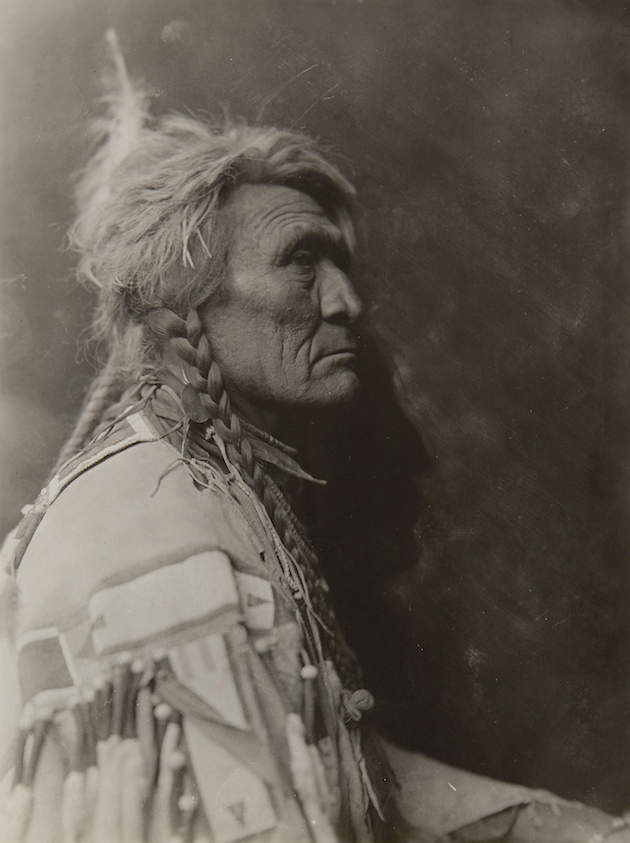 c.1910 / Gelatin silver print from 6 1/2″x8 1/2″ glass plate negative
Various collections including Museum of Photographic Arts, San Diego, CA
Sweezy was a Southern Arapaho painter from Oklahoma. He painted individual portraits, but was best known for his portrayals of ceremonies and dances. His Arapaho name was Wattan, meaning “Black.”
Around 1895, when Sweezy was 14 years old, ethnographer James Mooney commissioned Sweezy to paint images of traditional Arapaho life. Later, Sweezy also worked with anthropologist George Dorsey…By the 1920s Sweezy was a full-time painter. [i]
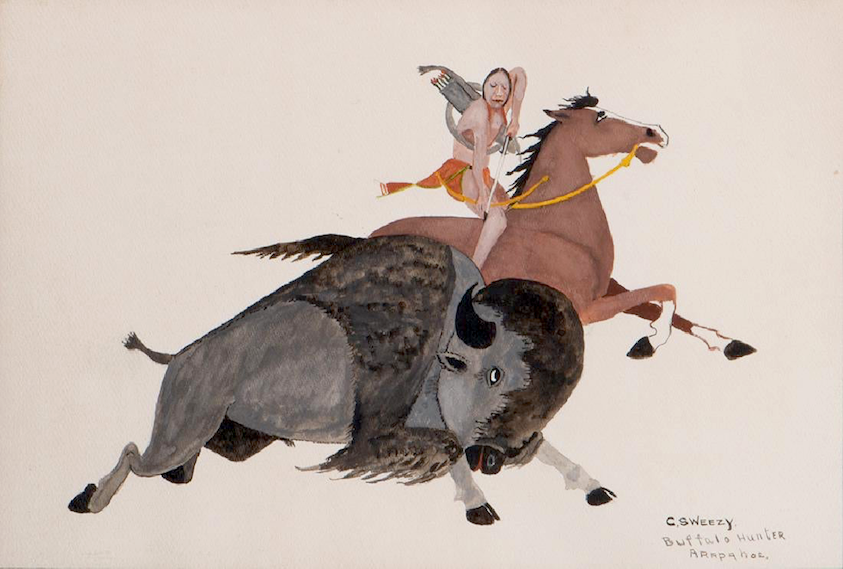 No date / Watercolor on paper / 13 1/2″x20″ / Private collection
[i] Philbrook Museum of Art. “Artist Info_Carl Sweezy,” 2026. Philbrook Museum of Art Collections.
https://philbrook.emuseum.com/people/objects/375
Cobb’s time as a photographer was brief — the majority of her work comes from a three-year period between 1902 and 1905, after which she put down her box camera to focus on her work as a teacher at Cherokee Nation public schools. Her surviving photographs have secured her reputation as the first-known female Native American photographer in Indian Territory…[i]
 c.1902 / Photograph / Dimensions not available / Oklahoma Historical Society, Oklahoma City, OK
[i] Chavez, Will. “Images from the First-Known Native American Female Photographer.” High Country News, March 25, 2022.
https://www.hcn.org/issues/54-4/indigenous-affairs-photos-images-from-the-first-known-native-american-female-photographer/
Many of Martinez’s family members were involved in producing pots, and she learned to make pottery in the traditional way, watching her aunt and grandmother work. By age 13, she was already celebrated within the tribe for her creative skills.
She and her husband, Julian Martinez, revived an ancient local process for making the all-black pottery. Their blackware stood in marked contrast to the all-red or polychrome ware that had dominated the pueblo’s production for generations. [i]
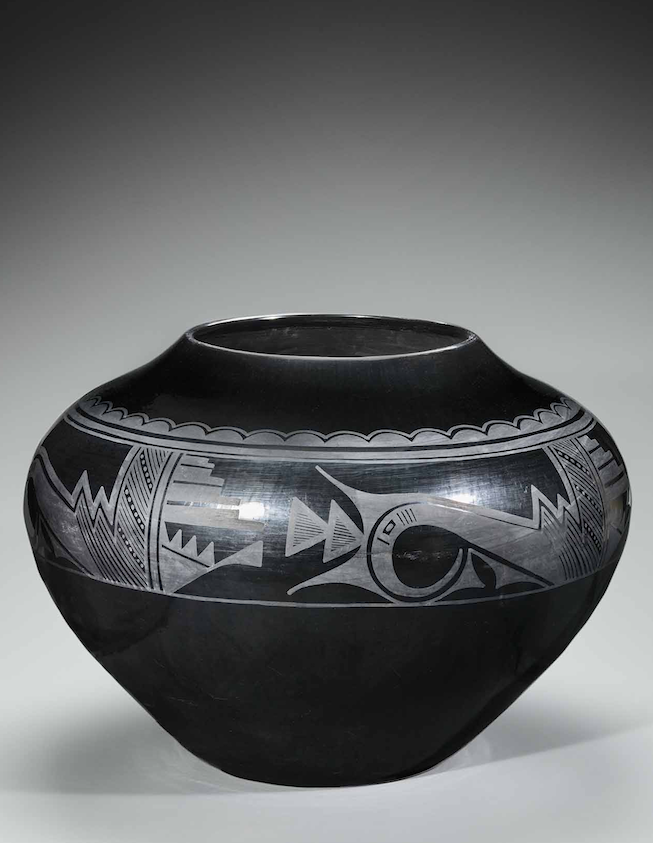 1940 / Polished blackware pottery with matte paint / 15 1/8″x21 3/4″ / Toledo Museum of Art, OH
[i] “Maria Martinez | Artist Profile.” n.d. National Museum of Women in the Arts
https://nmwa.org/art/artists/maria-martinez/
[B.A. Haldane’s] formal schooling was cut short when after completing the third grade he was told by [lay missionary William] Duncan that “there was nothing more for him to learn.” Undiscouraged, he continued his education on his own by purchasing books with the wages from the salmon cannery. He trained himself in both photography and music, mastering the piano, pipe organ, cornet, trombone, and violin in addition to composing orchestral music and translating ancient Tsimshian songs to sheet music. [i]
 1897 / Photograph / Dimensions not available
Sir Henry Wellcome Collection, National Archives at Seattle, WA
[i] Passalacqua, Veronica L. 2023. “Benjamin Alfred Haldane, Frederic Ridley, Metlakahtla, Alaska. Carpenter Who Built the Girl’s Home.” Ucdavis.Edu, January 5, 2023. https://gormanmuseum.ucdavis.edu/collection-piece/benjamin-alfred-haldane-frederic-ridley-metlakahtla-alaska-carpenter-who-built
Hinook-Mahiwi-Kalinaka, also known as Angel De Cora, was a Ho-Chunk (Winnebago) artist, designer, and educator. Born on the Winnebago Reservation in Nebraska in 1868 or 1869, she was forcibly removed from the reservation…to the Hampton Normal and Agricultural Institution in Virginia when she was around 14 years old. After graduating she attended Smith College and then Drexel Institute to study illustration under Howard Pyle, who would later recall De Cora as one of his most talented pupils. [i]
 1900 / Oil on canvas / No size available / Original held by J. Andrew Darling
[i] Rachael DiEleuterio, “My People Are a Race of Designers.” Delaware Art Museum, November 18, 2021.
https://delart.org/angel-de-cora/

