Tag Archives: Painter
Artist Birthday Quiz for 1/2~
What German expressionist’s ardor for war was extinguished during his experiences in WWI, with the result that he is mostly known for his later sculptures warning of war’s tragic consequences?
What American surrealist was one of only three Americans in the landmark 1932 exhibition at the Julien Levy Gallery in NYC, which introduced European surrealism to the United States?
Answers here~ https://schristywolfe.com/2016/01/02/january-2/
Edward Ruscha: Born December 16, 1937
Stopping off in New York City on his way back [from Europe], he paid a call on Leo Castelli, whose gallery showed Jasper Johns, Robert Rauschenberg, and Frank Stella. No introduction, no calling beforehand—he just walked in with the Paris paintings under his arm. Castelli, all European charm and suavity, said that Ruscha’s work looked interesting, and told him to stay in touch. Ruscha stayed in touch for twelve years, visiting the gallery on his occasional trips to New York, and in 1973 Castelli became his New York dealer. Ruscha never seriously considered moving East. “That was too big a decision, and too big a jump,” he told me. “It just didn’t feel like it was meant to be.” He wanted to live in Los Angeles, and by the time he returned from Europe he knew that the only thing he could possibly be was an artist. “I could see I was just born for the job, born to watch paint dry,” he said.
FROM http://www.newyorker.com/magazine/2013/07/01/ed-ruschas-l-a

Biography~ http://www.tate.org.uk/art/artists/edward-ruscha-1882
Where is Rocky II?~ https://www.hollywoodreporter.com/news/documentary-mysterious-ed-ruscha-work-gets-north-american-premiere-at-lacma-962057
Edward Ruscha’s Deadpan Artistry~ http://broadstreetonline.org/2015/01/edward-ruschas-deadpan-artistry/
How Kandinsky helped create abstract art

Lyrical (from Sounds) (1911) by Wassily Kandinsky
Facts within art history aren’t always as solidly verifiable as we would like them to be. Can we say with certainty that Wassily Kandinsky, born on this day, 16 December [4 Dec. Old Style], in 1866, was the first abstract painter?
Read more here: How Kandinsky helped create abstract art | Art | Agenda | Phaidon
Ray Eames: Born December 15, 1912
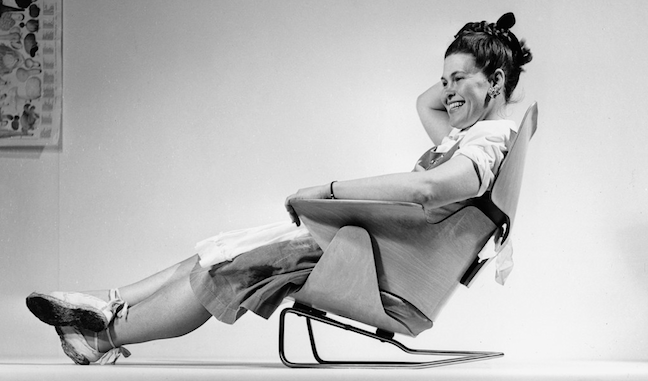
Ray-Ray was the nickname given to Bernice Alexandra Kaiser by her family. Beyond that, little is known of her childhood in Sacramento, although Ray’s artistic talent was evidently recognized early on. After high school she left California with her widowed mother for New York City, where she studied with the German Abstract Expressionist Hans Hofmann and exhibited her paintings. After her mother’s death, Ray left New York for further training at the Art Academy in Cranbrook, Michigan, where Charles Eames was one of her teachers and mentors. After divorcing his first wife, Charles married Ray in 1941 in Chicago. The couple left immediately for Southern California, where they opened a design office.
An extraordinary personal and artistic collaboration began with this move, an unusually creative partnership that resulted in innovative designs for furniture, houses, monuments, exhibitions — even toys.
FROM http://www.fembio.org/english/biography.php/woman/biography/ray-eames/
Eames Foundation~ http://eamesfoundation.org/
Official site of Ray and Charles Eames~ http://www.eamesoffice.com/eames-office/charles-and-ray/
JF Auburtin: Born December 2, 1866
Jean Francis Auburtin was a 19th Century Symbolist painter, an heir of Impressionism, influenced by Japonisme, and sometimes 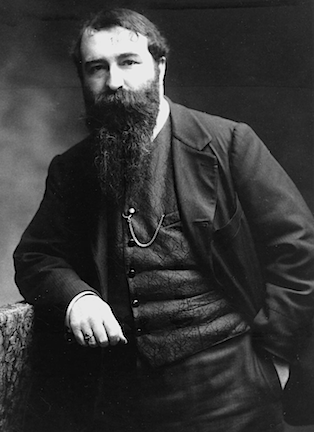 referred to as “the Symbolist of the Sea”. Born December 2, 1866, Auburtin was apprenticed early to the painter Louis-Theodore Devilly. He then enrolled at the Alsatian School of Paris in 1875 where he
  met his future wife Marthe Deloy, a sister of one of his classmates. After further education at the Ecole des Beaux-Arts, Auburtin found himself attracted to painting the cliffs and the ever-changing effects of light on the sea and as a result lived in various locations that offered these views. Auburtin mainly painted in gouache and watercolor, depicting the Normandy coastline, the sea, and later in life figures of dancers. At the end of the
  nineteenth century, Auburtin became interested in Japanese art and began a small collection of
 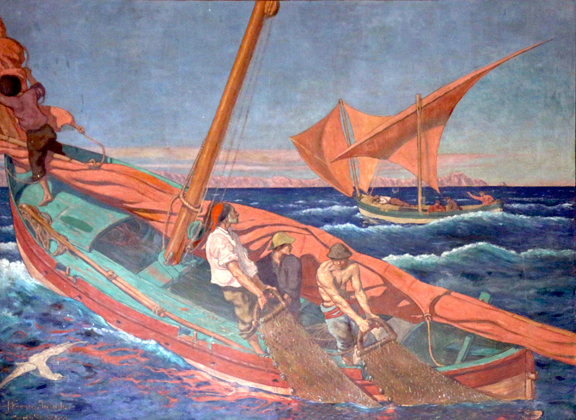 prints, some painted by the famous Japanese painter Hokusaï, which influenced his own work in no small measure. Jean Francis Auburtin rose to the rank of Officer of the Legion of Honor. From 1904 onwards he lived in Varengeville; when he died in 1930 he was buried in the cliff-top cemetery of Varengeville-sur-Mer, which is also the final resting place of Georges Braque.
“In A First, Spain’s Prado Museum Puts The Spotlight On A Female Artist”

Spain’s national art museum, the Prado, has been around nearly 200 years and has one of the world’s biggest collections of Renaissance and Baroque art.
But only now has it devoted a solo exhibition to a female artist: the 17th century Flemish painter Clara Peeters.
Read more via link below:
In A First, Spain’s Prado Museum Puts The Spotlight On A Female Artist : Parallels : NPR
Claude Monet (1840-1926)
Born November 5, 1783~ Caroline Tischbein
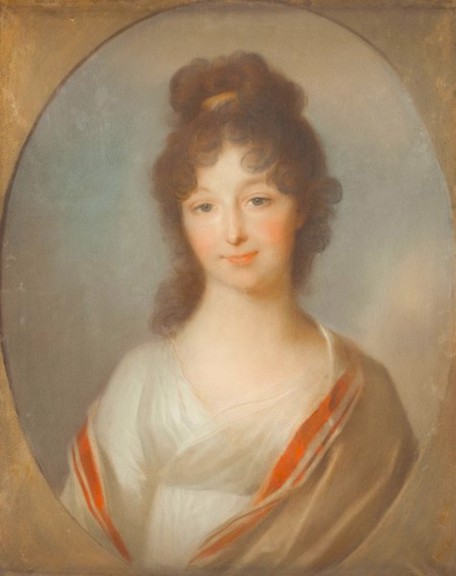 Caroline Tischbein (Wilken) ~ painter, illustrator, and writer ~ was born on this day in 1783.
Caroline Tischbein belonged to a family that produced more than 20 artists in three generations. Between 1770 and 1830, the women were well known as artists by their contemporaries. After that, the female members of the family fell into oblivion, although the male painters did not. The best known among them is Johann Heinrich Wilhelm Tischbein (1751-1829) who in 1787 shared a flat in Rome with Johann Wolfgang von Goethe, during which time Johann painted “Goethe in the Roman Campagna”.
Caroline and the other Tischbein women have been resurrected by art historian Prof. Dr. Martina Sitt, Professor of General Art History at the University of Kassel. For more than a year, under her leadership, the students at the Kunsthochschule Kassel researched these “disappeared artists” and used the results to mount an exhibition about them.
Caroline was the daughter of the Arolsen court painter Johann Friedrich August Tischbein and Sophie Tischbein. She received drawing lessons from her father, who later became director of the Academy in Leipzig (the city where Caroline would meet her future husband). Historian and professor Friedrich Wilken and Caroline met during his studies in Leipzig and married in 1806. The couple moved first to Heidelberg and later to Berlin; in both cities they traveled in intellectual and artistic circles. Caroline Tischbein died in Berlin on April 29, 1843. She left behind her memoirs which were written for her children but subsequently published.
In addition to Caroline, women painters from the Tischbein family included:
Elisabeth (Betty) Tischbein (1787-1867), another daughter of Johann Friedrich August Tischbein.
Amalie Tischbein (1756-1839), daughter of the Kassel court painter and academy professor Johann Heinrich Tischbein.
Sophia Antoinette Tischbein (1761-1826), daughter of Johann Jacob Tischbein and his wife, the painter Magdalene Gertrud Lilly.
Magdalene Margarethe Tischbein (1763-1836), sister of Sophia Antoinette
Top: portrait of Caroline Tischbein by her father Johann Friedrich August Tischbein (1750-1812)
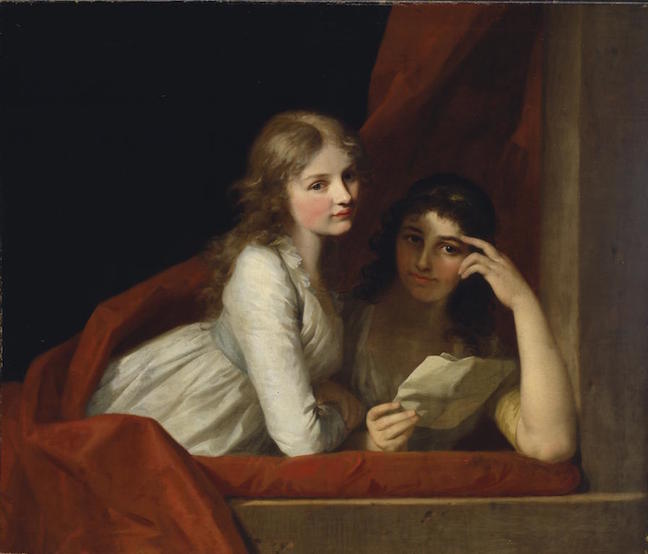
Bottom: “Two Sisters” painted by Caroline Tischbein. The picture probably shows members of the Tischbein family, but their identity is unknown.
SOURCES~
“Disappeared artists”: University of Kassel [link has since broken]
The women of the family Tischbein
Tischbein, Caroline (5 November 1783–1843)
Katsushika Hokusai: Born October 31(?), 1760
Katsushika Hokusai (c.October 31, 1760-May 10, 1849) was a Japanese artist, ukiyo-e painter, and printmaker during the Edo period. Born to an artisan family in present-day Tokyo, he began painting at a young age, and became apprenticed to a wood-carver as a teenager. At the age of 18, he was accepted into the studio of Katsukawa Shunsho, an artist of the ukiyo-e style, which was focused on the depiction of the booming merchant class, including courtesans, Kabuki actors, and sumo wrestlers. After Shunsho’s death, Hokusai began experimenting with other styles of art, including Western styles. But he didn’t fully develop his own signature technique until he was expelled from the Katsukawa School.
FROM http://www.artnet.com/artists/katsushika-hokusai/biography
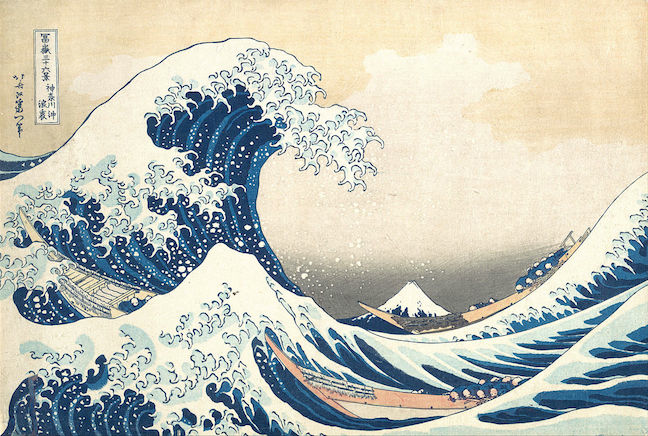
Hokusai is best known for the woodblock print series Thirty-Six Views of Mount Fuji which includes the internationally iconic print The Great Wave off Kanagawa.
Hokusai created the monumental Thirty-Six Views of Mount Fuji both as a response to a domestic travel boom in Japan and as part of a personal obsession with Mount Fuji. It was this series, specifically The Great Wave off Kanagawa and Fine Wind, Clear Morning, that secured his fame both in Japan and overseas. While Hokusai’s work prior to this series is certainly important, it was not until this series that he gained broad recognition.
Artwork~ https://ukiyo-e.org/artist/katsushika-hokusai
Artwork~ https://www.rijksmuseum.nl/en/rijksstudio/artists/katsushika-hokusai
Woodblock Prints in the Ukiyo-e Style~
http://www.metmuseum.org/toah/hd/ukiy/hd_ukiy.htm