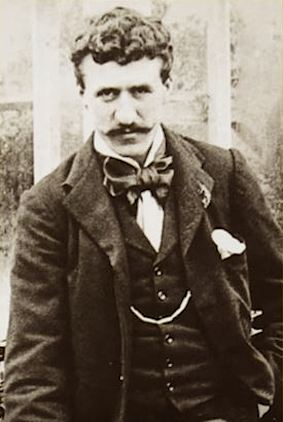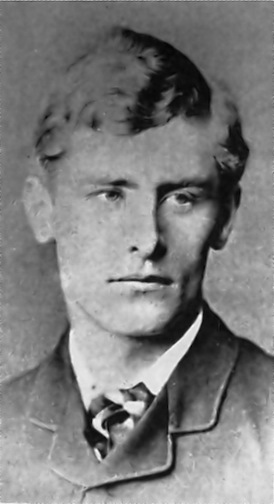
Marc Chagall: Born July 7, 1887


https://www.artic.edu/exhibitions/3172/chagall-s-america-windows

https://www.guggenheim.org/artwork/artist/marc-chagall

http://www.jewishvirtuallibrary.org/marc-chagall

Chagall himself said he was a dreamer who never woke up. “Some art historians have sought to decrypt his symbols,” says Jean-Michel Foray, director of the Marc Chagall Biblical Message Museum in Nice, “but there’s no consensus on what they mean. We cannot interpret them because they are simply part of his world, like figures from a dream.” ~The Elusive Marc Chagall, Smithsonian, December 2003

The United States of America: Born July 4, 1776

painting

This painting depicts the moment on June 28, 1776, when the first draft of the Declaration of Independence was presented to the Second Continental Congress.

This is the first completed painting of four Revolutionary-era scenes that the U.S. Congress commissioned from John Trumbull (1756–1843) in 1817. It is an enlarged version of a smaller painting (approximately 21 inches by 31 inches) that the artist had created as part of a series to document the events of the American revolution.

When Trumbull was planning the smaller painting in 1786, he decided not to attempt a wholly accurate rendering of the scene; rather, he made his goal the preservation of the images of the Nation’s founders. He excluded those for whom no authoritative image could be found or created, and he included delegates who were not in attendance at the time of the event. In all, 47 individuals (42 of the 56 signers and 5 other patriots) are depicted, all painted from life or life portraits. Some of the room’s architectural features (e.g., the number and placement of doors and windows) differ from historical fact, having been based on an inaccurate sketch that Thomas Jefferson produced from memory in Paris. Trumbull also painted more elegant furniture, covered the windows with heavy draperies rather than venetian blinds, and decorated the room’s rear wall with captured British military flags, believing that such trophies were probably displayed there.
http://www.aoc.gov/capitol-hill/historic-rotunda-paintings/declaration-independence

Charles Rennie Mackintosh~ Born June 7, 1868

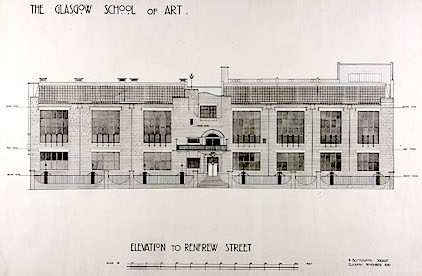
Charles Rennie Mackintosh (7 June 1868-10 December 1928) “was a Scottish architect, designer, water colourist and artist. He was a designer in the Post-Impressionist movement and also the main representative of Art Nouveau in the United Kingdom. He had considerable influence on European design. He was born in Glasgow…”
FROM https://alchetron.com/Charles-Rennie-Mackintosh-1221200-W

“Mackintosh was apprenticed to a local architect John Hutchison, but in 1889 he transferred to the larger, more established city practice of Honeyman and Keppie.

To complement his architectural apprenticeship, Mackintosh enrolled for evening classes at the Glasgow School of Art where he pursued various drawing programmes.”
FROM https://www.crmsociety.com/about-mackintosh/charles-rennie-mackintosh/

“The majority of Mackintosh’s architectural practice was supported by his wife Margaret Macdonald with whom he had studied at the Glasgow School of Art. Her mind was often responsible for the artistic flourish that became so integral to the aforementioned Mackintosh Rose motif. In his time as a professional architect, Mackintosh worked with his wife to design buildings ranging in use from residential, to commercial and religious.”
FROM https://www.archdaily.com/639483/spotlight-charles-rennie-mackintosh

“Despite success in Europe and the support of clients such as Blackie and Cranston, Mackintosh’s work met with considerable indifference at home and his career soon declined. Few private clients were sufficiently sympathetic to want his ‘total design’ of house and interior.

A move to the South of France in 1923 signalled the end of Mackintosh’s three-dimensional career and the last years of his life were spent painting. He died in London on 10 December 1928.”
FROM https://gsaarchives.net/collections/charles-rennie-mackintosh/

Design Museum~ https://designmuseum.org/designers/charles-rennie-mackintosh#toggle-submenu
Charles Rennie Mackintosh Society~ https://www.crmsociety.com/


Walter Richard Sickert: Born May 31, 1860

Persuasion

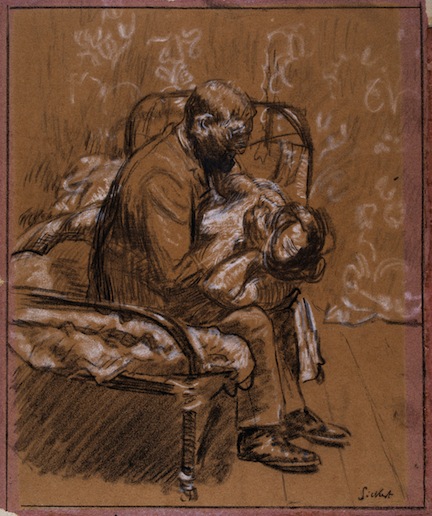
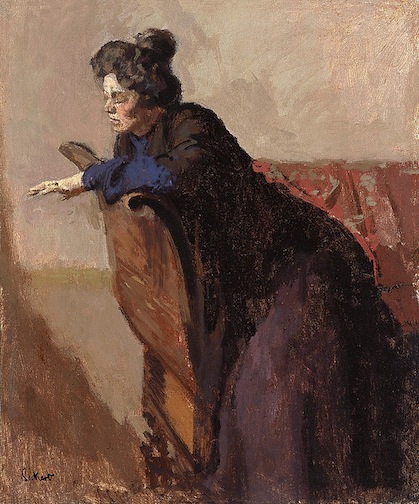
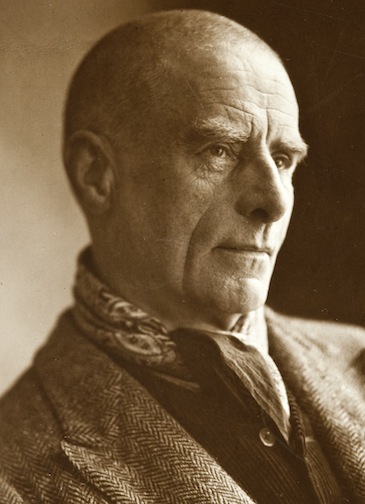
Sickert1Unlike the majority of the Camden Town Group, Walter Richard Sickert was recognised during his own lifetime as an important artist, and in the years since his death has increasingly gained a reputation as one of the most influential figures in twentieth-century British art…His art, like his personality, is multifaceted, complex and compelling.

The twenty-first century has seen a sustained period of Sickert research and exhibitions,TheRing crystallising his reputation as one of the most significant British artists of the early modern period.
FROM http://www.tate.org.uk/art/research-publications/camden-town-group/walter-richard-sickert-r1105345

Sickert2The most popular and famous theory as to the identity of Jack the Ripper…was first posited by author Stephen Knight in the 1970s.

He claimed the Ripper’s victims were really killed to cover up a scandalous secret marriage between the Queen’s son Prince Albert Victor, then second in line to the throne, and a Catholic prostitute named Annie Elizabeth Crook, who bore Albert’s child.

Knight got much of his information from Joseph Gorman-Sickert, who claimed to be the illegitimate son of painter Walter Sickert, himself a Ripper suspect.
FROM http://theunredacted.com/jack-the-ripper-the-royal-conspiracy/

Top 10 Stupidest/Weirdest Jack the Ripper theories~ http://swallowingthecamel.me/2013/11/10/top-10-stupidestweirdest-jack-the-ripper-theories/

Emanuel Gottlieb Leutze: Born May 24, 1816

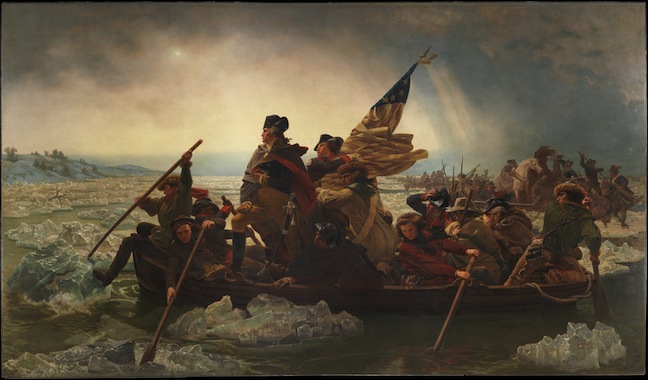
WashingtonWashington Crossing the Delaware, 1851 • Emanuel Gottlieb Leutze
Oil on canvas; 149 x 255 in. (378.5 x 647.7 cm)

Leutze’s depiction of a critical moment during the American revolution has become one of the best known and most extensively published images in American history. He portrays George Washington, accompanied by some 2,500 of his troops, crossing the Delaware River about nine miles above Trenton, New Jersey, in a surprise attack on the Hessians. The strategic crossing took place after midnight on December 25, 1776; ice floes and a heavy snowstorm kept the American soldiers and their allies from reaching shore until daybreak, which Leutze captured with the morning star overhead.
http://www.metmuseum.org/toah/works-of-art/97.34

Crossing of the Delaware: http://www.mountvernon.org/research-collections/digital-encyclopedia/article/crossing-of-the-delaware/
Emanuel Gottlieb Leutze…German-born American historical painter whose picture Washington Crossing the Delaware (1851) numbers among the most popular and widely reproduced images of an American historical event.
http://www.britannica.com/EBchecked/topic/337776/Emanuel-Gottlieb-Leutze

Richard Wagner~ Born May 22, 1813

Early in his career, Wagner learned both the elements and the practical, political realities of his craft by writing a handful of operas which were unenthusiastically, even angrily, received. Beginning with Rienzi (1838-40) and The Flying Dutchman (1841), however, he enjoyed a string of successes that propelled him to immortality and changed the face of music. His monumental Ring cycle of four operas — Das Rheingold (1853-54), Die Walküre (1854-56), Siegfried (1856-71) and Götterdämmerung (1869-74) — remains the most ambitious and influential contribution by any composer to the opera literature.
http://www.allmusic.com/artist/richard-wagner-mn0000958980/biography

“The Brilliant, Troubled Legacy of Richard Wagner”
https://www.smithsonianmag.com/arts-culture/the-brilliant-troubled-legacy-of-richard-wagner-16686821/

A great music lover, Renoir was one of the first admirers of Wagner in France. At the beginning of 1882, when the painter was travelling in the south of Italy, he had the opportunity to visit Palermo where Wagner was staying. After two fruitless attempts, Renoir was finally introduced to the “maestro” who, the day before, had put the final notes to Parsifal.
The course of this meeting is well known thanks to a letter from Renoir to one of his friends, dated 15 January 1882:
https://www.musee-orsay.fr/en/artworks/richard-wagner-1159

Richard Wagner by Auguste Renoir, 1882
Oil on canvas / Musee d’Orsay, Paris, France

[4 embedded links above]

Tamara de Lempicka~ Born May 16, 1898(?)


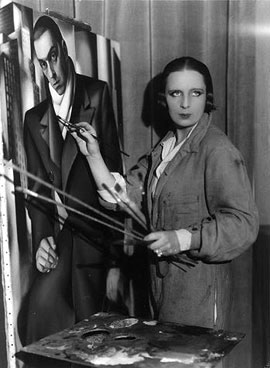
Who was she? De Lempicka shuffled the facts of her biography much as she  meddled with her birth date.


Her time was the 1920s: a period of transition, an era in which functionalism merged with fantasy and formal social structures lurched into the frenetic. In essence, De Lempicka was a classicist, having admired Renaissance painting since her adolescent travels in Italy. But she astutely combined traditional portraiture with advertising techniques, photographic lighting, vistas of the tower architecture of great cities.

In 1939, urged by Tamara, who was partly Jewish, Kuffner sold his estates in Hungary and they moved to the US. In New York, she tried abstract expressionism unsuccessfully, and was reduced to the role of a chic curiosity, “the painting baroness”.
FROM https://www.theguardian.com/artanddesign/2004/may/15/art

http://www.nytimes.com/books/99/10/24/reviews/991024.24vincent.html
http://culture.pl/en/artist/tamara-lempicka-tamara-de-lempicka

Keith Haring: May 4, 1958 – February 16, 1990

ArtnetNews

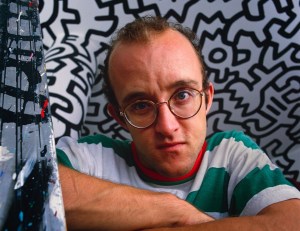
Renowned street artist Keith Haring…was born on May 4, 1958, in Pennsylvania, and died in New York in 1990. His eponymous foundation was established a year before his death, and provides grants to those affected by AIDS.
FROM 2016 https://news.artnet.com/people/keith-haring-birthday-2016-485381

After graduating high school, he enrolled in the Ivy School of Professional Art, Pittsburgh but quickly discovered he had no desire to become a commercial graphic artist. He dropped out and in 1978 moved to New York where he joined the School of Visual Arts as a scholarship student.
FROM https://www.pbs.org/wnet/americanmasters/keith-haring-biography/16012/
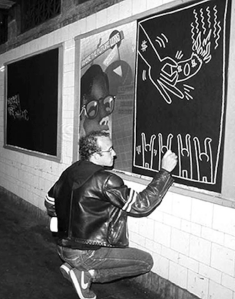
DrawingWhen not torn or cut from their locations by admirers, they would eventually be covered with new ads. The routine disappearance of these works, in fact, became an incentive for their replenishment and a catalyst for constant reinvention. While many were documented by photographer Tseng Kwong Chi…most of the drawings went unrecorded, thus creating one of the most epic and ephemeral projects in the history of the city.
FROM http://publicdelivery.org/keith-harings-subway-drawings/

By the mid-1980’s, Mr. Haring was also doing oil and acrylic paintings, asgracejones well as wall sculptures and free-standing constructions. He had 42 one-man exhibitions, and was represented in group shows like the 1983 Sao Paulo Bienal, the 1984 Venice Biennale and exhibitions at the Hirshhorn Museum in Washington and the San Francisco Museum of Modern Art. His works are also in the permanent collections of museums like the Stedelijk in Amsterdam, the Whitney in New York and the Beaubourg at the Pompidou Center in Paris.
FROM http://www.nytimes.com/1990/02/17/obituaries/keith-haring-artist-dies-at-31-career-began-in-subway-graffiti.html

Haring Kids~ http://www.haringkids.com/
The Keith Haring Foundation~ http://www.haring.com/

This slideshow requires JavaScript.
Andrew John Henry Way: Born April 27, 1826

In 1860, Way came to the attention of visiting history painter Emanuel Leutze who encouraged him to pursue still life subject matter in the Düsseldorf style. Taking this advice to heart, Way began to paint fruit, primarily grapes, executed with great detail to form, a particular brilliance of light and typically staged against a dark background.…Despite the market demand and critical preference for vast panoramic landscapes and historic scenes, Way prospered, becoming the most important still life painter in the mid-Atlantic area during the late nineteenth century.

FROM http://thejohnsoncollection.org/andrew-way/

http://americanart.si.edu/collections/search/artist/?id=5261
https://art.thewalters.org/detail/18788//