March 10, 1945~ Firebombing of Tokyo

The Flames of Kototoi Bridge—Memories of Losing my Family by Kano Teruo
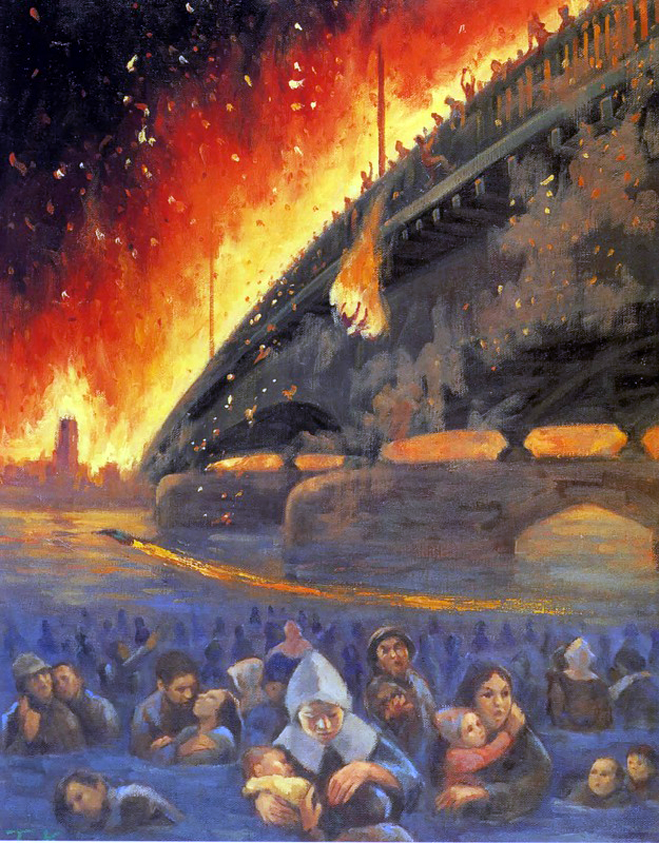
Age at time of raid: 14 / The Great Tokyo Air Raid through Drawings

Previous March 10 posts:

March 10~ Women’s History Month in visual arts

William Etty: Born March 10, 1787

Dame Eva Turner: Born March 10, 1892

David Hare: March 10, 1917-December 21, 1992

Artist Birthday Quiz for 3/10~

Salmagundi

A Taube  by  C.R.W. Nevinson
[War]

1916 / Oil on canvas / 25”x30” / Imperial War Museums, UK

Christopher Richard Wynne Nevinson ARA (13 August 1889 – 7 October 1946) was an English figure and landscape painter, etcher and lithographer, who was one of the most famous war artists of WWI.  ~Wikipedia

He served in France with the Red Cross and the Royal Army Medical Corps, 1914–16, before being invalided out, and his harsh, steely images of life and death in the trenches received great acclaim when he held a one-man exhibition at the Leicester Galleries, London, in 1916…In 1917 Nevinson returned to France as an Official War Artist, and he was the first to make drawings from the air. ~artuk.org

After the war Nevinson concentrated on townscape and genre painting. His autobiography, “Paint and Prejudice”, was published in 1937. He renewed his career as a war artist with the onset on the Second World War but a stroke cut short his war involvement in 1942. He died in 1946.  ~firstworldwar.com

^^  (Learn more by clicking on hyperlinks embedded in images and text)  ^^

Salmagundi

In Flanders Field-Where Soldiers Sleep and Poppies Grow / Robert Vonnoh
1890 / Oil on canvas / 58”x104” / The Butler Institute of American Art

In Flanders Fields By John McCrae

In Flanders fields the poppies blow
Between the crosses, row on row,
That mark our place; and in the sky
larks, still bravely singing, fly
Scarce heard amid the guns below.

We are the Dead. Short days ago
We lived, felt dawn, saw sunset glow,
Loved and were loved, and now we lie,
In Flanders fields.

Take up our quarrel with the foe:
To you from failing hands we throw
The torch; be yours to hold it high.
If ye break faith with us who die
We shall not sleep, though poppies grow
In Flanders fields.

“ ‘In Flanders Field’  became popular almost immediately upon its publication. It was translated into other languages and used on billboards advertising Victory Loan Bonds in Canada. The poppy soon became known as the flower of remembrance for the men and women in Britain, France, the United States, and Canada who have died in service of their country.” ~poets.org

^^  (Learn more by clicking on the six hyperlinks embedded in text)  ^^

Salmagundi

Dorothea Lange [War]Lange

Mules

Biographies:
International Photography Hall of Fame and Museum~ http://www.iphf.org/hall-of-fame/dorothea-lange/
PBS~ http://www.pbs.org/video/2365971488/

Three months after Pearl Harbor, President Franklin Roosevelt ordered the relocation of Japanese-Americans into armed camps in the West. Soon after, the War Relocation Authority hired [Dorothea Lange (1895-1965)] to photograph Japanese neighborhoods, processing centers, and camp facilities.

To capture the spirit of the camps, Lange created images that frequently juxtapose signs of human courage and dignity with physical evidence of the indignities of incarceration. Not surprisingly, many of Lange’s photographs were censored by the federal government, itself conflicted by the existence of the camps.

The true impact of Lange’s work was not felt until 1972, when the Whitney Museum incorporated twenty-seven of her photographs into Executive Order 9066, an exhibit about the Japanese internment. New York Times critic A.D. Coleman called Lange’s photographs “documents of such a high order that they convey the feelings of the victims as well as the facts of the crime.”
FROM http://www.loc.gov/exhibits/wcf/wcf0013.html

FatherSonNational Archives~ https://www.archives.gov/news/articles/japanese-internment-75th-anniversary
National Park Service~ https://www.nps.gov/manz/learn/photosmultimedia/dorothea-lange-gallery.htm

(Learn more by clicking on embedded hyperlinks)

Salmagundi

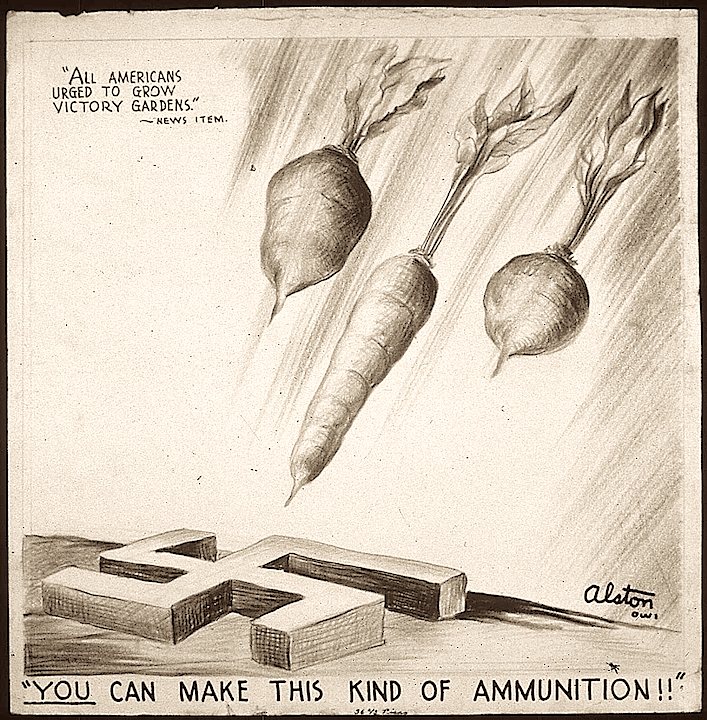
Victory Gardens [War]

During World War I, Liberty Gardens (and later, Victory Gardens) grew out of the government’s efforts to encourage home gardening among Americans, both to express their patriotism and to aid the war effort by freeing up food production for soldiers. ~cbsnews.com
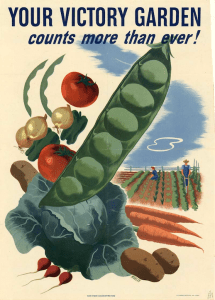
As part of the (World War II) effort, the government rationed foods like sugar, butter, milk, cheese, eggs, coffee, meat and canned goods. Labor and transportation shortages made it hard to harvest and move fruits and vegetables to market. So, the government turned to its citizens and encouraged them to plant “Victory Gardens.” They wanted individuals to provide their own fruits and vegetables. ~livinghistoryfarm.org
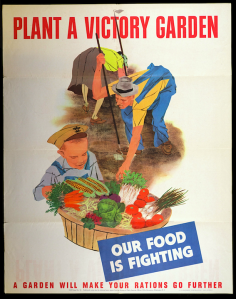
Americans were encouraged to grow their own to ensure everyone at home had enough to eat…There were 20 million gardens everywhere from rooftops and empty lots to backyards and schoolyards. 40% of produce, which made over 1 million tons, consumed in America was grown in victory gardens. People learned how to can and preserve so the harvests lasted all year. ~nww2m.com

(Learn more by clicking on links in the images and text)

Salmagundi

Sir Winston Churchill by Ernest Hamlin Baker
[War]

1949 / Gouache, ink and graphite pencil on paperboard / 11 3/4”x10 1/2″

Ernest Baker, born in 1889 in Rhode Island, was a self-taught illustrator. Most of his works were covers for Time magazine, although he was responsible for eleven covers for Fortune magazine between 1929 and 1941.

Beginning in 1939, Baker produced over 300 covers for Time during his seventeen-year tenure with the magazine. He was described by Time publisher, Ralph Ingersoll, as an artist who could do anything.
http://www.askart.com/artist_bio/Ernest_Hamlin_Baker/28830/Ernest_Hamlin_Baker.aspx

In December of 1949, Winston Churchill was chosen by Time magazine as theMan of the Half-Century, celebrated in a 16-page supplement which was contained in the January 2nd issue of 1950. Baker did the cover illustration for that issue.

This slideshow requires JavaScript.

(Learn more by clicking on embedded hyperlinks)

Salmagundi

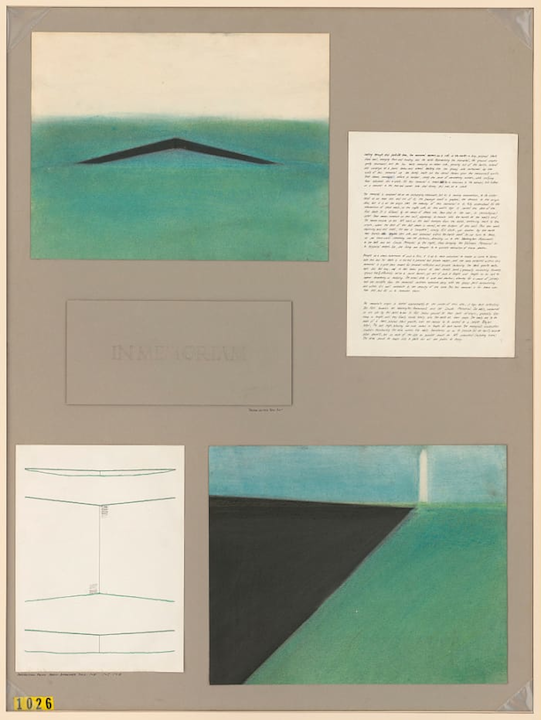
Vietnam Veterans Memorial

Maya Lin’s original competition submission for the Vietnam Veterans Memorial in Washington, D.C. Architectural drawings and a one-page written summary, 1980 or 1981.

In 1979, Congress grants a Vietnam War veterans’ committee the right to build a memorial on the Mall in Washington, D.C., dedicated to American soldiers killed in the conflict in Vietnam…When the winner is announced, no one is more surprised than the student architect herself, Maya Lin, a 20-year-old Yale undergraduate…Lin describes the Memorial thus: “I went to see the site. I had a general idea that I wanted to describe a journey…a journey that would make you experience death and where you’d have to be an observer, where you could never really fully be with the dead. It wasn’t going to be something that was going to say, ‘It’s all right, it’s all over,’ because it’s not.”
FROM http://www.pbs.org/wgbh/cultureshock/flashpoints/visualarts/thewall_a.html

Spotlight: Maya Lin~ https://www.archdaily.com/774717/spotlight-maya-lin

(Learn more by clicking on embedded hyperlinks)

Salmagundi

Mathew Brady [War]

Mathew Brady is often referred to as the father of photojournalism and is most well known for his documentation of the Civil War. His photographs, and those he commissioned, had a tremendous impact on society at the time of the war, and continue to do so today. He and his employees photographed thousands of images including battlefields, camp life, and portraits of some of the most famous citizens of his time including Abraham Lincoln and Robert E. Lee.
https://www.battlefields.org/learn/biographies/mathew-brady

The Civil War as Photographed by Mathew Brady~
http://www.archives.gov/education/lessons/brady-photos/


(Learn more by clicking on embedded hyperlinks)

Salmagundi

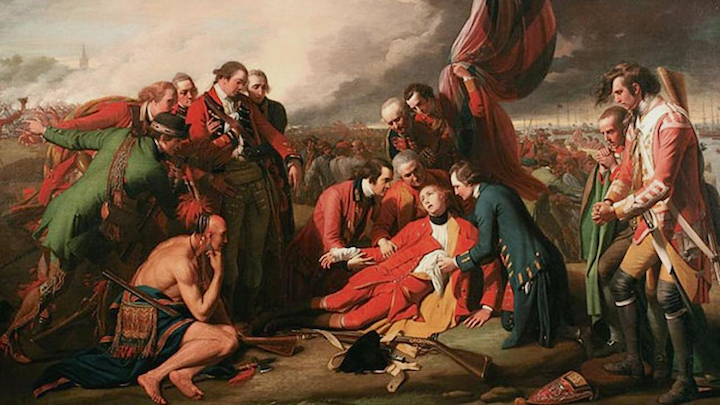
The Death of General Wolfe by Benjamin West

On September 13, 1759, during the Seven Years’ War (1756-63) [known in the United States as the French and Indian War], the British General James Wolfe achieved a dramatic victory; Wolfe was fatally wounded during the battle, but his victory ensured British supremacy in Canada.
https://www.history.com/topics/native-american-history/battle-of-quebec-1759

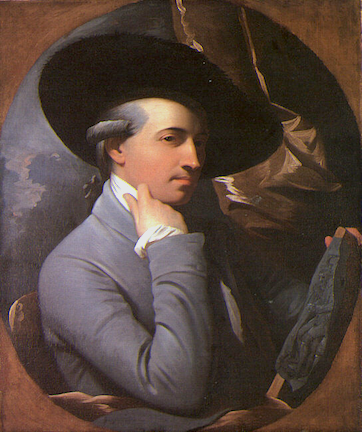
Benjamin West, Self-portrait 1770

Besides the original, at least four other additional versions of The Death of General Wolfe were also produced by West. The primary copy of The Death of General Wolfe is currently in the collection of the National Gallery of Canada, with further examples at the Royal Ontario Museum (Canadiana art collection), as well as the University of Michigan Museum of Art. The fourth copy produced resides at Ickworth House, Suffolk, England. Each reproduction had its own variation in the depiction of Wolfe’s death. A fifth autograph copy was commissioned by George III in 1771 and is still in the Royal Collection.
FROM https://en.wikipedia.org/wiki/The_Death_of_General_Wolfe

(Learn more by clicking on embedded hyperlinks)

Salmagundi

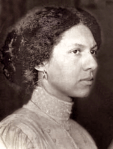
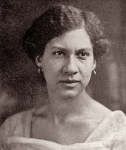
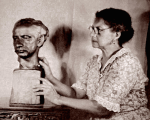
Meta Vaux Warrick Fuller
“Peace Halting the Ruthlessness of War”

1917 / Bronze cast sculpture / 14”x16 3/4”x9”/ Private collection

Meta Vaux Warrick Fuller (June 9, 1877-March 18, 1968) was…a multi-talented artist who wrote poetry, painted, and sculpted but was most noted for her sculpture. Warrick was a protegé of Auguste Rodin…Warrick is considered a forerunner of the Harlem Renaissance. ~FROM Wikipedia

In May, 1917, Meta Warrick Fuller took second prize in a competition under the auspices of the Massachusetts Branch of the Woman’s Peace Party, her subject being “Peace Halting the Ruthlessness of War.” War is personified as on a mighty steed and trampling to death numberless human beings. In one hand he holds a spear on which he has transfixed the head of one of his victims. ~FROM Documenting the American South

(Learn more by clicking on hyperlinks embedded in text)

In the Studio: The Meta Vaux Warrick Fuller Collection~ https://danforth.framingham.edu/exhibition/meta-fuller/