“Probably one of the most recognized names in agricultural research, George Washington Carver (c.1865-1943) overcame numerous obstacles to achieve a graduate education and gain international fame as an educator, inventor, and scientist. FROM http://www.encyclopediaofalabama.org/article/h-1064
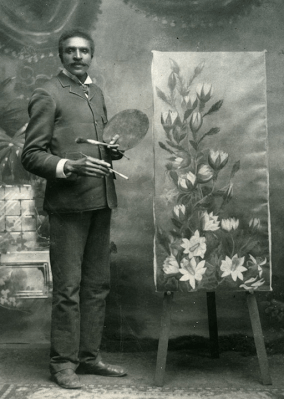
Born a slave, [Carver] is one of the most historically prominent African American scientists. Carver was a pioneer as an agriculturalist and botanist by introducing methods of soil conservation for farmers, inventing hundreds of by-products from peanuts, pecans, sweet potatoes, and soybeans, and practicing “zero waste” sustainability. Scholars have recognized Carver’s talent as a painter and his ability to develop paints and dyes from various natural sources; 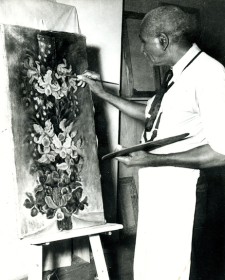 however, there is very little scholarship documenting his work as a textile artist.”
FROM http://digitalcommons.unl.edu/cgi/viewcontent.cgi?article=1922&context=tsaconf
“Throughout Carver’s life, he balanced two interests and talents that may seem at odds – the creative arts and the natural sciences. Skills of observation, experimentation, replication, and communication applied to both art and science, making Carver as comfortable in the sciences as in the arts.” FROM https://www.thehenryford.org/explore/stories-of-innovation/what-if/george-washington-carver
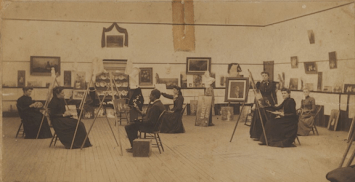
“In the late 1880s, [Carver] made his way to Winterset, Iowa, where a white couple encouraged him to apply to Simpson College in Indianola, Iowa. The only African American student, Carver enrolled in Simpson in September 1890 as an art major. His art teacher recognized his considerable talents, but she was concerned that as a black man, he would have difficulties finding work as a professional artist. After Carver showed her some plants he had hybridized, she suggested that he transfer to Iowa State College of Agricultural and Mechanic Arts (now Iowa State University), in Ames, Iowa, where her father,  J. L. Budd, taught horticulture”. FROM http://www.encyclopediaofalabama.org/article/h-1064
“Holdings at the G.W. Carver National Monument and Tuskegee Institute National Historic indicate that Carver was proficient in textile techniques such as embroidery, weaving, crocheting, knitting and basketry. According to a document written by the National Park Service Carver created, ’embroideries on burlap, ornaments made of chicken feathers, seed and colored peanut necklaces, woven textiles’ (p. 24) and that ‘He was an honorary member of the Royal Society of Arts in London, England’.” FROM http://digitalcommons.unl.edu/cgi/viewcontent.cgi?article=1922&context=tsaconf
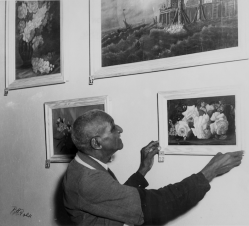 “What spare time he salvaged from his hectic schedule usually went for the pursuit of loves Carver had sacrificed, like botany and art. He found time to crochet, knit, and do needlework. He found these activities satisfactory and they enabled him to produce useful items for friends. He had great appreciation for the world around him, in particular, the materials found in nature. He dyed many of his own threads and fibers with natural dyes made from local walnut, mulberry, and ochre clay.
He became a scientist, a teacher, a speaker, and more, but he never entirely let go of his art. Rather he brought it to his other pursuits, and at times even let it guide them. Carver taught art classes at Tuskegee in addition to his regular roster of courses. He also allowed his artistic talents to improve his scientific work. He drew diagrams with the fine pen of an illustrator, collected specimens with the attention of a painter and crossbred plants with profound creativity. Through out his life he maintained the soul of an artist and continued to paint. Carver was driven by science, but art remained his passion.” FROM https://www.nps.gov/teachers/classrooms/george-washington-carver-the-artist-resource-to-his-people.htm
This slideshow requires JavaScript.
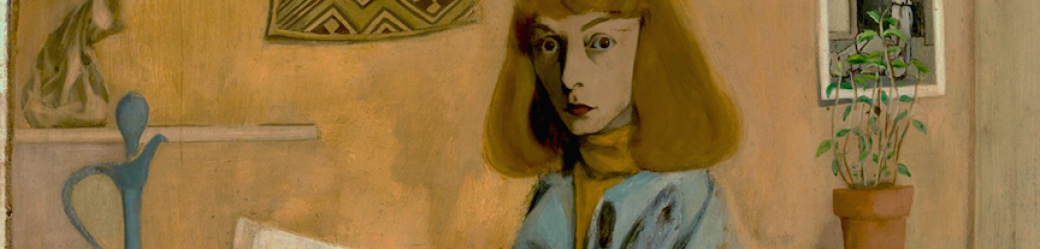




 The Misty Miss Christy