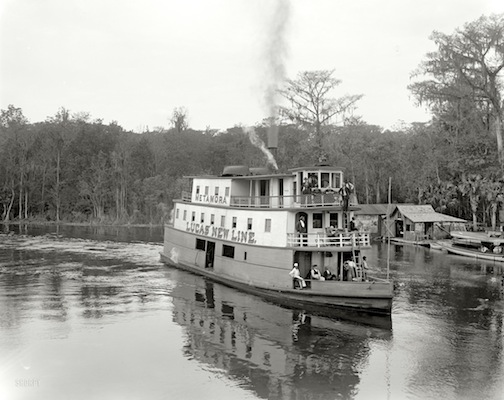
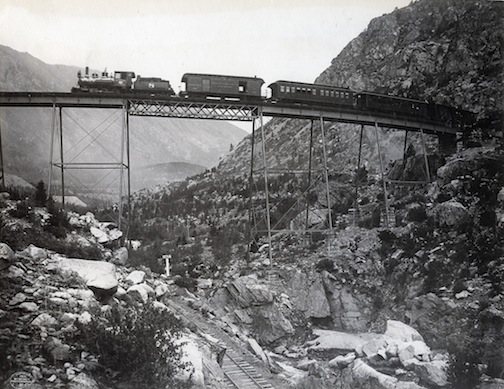
From age twelve until age ninety-nine, William Henry Jackson was involved on some level with photography. After a tour of duty in the Civil War, he headed West and eventually settled in Omaha, Nebraska, where he opened a portrait photography studio with his brother Edward. As Jackson explained, however, “Portrait photography never had any charms for me, so I sought my subjects from the house-tops, and finally from the hill-tops and about the surrounding country; the taste strengthening as my successes became greater in proportion to the failures.” In 1870 he accompanied geologist Ferdinand Vandiveer Hayden on an expedition across Wyoming, along the Green River, and eventually into the Yellowstone Lake area. Jackson’s images were the first published photographs of Yellowstone. Partly on the strength of these photographs, the area became America’s first national park in March 1872.
On one of several independent expeditions that he headed, Jackson also became the first to photograph the prehistoric Native American dwellings in Mesa Verde, Colorado. He finally settled in Denver, Colorado, where he worked as a commercial landscape photographer and continued to publish his photographs as postcards.
FROM http://www.getty.edu/art/collection/artists/1853/william-henry-jackson-american-1843-1942/
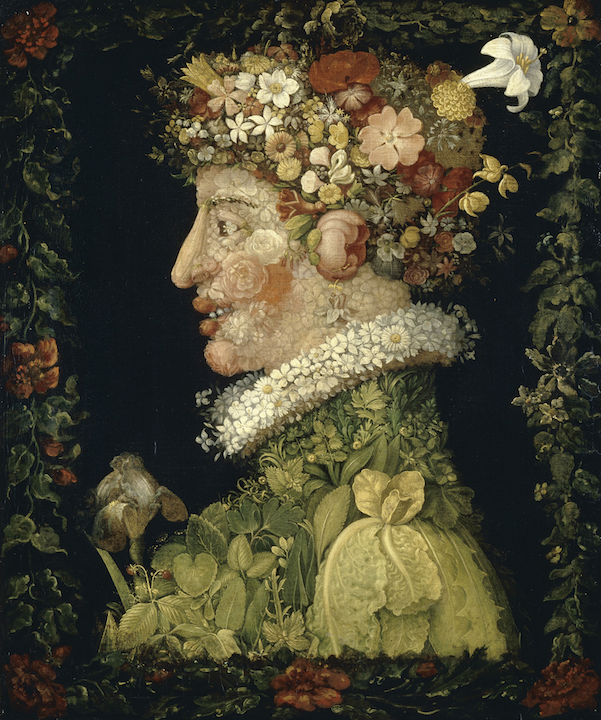
Spring~ April 4
Spring by Giuseppe Arcimboldo
1573 / Oil on canvas / 30”x25” / Royal Academy of Fine Arts of San Fernando

≈ ≈ ≈ ≈ ≈ ≈ ≈ ≈ ≈ ≈
Spring by Pieter Brueghel the Younger
c.1620s/1630s / Oil on panel / 16 1/2”x22 1/2”
Many versions incl. one in The National Museum of Art of Romania

Spring~ April 3
Peach Blossom Spring by Qiu Ying
Ming Dynasty (1368-1644) / Handscroll, ink and color on paper / 13”x185 13/16” / Museum of Fine Arts, Boston

≈ ≈ ≈ ≈ ≈ ≈ ≈ ≈ ≈ ≈
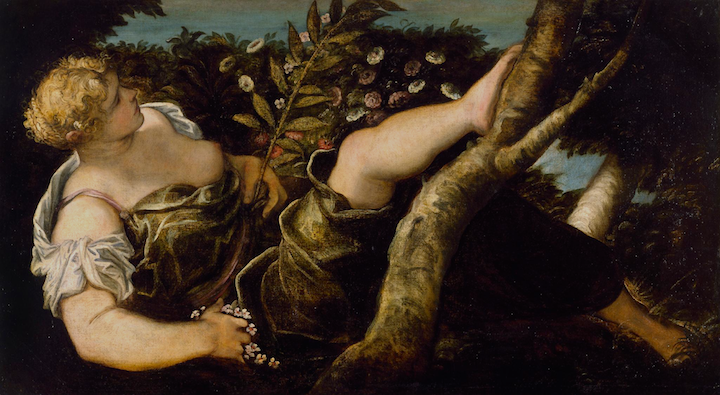
Allegorical Figure of Spring by Tintoretto
c.1555 / Oil on canvas / 41 1/2”x76 3/4” / Chrysler Museum of Art

Spring~ April 2
Walking on a Path in Spring by Ma Yuan
c.1127-1279 / Album leaf, ink and color on silk / 10.8”x17” / National Palace Museum, Taipei

≈ ≈ ≈ ≈ ≈ ≈ ≈ ≈ ≈ ≈
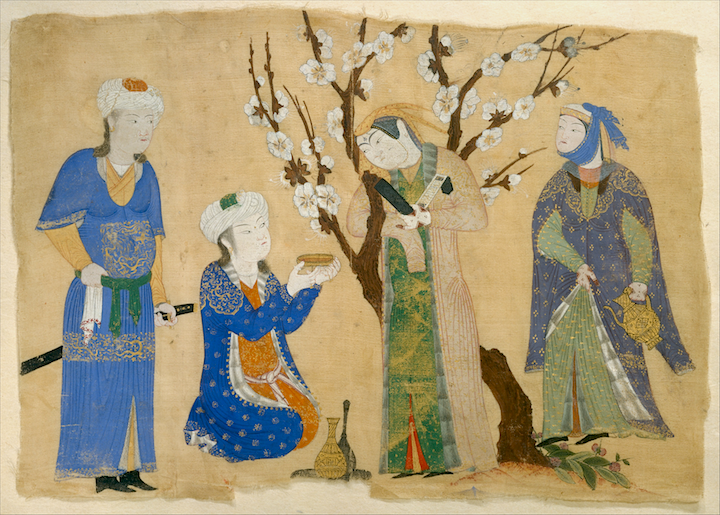
Wine Drinking in a Spring Garden Attributed to Iran, possibly Tabriz
c.1430 / Opaque watercolor and gold on undyed silk / 8.5”highx30.20” / Metropolitan Museum of Art

Spring~ April 1
Primavera by Sandro Botticelli
c.1482 / Tempera on panel / 79.9”x123.6” / Uffizi Gallery, Florence
The Four Seasons: Spring
March 31~
Johann Sebastian Bach (1685-1750)
art: Elias Gottlob Haussmann
Leipzig Bach Museum
bio: http://www.bach-cantatas.com/Lib/Bach-Johann-Sebastian.htm
video: https://youtu.be/BOZEj8wyj-I
Franz Joseph Haydn (1732-1809)
art: John Hoppner
Royal Collection Trust
bio: https://www.chambermusicsociety.org/about-the-music/composers/joseph-haydn
video: https://youtu.be/E6JVYrhbxWs
March 31~ Women’s History Month in visual arts
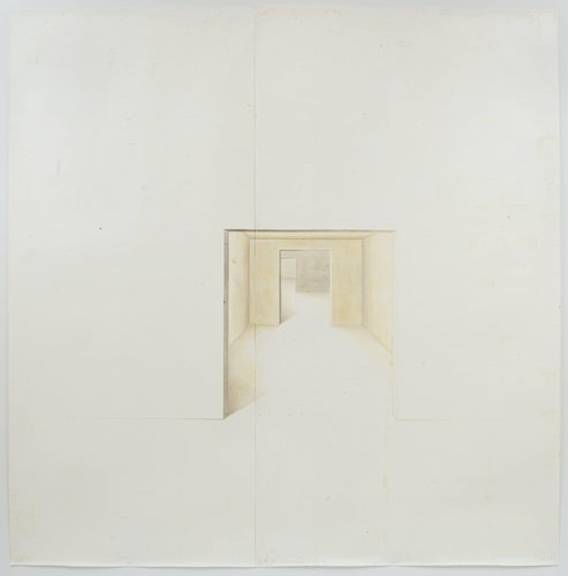
Toba Khedoori (Born 1964), Australian-born American artist known for detailed renderings on wall-size sheets of wax-treated paper https://www.davidzwirner.com/artists/toba-khedoori/biography
Untitled (rooms) / 2001 / Oil and wax with graphite on two sheets of paper / 144”x144”

Kara Walker (Born 1969)
African-American contemporary painter, silhouettist, printmaker, installation artist, and filmmaker
https://www.britannica.com/biography/Kara-Walker
The Emancipation Approximation (Scene #18) / 1999-2000 / Screenprint / 44”x33 15/16”
March 30~ Women’s History Month in visual arts
Chakaia Booker (Born 1953)
African-American sculptor best known for her work using tires as a medium
https://nmwa.org/explore/artist-profiles/chakaia-booker
Urban Butterfly / 2001 / Rubber tires / 57”x53”
Kiki Smith (Born 1954)
German-born American artist’s work includes sculpture, printmaking, photography, drawing, and textiles
https://www.guggenheim.org/artwork/artist/kiki-smith
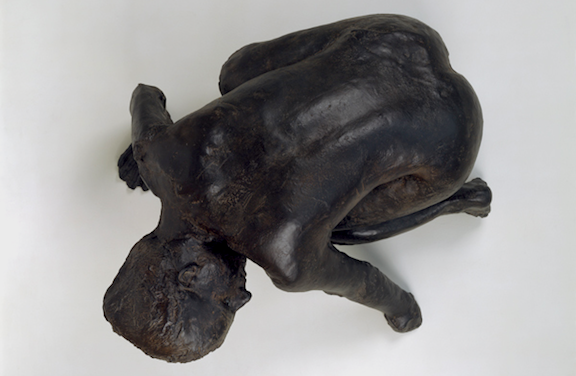
Lilith / 1994 / Bronze with glass eyes / 31 1/2”x27”x17 1/2”

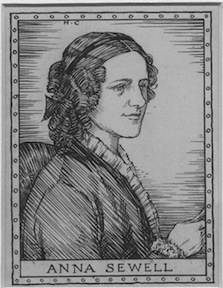
Anna Sewell: Born March 30, 1820
While in her fifties Sewell first devised the idea to write her own book about horses. Initially intended, as she wrote in her diary, to be an instructional work to induce kindness, sympathy, and an understanding treatment of horses little did she know it would become a best-seller. Bustling Victorian London’s society, transportation and industry was dependent on horse power, but there were also emerging vegetarian and animal anti-cruelty groups. Through the trials and tribulations of Black Beauty we see a cross-section of the working conditions and quality of life for horses.
FROM http://www.online-literature.com/anna-sewell/Black Beauty is widely credited with helping to change the way horses were cared for. There is little doubt that the book helped hasten the abolishment of the “bearing rein” — a strap used to pull a horse’s head in toward its chest to force the appearance of a noticeable arch of the neck. Black Beauty also placed a harsh spotlight on the practice of “docking” or cutting short a horses tail, largely for the sake of appearances — a practice that is still widely debated.
FROM How ‘Black Beauty’ Changed The Way We See Horses
http://www.npr.org/2012/11/02/163971063/how-black-beauty-changed-the-way-we-see-horses