Benny Goodman: Born May 30, 1909

AlbumCover

YoungBGBefore he was in his teens, Goodman had begun performing in public…Goodman’s precocious talent allowed him to become a member of the American Federation of Musicians at the age of 14 and that same year he played with Bix Beiderbecke. By his mid-teens Goodman was already established as a leading musician, working on numerous engagements with many bands to the detriment of his formal education.
FROM http://biography.just-the-swing.com/benny-goodmanOrchestra

The second band that he formed (in 1934) got a job at Billy Rose’s Music Hall. This band made some great recordings and began appearing on the 3-hour NBC radio program called “Let’s Dance.”

After this, the Benny Goodman Orchestra began touring (with not so fantastic results) until August 21, 1935, when the Benny Goodman Orchestra opened in the Palomar Ballroom in Los Angeles. After playing a few dance tunes, he told the band to play some Fletcher Henderson arrangements. The mostly young crowd promptly started something of a riot. After this public approval of the music – this thing called “Swing” – there was no looking back!
FROM http://www.touchoftonga.com/DavidMulliss/benny-goodman.html

OlderBGBenny did for clarinet what Louis Armstrong had done for the trumpet.  He gave it a newly assertive leadership role in the jazz ensemble.
FROM http://jazzhotbigstep.com/45801.html

Benny Goodman Discography: http://www.discogs.com/artist/254768-Benny-Goodman
May 29, 1913: Premiere of “Le sacre du printemps”

The riot turned the work into a symbol of all that modernist art was supposed to be: a break with tradition and a thumb in the eye of bourgeois taste. Yet for quite some time scholars have called into question the size, the ferocity, and the immediate effects of what definitely was a disturbance on opening night.

But the extent to which this disturbance counts as a riot really is beside the point, as is the question of what actually happened that night. What matters most is that whatever it was, it never happened again.
FROM Spring Fever~ http://www.theparisreview.org/blog/2013/07/11/spring-fever/

A Reconstruction Of ‘The Rite Of Spring”, 2013~ https://www.wbur.org/news/2013/03/15/rite-of-spring
Biographical background~ http://www.cco.caltech.edu/~tan/Stravinsky/biography.html

Bill “Bojangles” Robinson: Born May 25, 1878

“Bill “Bojangles” Robinson (May 25, 1878-November 25, 1949), was a pioneer and pre-eminent African-American tap dance performer since his childhood.”
https://www.harlemworldmagazine.com/bill-bojangles-robinson/

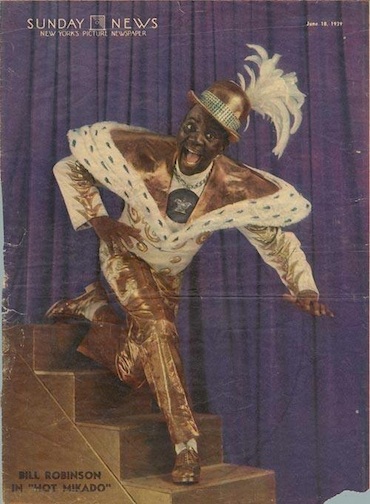
SundayNews

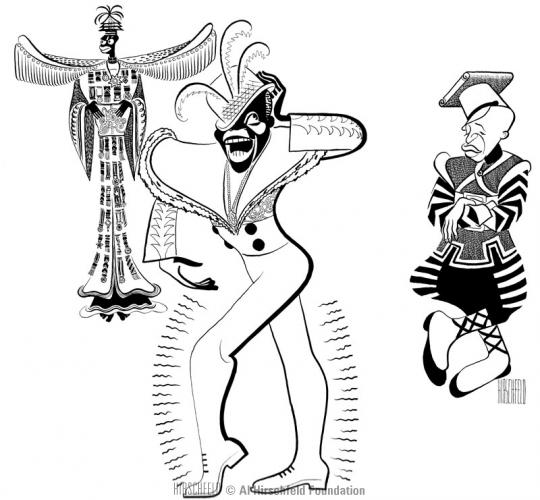
“The Hot Mikado,” starring Bill “Bojangles” Robinson, was a big Broadway hit. It was noted for its wild costuming and all black cast. It ran at the Broadhurst Theater, in Manhattan, from March 23 to June 3, 1939.
Producer Mike Todd announced he was moving the show to the New York World’s Fair. The show became one of the biggest hits at the fair and opened at the Hall of Music on June 22, 1939.
FROM http://www.qchron.com/qboro/i_have_often_walked/bill-bojangles-robinson/article_81b0281a-c1ee-5853-ae31-f810fb8b92a7.html

Silent movie film footage of the Michael Todd production at the New York World’s Fair 1939-1940:

Erskine Hawkins Orchestra – Two Selections from “Hot Mikado”~
https://archive.org/details/ErskineHawkinsOrchestra-TwoSelectionsFromhotMikado

HotMikado

Bill Robinson:
https://artsedge.kennedy-center.org/interactives/harlem/faces/bill_robinson.html

 https://www.pbs.org/wnet/broadway/stars/bill-bojangles-robinson/

https://en.wikipedia.org/wiki/Bill_Robinson

Bob Dylan: Born May 24, 1941

Bob Dylan Through The Years~
http://www.rollingstone.com/music/pictures/photos-70-photos-of-bob-dylan-on-his-70th-birthday-20110524

 Bob Dylan: Official Site~ http://www.bobdylan.com/us/home

Bob Dylan: Halcyon Gallery~ https://www.halcyongallery.com/bob-dylan/

Bob Dylan: Castle Fine Art~ https://www.castlefineart.com/artists/bob-dylan

Emanuel Gottlieb Leutze: Born May 24, 1816

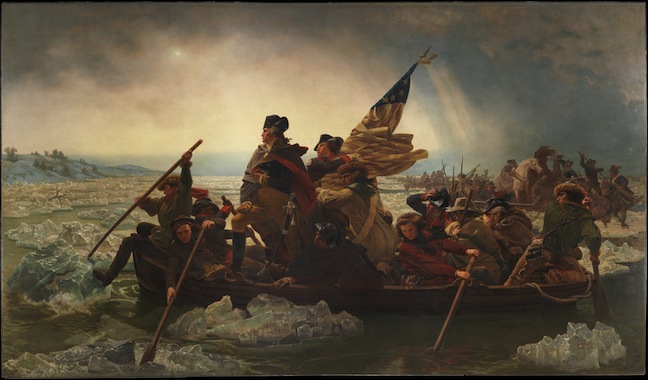
WashingtonWashington Crossing the Delaware, 1851 • Emanuel Gottlieb Leutze
Oil on canvas; 149 x 255 in. (378.5 x 647.7 cm)

Leutze’s depiction of a critical moment during the American revolution has become one of the best known and most extensively published images in American history. He portrays George Washington, accompanied by some 2,500 of his troops, crossing the Delaware River about nine miles above Trenton, New Jersey, in a surprise attack on the Hessians. The strategic crossing took place after midnight on December 25, 1776; ice floes and a heavy snowstorm kept the American soldiers and their allies from reaching shore until daybreak, which Leutze captured with the morning star overhead.
http://www.metmuseum.org/toah/works-of-art/97.34

Crossing of the Delaware: http://www.mountvernon.org/research-collections/digital-encyclopedia/article/crossing-of-the-delaware/
Emanuel Gottlieb Leutze…German-born American historical painter whose picture Washington Crossing the Delaware (1851) numbers among the most popular and widely reproduced images of an American historical event.
http://www.britannica.com/EBchecked/topic/337776/Emanuel-Gottlieb-Leutze

Margaret Wise Brown: Born May 23, 1910

5 Fascinating Facts About Margaret Wise Brown
https://mymodernmet.com/margaret-wise-brown-facts/


Margaret Wise Brown’s life was full of what her admirers like to call whimsy and other people might call childlike behavior. She spent her first royalty check on an entire flower cart full of flowers. At her house in Maine, which she called “The Only House,” she had an outdoor boudoir with a table and nightstand and a mirror nailed to a tree, along with an outside well that held butter and eggs, and wine bottles kept cold in a stream; one could easily imagine a little fur family living in “The Only House,” but it was just her friends, associates, editors, and lovers passing through. She was once chastised by a hotel owner in Paris because she had brought giant orange trees and live birds into her room. The orange trees might have been OK, the owner thought, but the live birds were a little de trop.

FROM The Restless Life of Margaret Wise Brown

Richard Wagner~ Born May 22, 1813

Early in his career, Wagner learned both the elements and the practical, political realities of his craft by writing a handful of operas which were unenthusiastically, even angrily, received. Beginning with Rienzi (1838-40) and The Flying Dutchman (1841), however, he enjoyed a string of successes that propelled him to immortality and changed the face of music. His monumental Ring cycle of four operas — Das Rheingold (1853-54), Die Walküre (1854-56), Siegfried (1856-71) and Götterdämmerung (1869-74) — remains the most ambitious and influential contribution by any composer to the opera literature.
http://www.allmusic.com/artist/richard-wagner-mn0000958980/biography

“The Brilliant, Troubled Legacy of Richard Wagner”
https://www.smithsonianmag.com/arts-culture/the-brilliant-troubled-legacy-of-richard-wagner-16686821/

A great music lover, Renoir was one of the first admirers of Wagner in France. At the beginning of 1882, when the painter was travelling in the south of Italy, he had the opportunity to visit Palermo where Wagner was staying. After two fruitless attempts, Renoir was finally introduced to the “maestro” who, the day before, had put the final notes to Parsifal.
The course of this meeting is well known thanks to a letter from Renoir to one of his friends, dated 15 January 1882:
https://www.musee-orsay.fr/en/artworks/richard-wagner-1159

Richard Wagner by Auguste Renoir, 1882
Oil on canvas / Musee d’Orsay, Paris, France

[4 embedded links above]

Fats Waller: Born May 21, 1904

Fats Waller (May 21, 1904-December 15, 1943), jazz and popular pianist, singer, and songwriter, was born Thomas Wright Waller in New York City, the son of Edward Martin Waller, a Baptist preacher, and Adeline Lockett. From age six Waller was devoted to the piano but initially failed to practice properly or learn to read music well, because he could memorize lessons immediately. In his youth he also played reed organ in church. He studied piano, string bass, and violin at P.S. 89, which he attended to about age fourteen or fifteen. Although his girth had earned him a nickname by this time, the names Thomas and Fats appeared interchangeably (and sometimes together, as Thomas “Fats” Waller) in his professional work until at least 1931. Later in his career, and posthumously, the nickname prevailed.
http://www.anb.org/articles/18/18-01201.html

Norma Bassett Hall, American printmaker: Born May 21, 1889

NBHOne

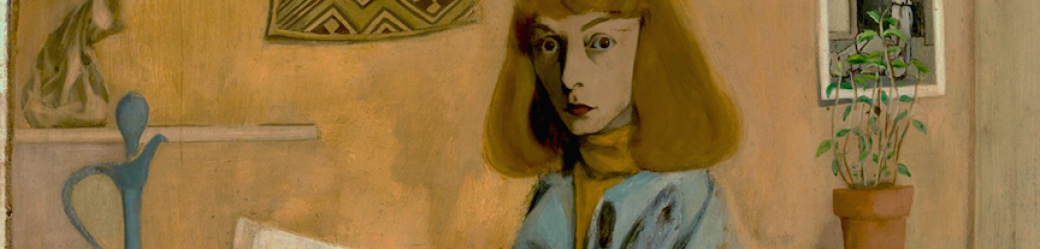
Norma Bassett Hall was an American woodblock printmaker who often depicted landscapes and outdoor scenes. She was born in Halsey, Oregon. In 1910, she become a member of the inaugural class of the Museum Art School in Portland, Oregon. After leaving Portland, she briefly taught in Milwaukee, Wisconsin, before continuing her education at the School of the Art Institute of Chicago from 1915-1918. She also studied privately with the noted British printmaker Mabel Royds, who introduced Norma to the Japanese method of printing woodcuts on rice paper with transparent watercolors. While studying at the SAIC, Norma Bassett met and would later NBHTwomarry Arthur William Hall, a fellow student and artist. Following their marriage, they made their home in Kansas, becoming deeply involved with the state’s flourishing printmaking culture and helping to found the Prairie Print Makers. Hall, the only female among the group’s eleven charter members, designed their distinctive logo, a monogram set within a stylized sunflower. Hall and her husband divided their time and subjects between the rolling hills of Kansas and the dramatic vistas of New Mexico. In 1944 the couple permanently relocated to New Mexico, living first in Santa Fe and eventually purchasing an estate near Alcade from which they operated an art school. Bassett Hall continued to work and teach from their estate until her death in 1957. ~FROM Wikipedia

Jordan Schnitzer Museum of Art~
http://jsma.uoregon.edu/jordan-schnitzer-museum-art-opens-first-solo-exhibition-norma-bassett-hall-1957
Biography~ https://www.annexgalleries.com/artists/biography/927/Hall/Norma
Artnet~ http://www.artnet.com/artists/norma-bassett-hall/past-auction-results

“Curator’s Pick: Favorite Item from the Alice 150 Exhibit”

hornbakelibrary's avatarSpecial Collections & University Archives

I haven’t counted, but I would guess that at least 10% of people who meet me ask if I play basketball. I haven’t.But when you are almost 6′ tall, that’s a fair question.Jabberwocky1

It might seemsurprising then that someone who cannot dribble to save her life might choose Christopher Myer’s Jabberwocky, the Classic Poem from Lewis Carroll’s Through the Looking-Glass and What Alice Found Thereas her favorite item in the Alice 150 exhibit. But I have my reasons. Myers’brilliant recreation Carroll’s most famous poem as a pick-up basketball game is visually engrossing and thought provoking and hisstriking illustrationspulse with energy. Myers uses his original illustrations in tandem with Carroll’s original poem to create a “Jabberwock” who is the towering king of an urban basketball court…up until now!The oversize, oddly shaped and multicolored font sprawls across the page in between large, fiery-eyed players who seem as if they are somehow…

View original post 227 more words