What painter, born in 1725, is fabled to have convinced his father of his natural aptitude for painting when the parent mistook his son’s pen-and-ink drawing of Saint James for an engraving?
What illustrator’s fame was established when the first volume of The Yellow Book — an art and literature quarterly for which he served as art editor as well as contributing drawings and covers — appeared in April 1894?
Which early member of the American Abstract Artists group articulated her philosophical theorems not only through her art but also through her writing, lectures, teaching, and poetry?
Which Russian-born Constructivist artist, a pioneer of Kinetic Art, used materials such as glass, plastic, and metal and created a sense of spatial movement in his work?
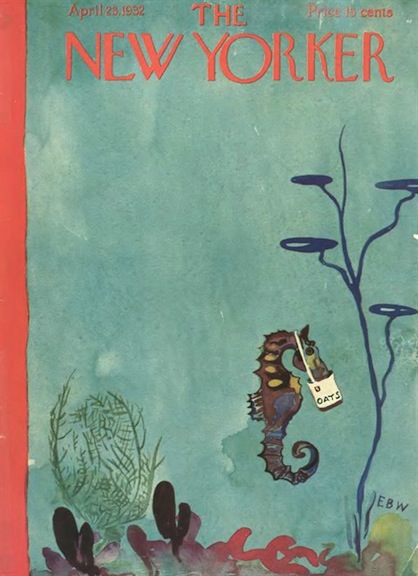
INTERVIEWER You were also an artist. What did Thurber and the other New Yorker artists think of your drawings and New Yorker covers? WHITE I’m not an artist and never did any drawings for The New Yorker. I did turn in a cover and it was published. I can’t draw or paint, but I was sick in bed with tonsillitis or something, and I had nothing to occupy me, but I had a cover idea—of a sea horse wearing a nose bag. I borrowed my son’s watercolor set, copied a sea horse from a picture in Webster’s dictionary, and managed to produce a cover that was bought. It wasn’t much of a thing. I even loused up the whole business finally by printing the word “oats” on the nose bag, lest somebody fail to get the point. I suppose the original of that cover would be a collector’s item of a minor sort, since it is my only excursion into the world of art. But I don’t know where it is. I gave it to Jed Harris. What he did with it, knows God. FROMhttp://www.theparisreview.org/interviews/4155/the-art-of-the-essay-no-1-e-b-white
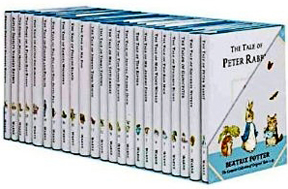
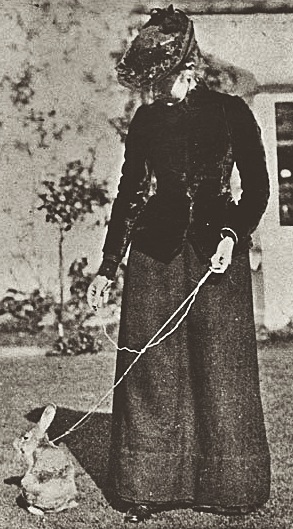
Helen Beatrix Potter was born on 28th July 1866 at 2 Bolton Gardens, in Kensington, London to a wealthy family. Both Beatrix’s parents lived on inheritances from the cotton trade and, though qualified as a barrister, her father, Rupert, focused much of his time on his passion for art and photography. He and his wife, Helen, enjoyed an active social life among a group of writers, artists and politicians and the family included many connoisseurs and practitioners of art. Helen herself was a fine embroiderer and watercolourist and Edmund Potter, Beatrix’s paternal grandfather, was co-founder and president of the Manchester School of Design. FROM http://www.vam.ac.uk/content/articles/b/biography-beatrix-potter/
Art lessons were provided but Beatrix found them barely tolerable. She politely rebelled, secretly worried that copying another artist would compromise her own originality, and hoped that she “wouldn’t catch it.” More to her liking were outings with her father, an
sometime amateur photographer, to the great art galleries of London which constituted her real artistic apprenticeship. Her education was limited only by her capacity to observe. Although she experimented with a variety of media, by 19 she had chosen watercolour and was rapidly perfecting her dry-brush technique. FROM http://www.bpotter.com/Beatrix.aspx
Margaret Wise Brown’s life was full of what her admirers like to call whimsy and other people might call childlike behavior. She spent her first royalty check on an entire flower cart full of flowers. At her house in Maine, which she called “The Only House,” she had an outdoor boudoir with a table and nightstand and a mirror nailed to a tree, along with an outside well that held butter and eggs, and wine bottles kept cold in a stream; one could easily imagine a little fur family living in “The Only House,” but it was just her friends, associates, editors, and lovers passing through. She was once chastised by a hotel owner in Paris because she had brought giant orange trees and live birds into her room. The orange trees might have been OK, the owner thought, but the live birds were a little de trop.
The Hollywood Reporter:You made a hilarious, new 74-minute version of your X-rated 1972 cult film Pink Flamingos, rewritten as a “desexualized sequel” — a children’s movie with an all-kid cast. Why did you decide to exhibit the video here, in this way? John Waters: I don’t think of it as the next movie in my filmography at all.I don’t want it showing in a movie theater where people have to come in and take a seat and have to watch it straight through. You understand what the piece is if you watch it for 20 minutes. The Hollywood Reporter: Tell me a little bit about how you reconcile your work in the worlds of art and of film, pop and pulp culture? John Waters: I have gone to great lengths in my career to keep my art career and my film career completely separate. But my art work is as equal to me as making movies.
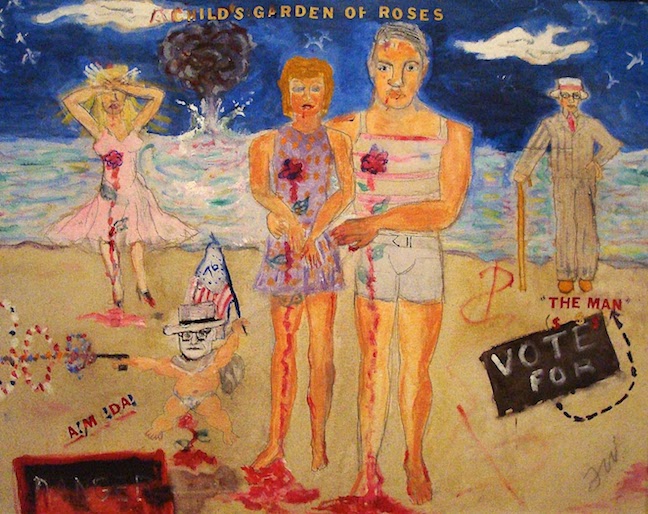
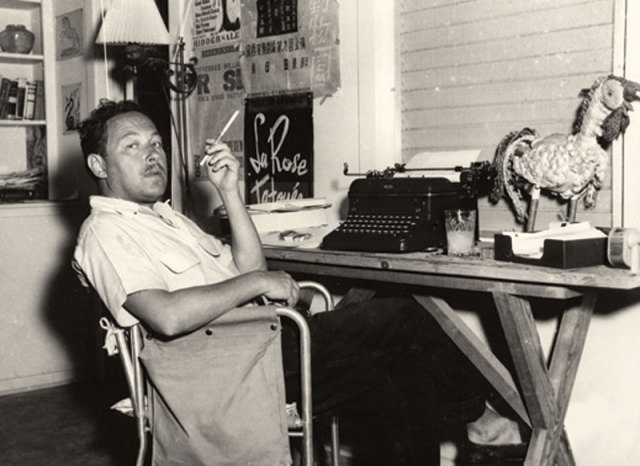
Williams first took up painting in the early 1960s when his career as a playwright ebbed. He often relaxed on the patio of his Key West home and painted. Williams’ patio was his preferred art studio. People frequently visited his house on Duncan Street and purchased his artwork before the paint was dry. …Painting was a passion for him, almost to the point that it became a second profession. Toward the end of his life, Williams gradually gave up writing for painting; a less harsh way to express himself. Critics did not think as much of his painting as his plays, however his artwork remains widely popular among collectors. FROMhttps://www.kwahs.org/exhibit/tw-painter/








 The Misty Miss Christy