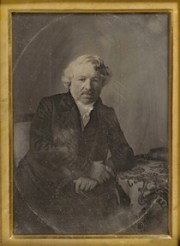
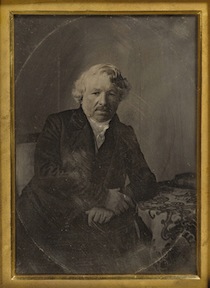
 Louis Jacques Mande Daguerre was born near Paris, France in 1787. The illusionistic painter Pierre Prevost asked him to join his team of panorama-painting artists when he was just twenty years old. Daguerre soon after became an assistant stage designer for a theater. He was a gifted illusionist in terms of his ability to design sets that dazzled his audiences. An artist who wanted his work to be as real as possible, Daguerre created amazingly life-like scenes right in the theater. These designs, which were able to simulate the passage of day into night, changes in weather, and even give viewers the feel of motion, Daguerre later coined as “dioramas,” or “dramas of light.” By 1825, Daguerre was a successful creator, proprietor, and promoter of a successful illusionistic theater in Paris that specialized in these dioramas. https://www.fi.edu/history-daguerreotype
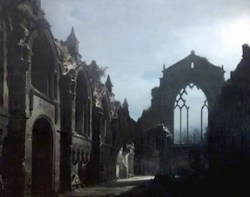 Daguerre had been searching since the mid-1820s for a means to capture the fleeting images he saw in his camera obscura, a draftsman’s aid consisting of a wood box with a lens at one end that threw an image onto a frosted sheet of glass at the other. In 1829, he had formed a partnership with Nicéphore Niépce, who had been working on the same problem—how to make a permanent image using light and chemistry—and who had achieved primitive but real results as early as 1826. By the time Niépce died in 1833, the partners had yet to come up with a practical, reliable process.
http://www.metmuseum.org/toah/hd/dagu/hd_dagu.htm
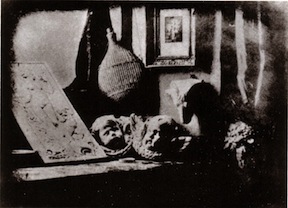
Niépce died in 1833 before practical success was achieved. But Daguerre had learned important things  through the partnership, and by 1837 had worked out a solution to the puzzle. In brief, his method consisted of treating silver-plated copper sheets with iodine to make them sensitive to light, then exposing them in a camera and “developing” the images with warm mercury vapor. On the basis of its novelty, and difference from the pewter-and-resin based systems developed by Niépce, Daguerre claimed the invention as his own by naming it “The Daguerreotype.”
https://www.daguerreiansociety.org/

The Diorama: 19th century entertainment~
Daguerre’s Sole Extant Diorama, Recently Restored~



 The Misty Miss Christy