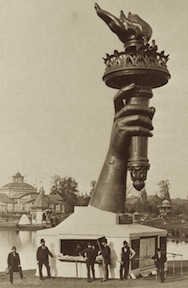
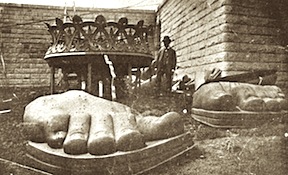
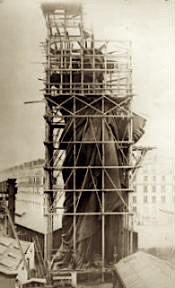
In 1865, a French political intellectual and anti-slavery activist named Edouard de Laboulaye proposed that a statue representing liberty be built for the United States. This monument would honor the United States’ centennial of independence and the friendship with France. French sculptor Auguste Bartholdi supported Laboulaye’s idea and in 1870 began designing the statue of “Liberty Enlightening the World.” While Bartholdi was designing the Statue, he also took a trip to the United States in 1871. During the trip, Bartholdi selected Bedloe’s Island as the site for the Statue. Although the island was small, it was visible to every ship entering New York Harbor, which Bartholdi viewed as the “gateway to America.” Creating the Statue of Liberty~http://www.nps.gov/stli/learn/historyculture/places_creating_statue.htm
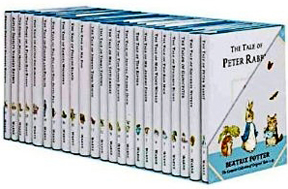
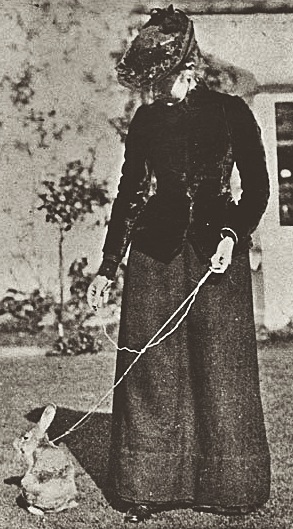
Helen Beatrix Potter was born on 28th July 1866 at 2 Bolton Gardens, in Kensington, London to a wealthy family. Both Beatrix’s parents lived on inheritances from the cotton trade and, though qualified as a barrister, her father, Rupert, focused much of his time on his passion for art and photography. He and his wife, Helen, enjoyed an active social life among a group of writers, artists and politicians and the family included many connoisseurs and practitioners of art. Helen herself was a fine embroiderer and watercolourist and Edmund Potter, Beatrix’s paternal grandfather, was co-founder and president of the Manchester School of Design. FROM http://www.vam.ac.uk/content/articles/b/biography-beatrix-potter/
Art lessons were provided but Beatrix found them barely tolerable. She politely rebelled, secretly worried that copying another artist would compromise her own originality, and hoped that she “wouldn’t catch it.” More to her liking were outings with her father, an
sometime amateur photographer, to the great art galleries of London which constituted her real artistic apprenticeship. Her education was limited only by her capacity to observe. Although she experimented with a variety of media, by 19 she had chosen watercolour and was rapidly perfecting her dry-brush technique. FROM http://www.bpotter.com/Beatrix.aspx
Stern’s family moved to the United States and settled in San Francisco when he was one year old. His mother, a professional singer, gave him his first music lessons. He began studying the violin at the San Francisco Conservatory in 1928. In 1932 he became the third immensely talented San Francisco-area boy to train with the San Francisco Symphony concertmaster Louis Persinger (the others were Menuhin and Ruggiero Ricci). However, he considered Naoum Blinder, with whom he studied until the age of 15, his only true teacher. Stern made his debut with the San Francisco Symphony on February 18, 1936, with Pierre Monteux conducting the Third Concerto by Saint-Saëns. FROMhttp://www.allmusic.com/artist/isaac-stern-mn0000965898/biography
However, Stern was to become as famous internationally for his contribution to public causes as he was for his concert performances and recordings. His social contributions took many forms: his most noted involvement as a cultural activist was his pivotal role in the 1960 salvation of Carnegie Hall, then facing demolition. Elected president of the Carnegie Hall Corporation, he guided the affairs of the edifice he called “our country’s affirmation of the human spirit” (Stern and Potok, p. 141) until the end of his life. He was chairman of the board of the America-Israel Cultural Foundation and founder and chairman of the Jerusalem Music Center, and in the United States he campaigned for and became a founding member of the National Endowment for the Arts in 1964. In 1975 he received the first Albert Schweitzer Award for “a life’s work dedicated to music and devoted to humanity” and two years later was made a member of the French Légion d’Honneur. FROMhttp://www.anb.org/articles/18/18-03785.html
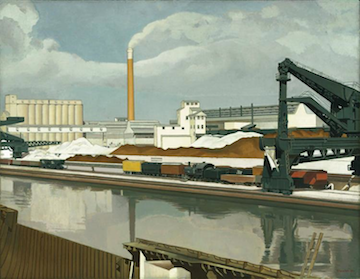
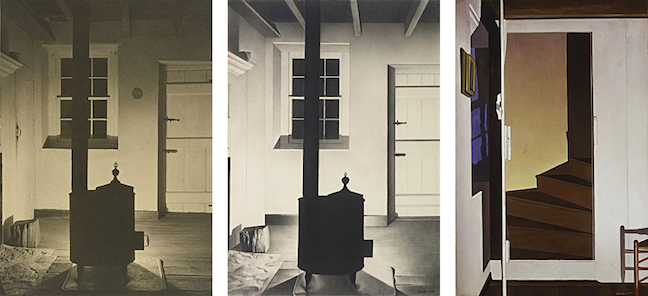
The American modernist Charles Sheeler (1883–1965) explored the relationships between photography, film, and more traditional media such as painting and drawing with more rigor and intellectual discipline than perhaps any other artist of his generation. As in a well-conceived scientific experiment, Sheeler used his own photographs and film stills as the basis for paintings and drawings, thus crystallizing the differences and similarities between them. Works in one medium manage to function as independent objects while also being inextricably linked to works in other media.Charles Sheeler: Across Media
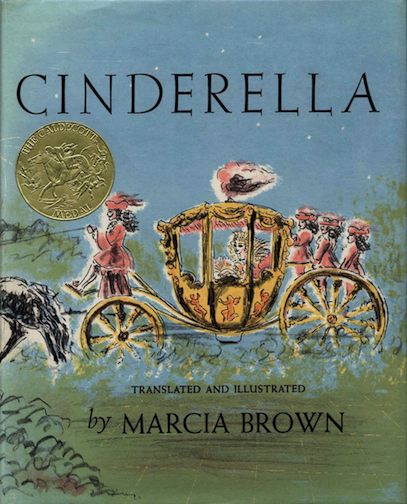
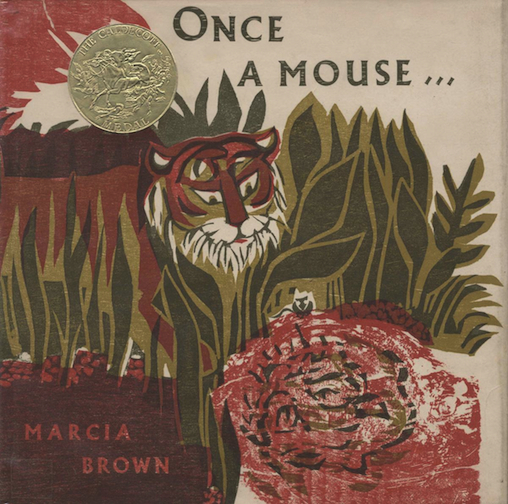
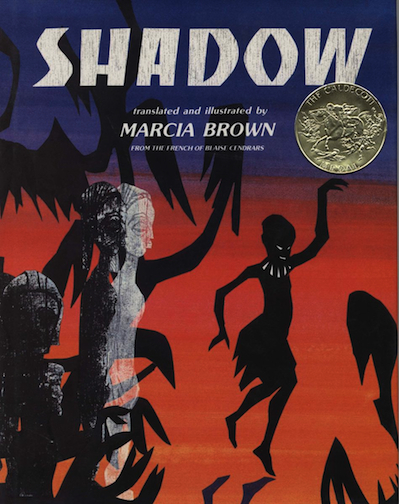
In 1946, Brown published her first book The Little Carousel, which chronicles the adventures of a lonely little boy who hears the sound of a merry-go-round near his home and features Brown’s vivid description of a bustling neighborhood in Greenwich Village, where she lived upon first arriving in New York City. The Little Carousel, which she wrote and illustrated, was followed by over thirty more books during her career. FROMhttps://archives.albany.edu/static/exhibits/marciabrown/bio.htm Brown’s first award was Caldecott Honors for Stone Soup (1948), an old folktale Brown retold and illustrated. She won the Caldecott Medal three times, and received Caldecott Honors a total of six times. She also received the Lewis Carroll Shelf Award, for Once a Mouse… (1961), and her book How, Hippo! (1969), the story of a baby hippo and a crocodile, was an American Library Association Notable Book. Brown illustrated more than thirty books, most of which she either wrote or adapted. She loves folklore and illustrated a number of classic tales from around the world, including Puss in Boots (1952), Anasi, the Spider Man (1954), and The Flying Carpet (1956). Throughout her career, Brown used a wide variety of media, although her most distinctive illustrations are her colored woodblocks. In 1986, Brown published Lotus Seeds: Children, Pictures, and Books, a compilation of her essays and speeches, and her only book for adults. FROMhttp://dla.library.upenn.edu/dla/pacscl/detail.html?id=PACSCL_FLP_clrc00013
Oscar Clendenning Hammerstein II (1895-1960) was perhaps the most influential lyricist and librettist of the American theater. Major musicals for which he wrote the lyrics include “Show Boat,” “South Pacific,” “The King and I,” and “The Sound of Music.” Oscar Hammerstein II~ http://www.pbs.org/wnet/broadway/stars/oscar-hammerstein-ii/
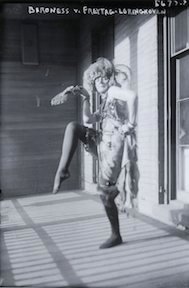
Early last century, when the sight of a woman in trousers could still cause a flap, the spectacle of Baroness Elsa von Freytag-Loringhoven must have aroused hairy panic.
With her five stray dogs trailing behind her on a gilded leash, she would walk regally through Washington Square Park, wearing a short Scottish kilt, a brassiere made from two tomato cans tied together with green string and, hanging from her neck, a wooden birdcage — with a live, chirping canary.
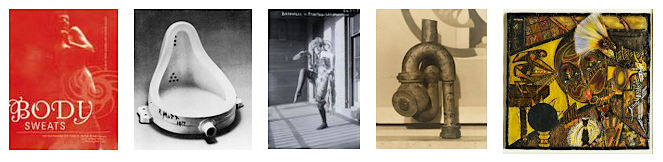
A Dada poet and collagist, artists’ model and troublemaker, she was called by those who knew her simply “the Baroness.” In the late 1910’s and early 1920’s, the Baroness reigned among the intellectual avant-garde who laughed at sexual taboos and made art their revolution. But in the wildly colorful hothouse of Greenwich Village bohemia, the Baroness was the most exotic blossom of them all. “She is not a futurist,” Marcel Duchamp said. “She is the future.” http://www.nytimes.com/2002/08/18/magazine/my-heart-belongs-to-dada.html
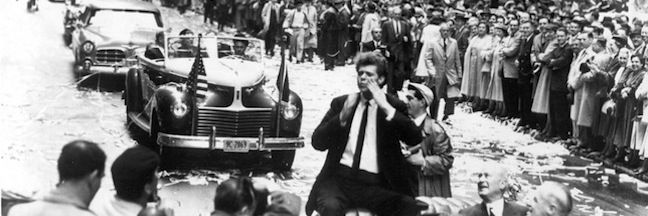
…But if the Tchaikovsky competition represented Mr. Cliburn’s breakthrough, it also turned out to be his undoing. Relying inordinately on his keen musical instincts, he was not an especially probing artist, and his growth was stalled by his early success. Audiences everywhere wanted to hear him in his prizewinning pieces, the Tchaikovsky First Concerto and the Rachmaninoff Third. Every American town with a community concert series wanted him to come play a recital. “When I won the Tchaikovsky I was only 23, and everyone talked about that,” Mr. Cliburn said in 2008. “But I felt like I had been at this thing for 20 years already. It was thrilling to be wanted. But it was pressure, too.” http://www.nytimes.com/2013/02/28/arts/music/van-cliburn-pianist-dies-at-78.html











 The Misty Miss Christy