Marion Post Wolcott: Born June 7, 1910

Wolcott

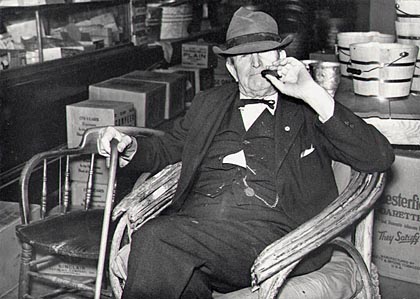
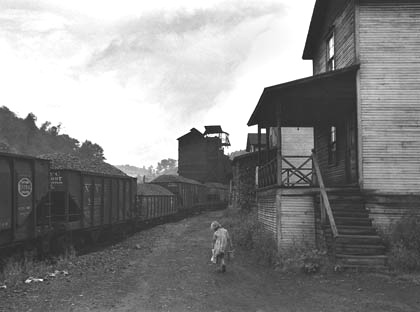
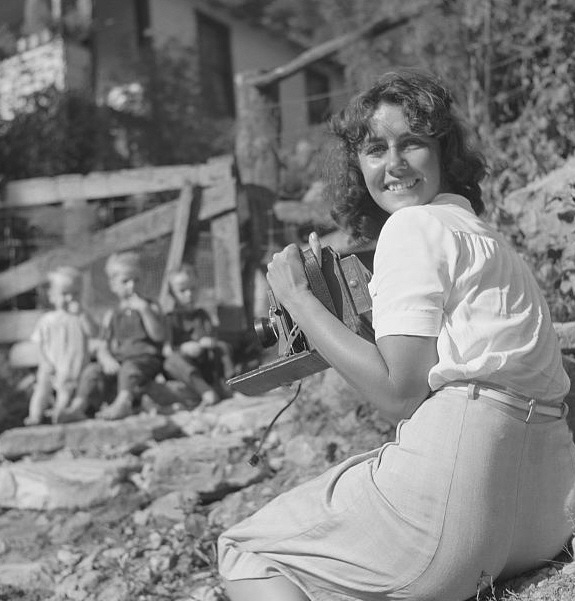
manwithstogieMarion Post Wolcott is best known for the more than 9,000 photographs she produced for the Farm Security Administration (FSA) from 1938 to 1942.1 This work is preserved at the Library of Congress Prints and Photographs Division and also available online. Before Wolcott became a government photographer, she earned her living making photographs for magazines and newspapers. Initially she worked freelance, but, as a staff photojournalist in 1937 and 1938, Wolcott broke gendertrain barriers in the newspaper darkroom. Then she worked for the Farm Security Administration, one of the largest news photography projects in the world.  students Although she worked professionally for only a few years, her artistry and perseverance have inspired many articles, books, and exhibitions and her photographs created a lasting record of American life on the eve of World War II.
FROM http://www.loc.gov/rr/print/coll/womphotoj/wolcottessay.html

The Photography of Marion Post Wolcott~
https://americanart.si.edu/artist/marion-post-wolcott-18332
Oral history interview with Marion Post Wolcott, 1965~
http://www.aaa.si.edu/collections/interviews/oral-history-interview-marion-post-wolcott-12262
Shorpy: M.P. Wolcott~ http://www.shorpy.com/image/tid/142

Edward Penfield: Born June 2, 1866

epportraitBicycleCatseptoo

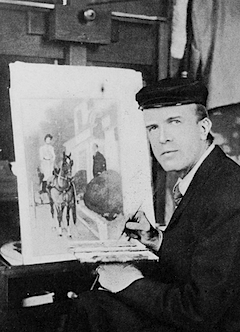
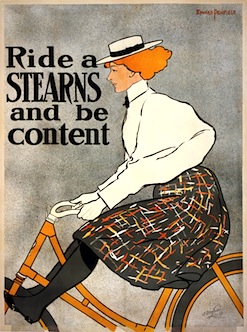
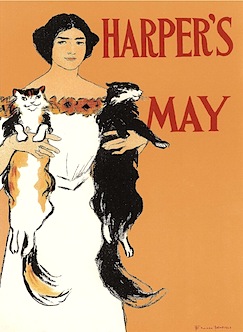
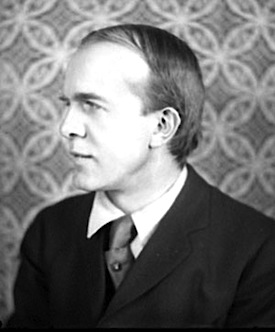
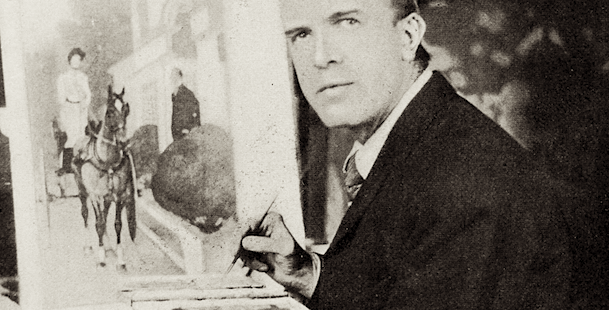
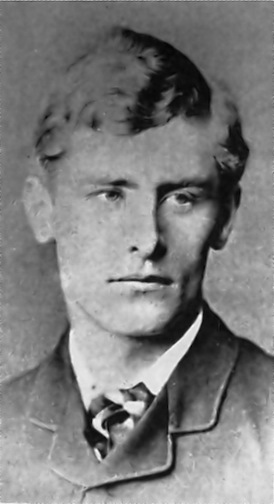
“What many do not realize is that Penfield’s Harpers years account for less than a third of his thirty-four year career. During the decade after his self-retirement from Harper and Brothers, his freelance work was seen by millions of people on hundreds of magazine covers and advertisements.

Not a boisterous self-promoter like some of his contemporaries — he rarely gave personal interviews — Penfield preferred to live a quiet life near his ancestral stomping grounds in New York. But at the same time he was considered “that rare person among artists, an active citizen.” He volunteered for civic duties, spoke at womens’ clubs, taught at the Art Students’s League and served as president of the Society of Illustrators.

More than a poster artist, Edward Penfield was an illustrator, art editor, graphic designer, writer, painter, educator and mentor — an American Master.” FROM https://edwardpenfield.com/introduction/

Google Arts: https://artsandculture.google.com/entity/edward-penfield/m09rt2r_?categoryId=artist&hl=en
Edward Penfield posters~ https://digitalcollections.nypl.org/collections/posters-by-edward-penfield#/?tab=about
eptopper

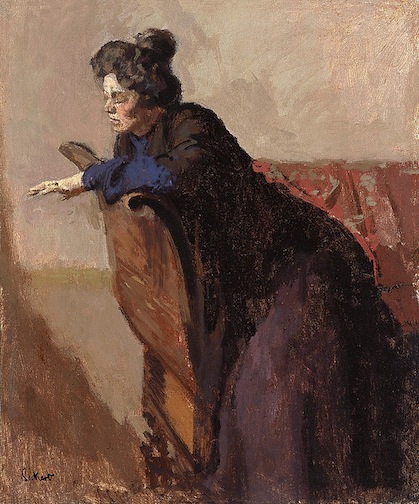
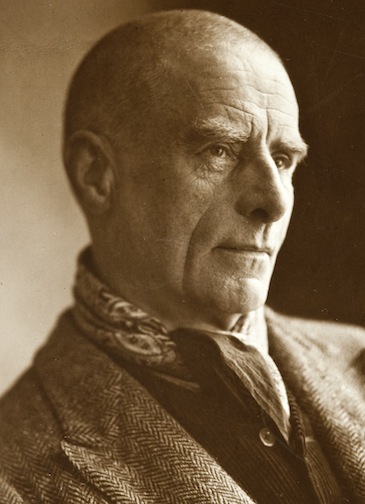
Walter Richard Sickert: Born May 31, 1860

Persuasion

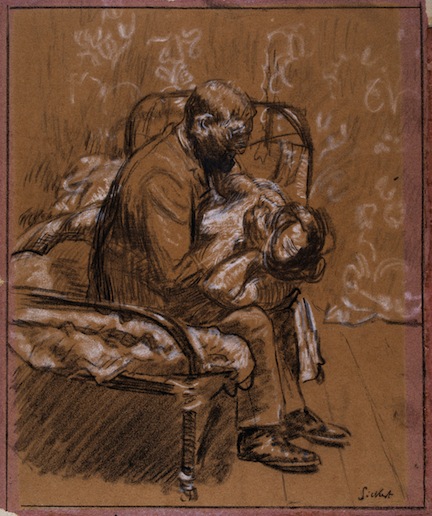
Sickert1Unlike the majority of the Camden Town Group, Walter Richard Sickert was recognised during his own lifetime as an important artist, and in the years since his death has increasingly gained a reputation as one of the most influential figures in twentieth-century British art…His art, like his personality, is multifaceted, complex and compelling.

The twenty-first century has seen a sustained period of Sickert research and exhibitions,TheRing crystallising his reputation as one of the most significant British artists of the early modern period.
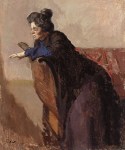
FROM http://www.tate.org.uk/art/research-publications/camden-town-group/walter-richard-sickert-r1105345
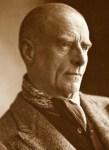
Sickert2The most popular and famous theory as to the identity of Jack the Ripper…was first posited by author Stephen Knight in the 1970s.

He claimed the Ripper’s victims were really killed to cover up a scandalous secret marriage between the Queen’s son Prince Albert Victor, then second in line to the throne, and a Catholic prostitute named Annie Elizabeth Crook, who bore Albert’s child.

Knight got much of his information from Joseph Gorman-Sickert, who claimed to be the illegitimate son of painter Walter Sickert, himself a Ripper suspect.
FROM http://theunredacted.com/jack-the-ripper-the-royal-conspiracy/

Top 10 Stupidest/Weirdest Jack the Ripper theories~ http://swallowingthecamel.me/2013/11/10/top-10-stupidestweirdest-jack-the-ripper-theories/
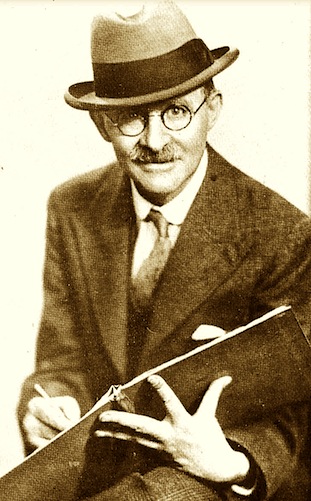
W. Heath Robinson: Born May 31, 1872

RobinsonRobinson was born into a family of artists in 1872. His father, grandfather and uncle all made their livings through art, via drawing or engraving. Robinson was educated at Islington Art School and the Royal Academy. He illustrated dozens of books, from famous works like Donoutdoors Quixote and A Midsummer Night’s Dream to lesser-known volumes such as The Incredible Adventures of Professor Branestawm and Plantation Barn Dance.
FROM http://www.abebooks.com/books/illustration-art-uncle-lubin-william/w-heath-robinson.shtml

…in World War Two the machine created by British code breakers at Bletchley Park, the golfdriverspredecessor to the world’s first computer Colossus, was nicknamed Heath Robinson. It consisted of reels and spools, which had to be precisely aligned and timed in order for it to work.
FROM http://www.bbc.com/news/magazine-27813927

waterFor his own pleasure, he continued to paint in watercolours, experimenting with effects of light and colour. His importance, as an innovator in the fields of illustration and advertising, and perhaps more importantly as the heir of Rowlandson and Cruikshank in the British humorous tradition, has yet to be fully appreciated, and his work is poorly represented in public collections.
FROM http://heathrobinson.org/robinson/index.htm

Benny Goodman: Born May 30, 1909

AlbumCover

YoungBGBefore he was in his teens, Goodman had begun performing in public…Goodman’s precocious talent allowed him to become a member of the American Federation of Musicians at the age of 14 and that same year he played with Bix Beiderbecke. By his mid-teens Goodman was already established as a leading musician, working on numerous engagements with many bands to the detriment of his formal education.
FROM http://biography.just-the-swing.com/benny-goodmanOrchestra

The second band that he formed (in 1934) got a job at Billy Rose’s Music Hall. This band made some great recordings and began appearing on the 3-hour NBC radio program called “Let’s Dance.”

After this, the Benny Goodman Orchestra began touring (with not so fantastic results) until August 21, 1935, when the Benny Goodman Orchestra opened in the Palomar Ballroom in Los Angeles. After playing a few dance tunes, he told the band to play some Fletcher Henderson arrangements. The mostly young crowd promptly started something of a riot. After this public approval of the music – this thing called “Swing” – there was no looking back!
FROM http://www.touchoftonga.com/DavidMulliss/benny-goodman.html

OlderBGBenny did for clarinet what Louis Armstrong had done for the trumpet.  He gave it a newly assertive leadership role in the jazz ensemble.
FROM http://jazzhotbigstep.com/45801.html

Benny Goodman Discography: http://www.discogs.com/artist/254768-Benny-Goodman

Bill “Bojangles” Robinson: Born May 25, 1878

“Bill “Bojangles” Robinson (May 25, 1878-November 25, 1949), was a pioneer and pre-eminent African-American tap dance performer since his childhood.”
https://www.harlemworldmagazine.com/bill-bojangles-robinson/

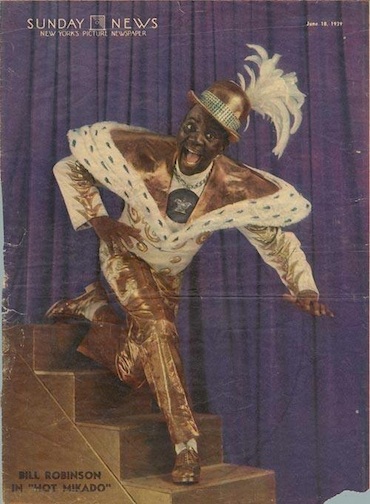
SundayNews

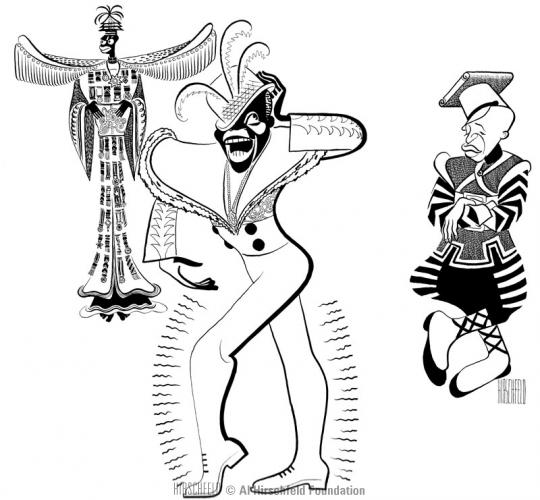
“The Hot Mikado,” starring Bill “Bojangles” Robinson, was a big Broadway hit. It was noted for its wild costuming and all black cast. It ran at the Broadhurst Theater, in Manhattan, from March 23 to June 3, 1939.
Producer Mike Todd announced he was moving the show to the New York World’s Fair. The show became one of the biggest hits at the fair and opened at the Hall of Music on June 22, 1939.
FROM http://www.qchron.com/qboro/i_have_often_walked/bill-bojangles-robinson/article_81b0281a-c1ee-5853-ae31-f810fb8b92a7.html

Silent movie film footage of the Michael Todd production at the New York World’s Fair 1939-1940:

Erskine Hawkins Orchestra – Two Selections from “Hot Mikado”~
https://archive.org/details/ErskineHawkinsOrchestra-TwoSelectionsFromhotMikado

HotMikado

Bill Robinson:
https://artsedge.kennedy-center.org/interactives/harlem/faces/bill_robinson.html

 https://www.pbs.org/wnet/broadway/stars/bill-bojangles-robinson/

https://en.wikipedia.org/wiki/Bill_Robinson

Bob Dylan: Born May 24, 1941

Bob Dylan Through The Years~
http://www.rollingstone.com/music/pictures/photos-70-photos-of-bob-dylan-on-his-70th-birthday-20110524

 Bob Dylan: Official Site~ http://www.bobdylan.com/us/home

Bob Dylan: Halcyon Gallery~ https://www.halcyongallery.com/bob-dylan/

Bob Dylan: Castle Fine Art~ https://www.castlefineart.com/artists/bob-dylan

Emanuel Gottlieb Leutze: Born May 24, 1816

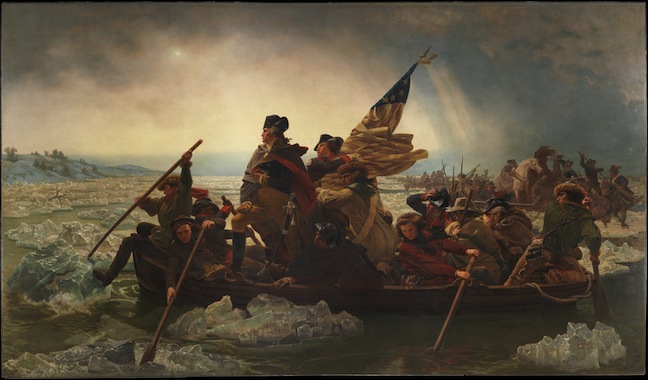
WashingtonWashington Crossing the Delaware, 1851 • Emanuel Gottlieb Leutze
Oil on canvas; 149 x 255 in. (378.5 x 647.7 cm)

Leutze’s depiction of a critical moment during the American revolution has become one of the best known and most extensively published images in American history. He portrays George Washington, accompanied by some 2,500 of his troops, crossing the Delaware River about nine miles above Trenton, New Jersey, in a surprise attack on the Hessians. The strategic crossing took place after midnight on December 25, 1776; ice floes and a heavy snowstorm kept the American soldiers and their allies from reaching shore until daybreak, which Leutze captured with the morning star overhead.
http://www.metmuseum.org/toah/works-of-art/97.34

Crossing of the Delaware: http://www.mountvernon.org/research-collections/digital-encyclopedia/article/crossing-of-the-delaware/
Emanuel Gottlieb Leutze…German-born American historical painter whose picture Washington Crossing the Delaware (1851) numbers among the most popular and widely reproduced images of an American historical event.
http://www.britannica.com/EBchecked/topic/337776/Emanuel-Gottlieb-Leutze

Margaret Wise Brown: Born May 23, 1910

5 Fascinating Facts About Margaret Wise Brown
https://mymodernmet.com/margaret-wise-brown-facts/


Margaret Wise Brown’s life was full of what her admirers like to call whimsy and other people might call childlike behavior. She spent her first royalty check on an entire flower cart full of flowers. At her house in Maine, which she called “The Only House,” she had an outdoor boudoir with a table and nightstand and a mirror nailed to a tree, along with an outside well that held butter and eggs, and wine bottles kept cold in a stream; one could easily imagine a little fur family living in “The Only House,” but it was just her friends, associates, editors, and lovers passing through. She was once chastised by a hotel owner in Paris because she had brought giant orange trees and live birds into her room. The orange trees might have been OK, the owner thought, but the live birds were a little de trop.

FROM The Restless Life of Margaret Wise Brown

Richard Wagner~ Born May 22, 1813

Early in his career, Wagner learned both the elements and the practical, political realities of his craft by writing a handful of operas which were unenthusiastically, even angrily, received. Beginning with Rienzi (1838-40) and The Flying Dutchman (1841), however, he enjoyed a string of successes that propelled him to immortality and changed the face of music. His monumental Ring cycle of four operas — Das Rheingold (1853-54), Die Walküre (1854-56), Siegfried (1856-71) and Götterdämmerung (1869-74) — remains the most ambitious and influential contribution by any composer to the opera literature.
http://www.allmusic.com/artist/richard-wagner-mn0000958980/biography

“The Brilliant, Troubled Legacy of Richard Wagner”
https://www.smithsonianmag.com/arts-culture/the-brilliant-troubled-legacy-of-richard-wagner-16686821/

A great music lover, Renoir was one of the first admirers of Wagner in France. At the beginning of 1882, when the painter was travelling in the south of Italy, he had the opportunity to visit Palermo where Wagner was staying. After two fruitless attempts, Renoir was finally introduced to the “maestro” who, the day before, had put the final notes to Parsifal.
The course of this meeting is well known thanks to a letter from Renoir to one of his friends, dated 15 January 1882:
https://www.musee-orsay.fr/en/artworks/richard-wagner-1159

Richard Wagner by Auguste Renoir, 1882
Oil on canvas / Musee d’Orsay, Paris, France

[4 embedded links above]