Richard D’Oyly Carte: Born May 3, 1844

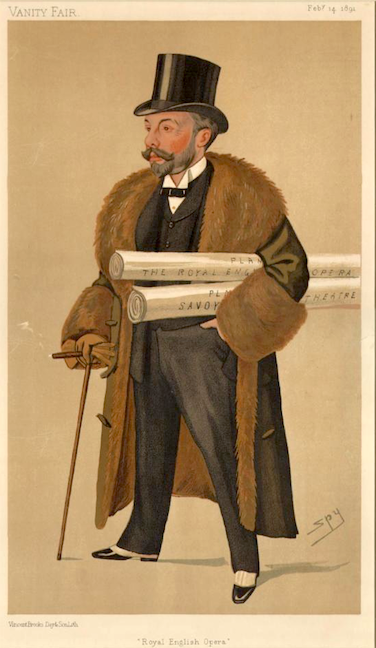
Richard D’Oyly Carte, born 1844, died 1901; was theatrical manager of the Royalty Theatre, London, where Trial by Jury was produced in 1875, when he became the originator and promoter of a scheme for English “comedy-opera,” of which the first-fruit was The Sorcerer, brought out at the Opéra Comique, London, on November 17, 1877. H.M.S. Pinafore, The Pirates of Penzance, and Patience followed at the same theatre, under the same auspices. In October, 1881, Patience was transferred to the Savoy Theatre, which Richard D’Oyly Carte had built specially for the production of Gilbert-Sullivan pieces, and of which he remained the owner and director, at the same time owning and directing numerous travelling companies both in the British provinces and in America. In January, 1891, he opened, in Cambridge Circus, London,–with Sullivan’s Ivanhoe specially written for the occasion–the English Opera House, of which he had been the projector, but which, in December, 1892, was re-christened the Palace Theatre, and later devoted, under other management, to “variety” performances. D’Oyly Carte himself wrote the music for two dramatic pieces entitled Dr. Ambrosias, his Secret (1887) and Maria (1871).
http://www.theatrehistory.com/british/richard_doyly_carte_001.html

(Click images to enlarge)

Richard D’Oyly Carte~  http://www.gsarchive.net/carte/burleigh.html

Savoy Hotel~  http://www.fairmont.com/savoy-london/hotelhistory/

Savoy Theatre~  http://grimsdyke.com/savoy-theatre-home-gilbert-sullivan/

Savoy Scaffolding etching by James McNeill Whistler (1834-1903), D’Oyly Carte was a strong supporter of Whistler and a close friend.
Artist Birthday Quiz for 5/3~

This Florentine painter was taken under the care of Agnolo Bronzino, a family friend, after his father died; his young life was spent in Bronzino’s workshop in Florence.

This sculptor’s “Orpheus and Apollo,” commissioned in 1961, is a 5-ton, 190-foot-long constellation of polished bronze bars connected by wires that hangs over the lobby at Avery Fisher Hall in Lincoln Center.

Answers here~ https://schristywolfe.com/2015/05/03/may-3/

Leonardo da Vinci: Died May 2, 1519

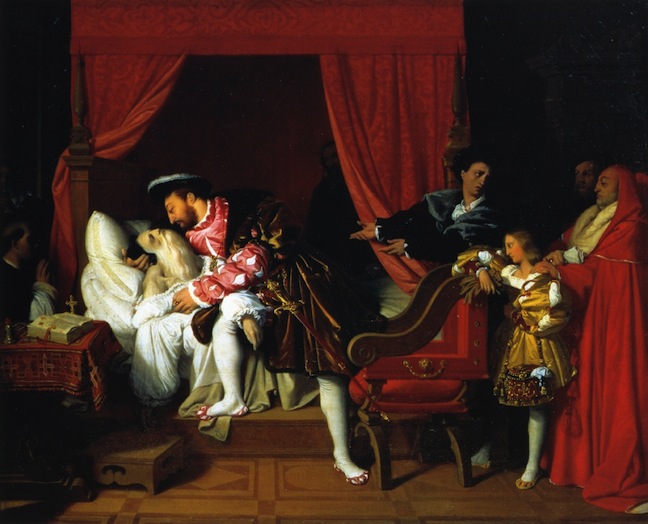
deathFrancis I Receives the Last Breaths of Leonardo da Vinci
by Jean-Auguste-Dominique Ingres, 1818 • Petit Palais, Paris, France

We know that Leonardo, who had come to France at the invitation of Francis I, died in Amboise in 1519. The undoubtedly fictitious story of his death in the presence of the king comes from The Lives by Vasari. This work, which appeared in 1550, celebrates the excellence of Italian painting following an ascending curve that starts with Cimabue and ends with Michelangelo and Raphael.
FROM http://www.petitpalais.paris.fr/en/oeuvre/francis-i-receives-last-breaths-leonardo-da-vinci

Theo van Gogh: Born May 1, 1857

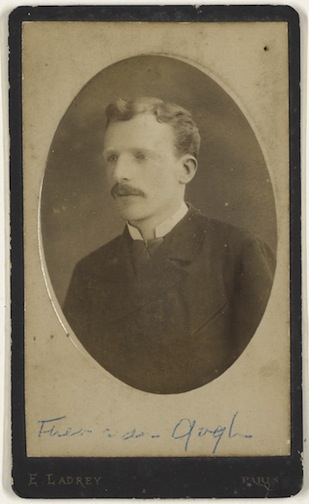
Theo van Gogh *1882Theo van Gogh (1857-1891) first worked as an art dealer in 1873 in the Brussels art gallery owned by his uncle Hendrick van Gogh. A few months later, he was sent to the Hague as an employee of Goupil & Co., an internationally-known Parisian merchant…

Vincent, his brother and elder by four years, preceded him in this career as early as TvG21869. He acted as Theo’s mentor…These exchanges continued in Paris, where Theo was sent for the 1878 World Fair. He settled there and around 1880 he became director of the Paris branch of Goupil & Co. As for Vincent, he left Goupil & Co. in 1876 and decided, after much hesitation, to become a painter. In 1886 he came to Paris, staying with his brother, before going two years later to the south of France.TvG3
FROM Theo van Gogh : art-dealer, collector, Vincent’s brother  ~Musée d’Orsay

The Letters From Vincent to Theo~
http://www.vggallery.com/letters/to_theo_main.htm

The Letters From Theo to Vincent~ http://www.vggallery.com/letters/to_vincent.htm

April 29, 1945: U.S. Seventh Army’s 45th Infantry Division liberates Dachau

music

“In 1944 Zoran Music was arrested by the Gestapo in Venice and deported to the concentration campo in Dachau, an experience that marked his life and his art thereafter. In 1945 he made a series of drawings depicting scenes related to the Holocaust: cremation ovens, hanged men and piles of corpses. These drawings would be the inspiration, in the 1970s, for the series Nous ne sommes pas les derniers (We Are Not the Last)…”
FROM http://www.museoreinasofia.es/en/collection/artwork/nous-ne-sommes-pas-derniers-we-are-not-last

When we were in the camp, people would often declare that this sort of thing could never happen again. When the war is over, they said, a better world will come into being and such horrors will never recur. . . But then, as time went by, I saw the same sort of thing starting to happen again all over the world—in Vietnam, in the Gulag, in Latin America—everywhere. And I realized that what we had said in those days—that we would be the last people to experience such things—was not true: the truth is that we were not the last. – Zoran Music
FROM http://thejewishmuseum.org/exhibitions/an-artists-response-to-evil-we-are-not-the-last-by-zoran-music#about

Zoran Mušič on Wikipedia: https://en.wikipedia.org/wiki/Zoran_Mušič