Tag Archives: Cartoonist
Artist Birthday Quiz for 1/26~
What 18th century French artist made his reputation with his acclaimed marble sculpture of Mercury, now in the Louvre?
What Pulitzer Prize-winning Village Voice satirical cartoonist went on to author books, plays, revues, and screenplays?
Answers here~ https://schristywolfe.com/2015/01/26/january-26/
Artist Birthday Quiz for 1/17~
What American figurative sculptor’s lifelike figures, made of cast fiberglass and polyester resin and dressed in everyday clothes, often fooled the public into believing that they were viewing real people?
What cartoonist left Havana for New York in May 1960, knowing only Spanish, but with his daughter acting as interpreter went to the offices of Mad Magazine with his drawings and was hired on the spot?
Answers here~ https://bit.ly/37RmBIo
The World’s First Cartoon: Fantasmagorie (1908)
On August 17, 1908, Cohl released the cartoon “Fantasmagorie”
Émile Cohl is one of the earliest pioneers of animation, along with John Stuart Blackton. Together they laid the foundations of the medium in the early 1900s, with simple caricatures and stick figures. Cohl goes down in history as the creator of the first genuine fully animated cartoon: ‘Fantasmagorie’ (1908). He was also the first to adapt a comic strip into a regular animated film series. Cohl was furthermore a well-known caricaturist in his day and made a few comics himself.
https://www.lambiek.net/artists/c/cohl_emile.htm

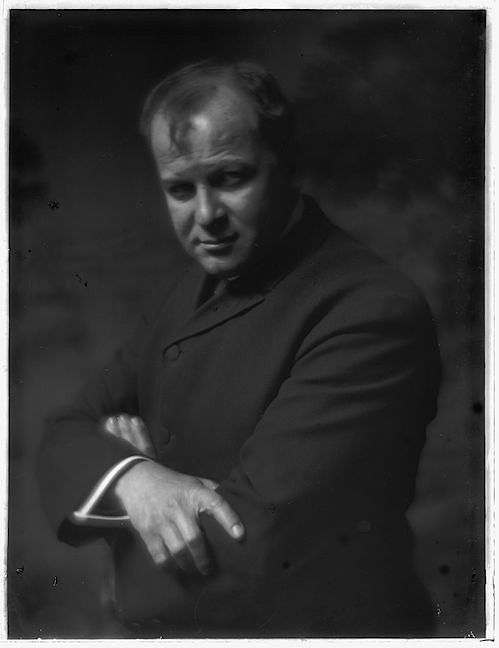
George Luks: Born August 13, 1867
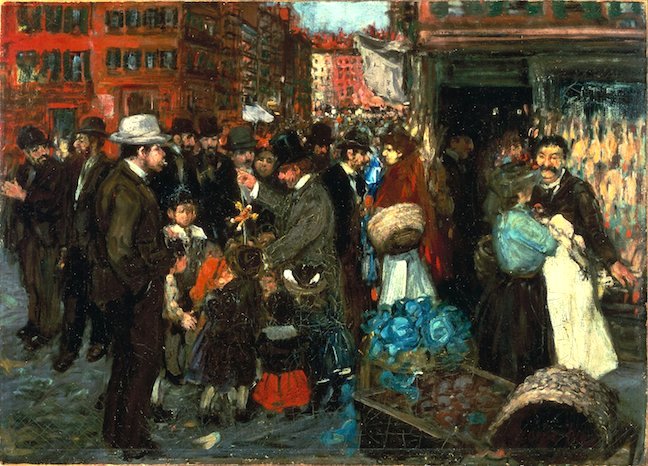
George Luks was an American realist painter and comic illustrator, best known for his images of New York and its inhabitants. Born in Williamsport, Pennsylvania, Luks worked as a vaudeville performer before moving to Philadelphia to study art at the Pennsylvania Academy of the Fine Arts…Luks was publishing comic illustrations in Puck and Truth, and upon his return in 1893 he accepted a job as a newspaper illustrator at the Philadelphia Press.
FROM http://www.illustrationhistory.org/artists/george-luksHis career took a small detour in 1895 when he
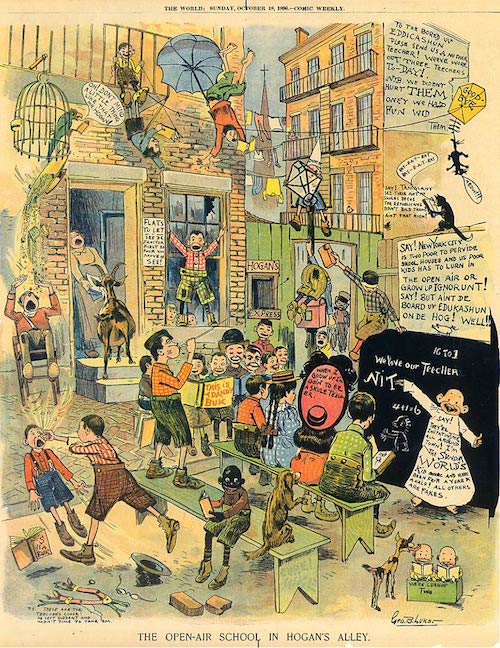
traveled to Cuba as an artist-correspondent for the Philadelphia Evening Bulletin…When he returned to America in 1896, he joined the staff of Pulitzer’s World as an illustrator and cartoonist…One of his many famous colleagues at the World was Richard F. Outcault, who had joined the staff in 1894…Outcault’s Yellow Kid became so popular with the public and showed that it increased the newspaper’s sales as well as the sales of merchandise his likeness appeared on, from candy to whiskey. This awareness was occurring at the same time that William Randolph Hearst had come to town, purchased the Journal and was having an intense battle with Pulitzer’s World for dominance in New York City. Hearst knew a good thing when he saw it and lured Outcault away from Pulitzer…Pulitzer was not to be outdone, however, and assigned Luks to continue drawing the Yellow
Kid in Hogan’s Alley for the World…Luks [continued to work] at his painting and was finally able to make a living at it. He left the newspaper in 1898.
FROM https://www.hoganmag.com/blog/george-luks-the-other-yellow-kid-artistGeorge Luks prided himself in being the “bad boy” of American art and would be pleased that this notion has survived as his reputation as a significant painter of the twentieth century continues to grow. A heavy drinker and engaged story-teller, Luks manufactured details of his own life to make himself more colorful. Most ingrained in his biography was his tall tale of
having fought in the Mid-West as “Chicago Whitey,” a middle-weight boxing champion. No one ever checked his details. However, the mythology Luks created around himself masked an insecurity that reveals itself in the diversity of styles he sometimes employed as a painter. His mainstay was realism, but he experimented with impressionism and post-impressionism and was known to alter a canvas if it was criticized, sometimes ruining it entirely. The critic, James Huneker, noted literally hundreds of unfinished canvases in Luks upper Manhattan studio which he would either re-work or paint over. But when Luks was “on” he was a forceful painter of huge talent and confidence, noted for his sure, brilliant handling of a brush.
FROM http://www.tfaoi.com/aa/2aa/2aa563.htm
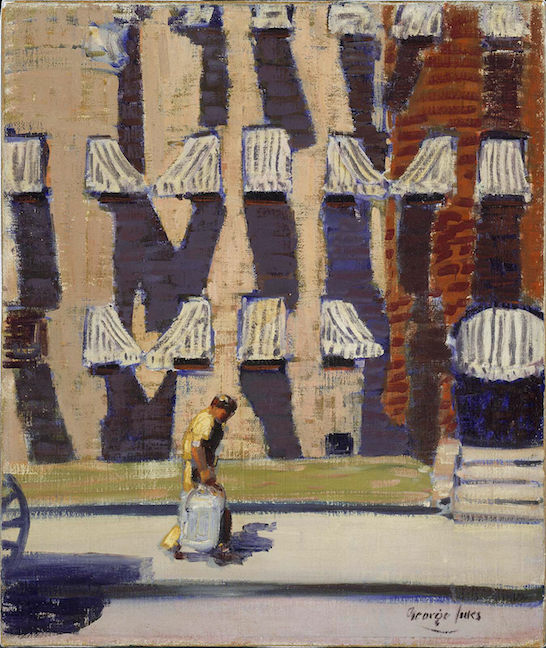

Ephemeral New York: Posts Tagged ‘George Luks’~
https://ephemeralnewyork.wordpress.com/tag/george-luks/
Rube Goldberg: Born July 4, 1883
Learn more~ http://www.rube-goldberg.com/
https://www.rubegoldberg.org/all-about-rube/a-cultural-icon/
[Rube Goldberg’s] father…convinced Rube to study Engineering at the School of Mining Engineering at UC Berkeley. He went on to graduate from UC Berkeley with a degree in Engineering in 1904.
After graduation, Rube Goldberg took on a position designing sewer pipes for the San Francisco Water and Sewers Department…he lasted six months. Rube Goldberg followed his passion and began to shift gears to pursue his previous dreams and pursue a career as a cartoonist.
Rube Goldberg made an important observation. In his eyes, many people seemed to be solving simple problems with overly complex contraptions. This…was his main inspiration for the “Inventions!” series. The most famous of which has come to be known as the Rube Goldberg Machine.
Rube Goldberg is the only cartoonist to be listed in the Merriam-Webster dictionary as an actual adjective. The phrase “Rube Goldberg” has been adopted into common use to mean “doing something simple in a very complicated way that is not necessary”.
http://interestingengineering.com/rube-goldberg-the-man-behind-the-worlds-craziest-machines/

Clifford Berryman: Born April 2, 1869
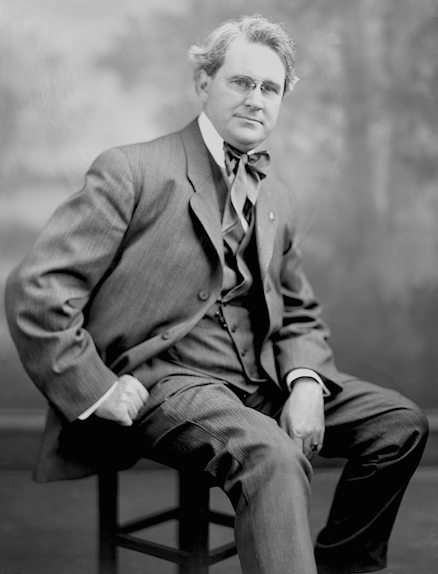 Clifford K. Berryman (1869-1949) was a Pulitzer Prize–winning editorial cartoonist, perhaps best known for inspiring the Teddy Bear toy. As a draftsman, illustrator, and cartoonist, Berryman always worked in pen and ink. Berryman satirized both Democrats and Republicans with a light-hearted approach.
Born April 2, 1869 in Clifton, Kentucky, he never attended art school and was entirely self-taught. His first job, in 1886, was as a draftsman at the United States Patent Office in D.C. From 1891 to 1896, he worked as a general illustrator and it was during this time that he learned cartooning by studying contemporary cartoons and copying the artist’ styles.
Berryman’s illustration entitled “And Boys, Remember the Maine!”, which appeared in the  Washington Post on April 3, 1898, depicts an angry Uncle Sam addressing sailors as the USS Maine sinks in the background. “Remember the Maine,” became the battle-cry for American sailors during the Spanish-American War.
 Berryman originated the “Teddy Bear” in his illustration “Drawing the Line in Mississippi”, published November 16, 1902 in the Post. It showed President Theodore Roosevelt refusing to shoot a captured cub during a bear hunt. This is the cartoon which inspired New York store owner Morris Michtom to create a new toy and call it the Teddy Bear. This little bear appeared in cartoons drawn by Berryman throughout Roosevelt’s career.

Berryman drew thousands of cartoons, first with the Washington Post and then with the Washington Star, where he drew cartoons until his death on December 11, 1949. Berryman’s cartoons can be found at the Library of Congress, the National Archives, and George Washington University.
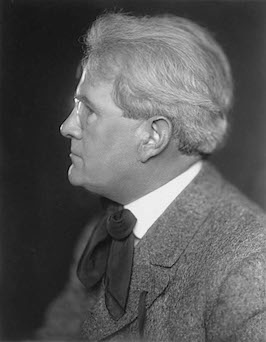
Biography~ https://alchetron.com/Clifford-K-Berryman-1222344-W
Running for Office: Candidates, Campaigns, and the Cartoons of Clifford Berryman~
https://www.archives.gov/exhibits/running-for-office/
Al Jaffee: Born March 13, 1921

…And in 1964 he had an idea. Playboy, Life and other magazines had their lavish color fold-outs, so Mad, he thought, should parody them with a cheap black-and-white fold-in.
From 2008: http://www.nytimes.com/2008/03/30/arts/design/30genz.html?pagewanted=allInstead of conducting a formal interview, we invited Mr. Jaffee to explain the thought process behind his favorite Fold-Ins from over the years. He certainly didn’t disappoint. Read on to discover how one of the world’s finest optical satirists creates his magic on a monthly basis.
From 2014: https://www.pastemagazine.com/books/state-of-the-art-mad-magazine-icon-al-jaffee-on-hi/Al Jaffee, Iconic Mad Magazine Cartoonist, Retires at Age 99 … and Leaves Behind Advice About Living the Creative Life
From 2020: https://www.openculture.com/2020/06/al-jaffee-iconic-mad-magazine-cartoonist-retires-at-age-99.htmlAl Jaffee, Now 102, Is Ready to Be Added to Mount Rushmore:
MAD’s longest-serving contributor on comedy, art, and the origins of the “Fold-in.”
From 2023: https://www.vulture.com/article/al-jaffee-interview.html
Al Jaffee on Artnet: https://www.artnet.com/artists/al-jaffee/
(updated 2023)

September 6~
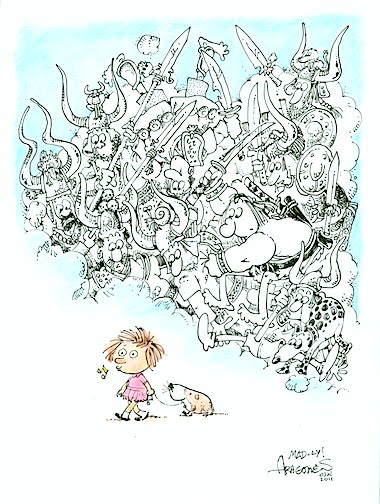
Sergio Aragonés (1937) http://www.sergioaragones.com/about-sergio/
Elizabeth Murray (1940-2007) http://www.artnet.com/artists/elizabeth-murray/
September 3~

Edmond Casarella (1920-1996)
https://www.annexgalleries.com/artists/biography/375/Casarella/Edmond
Mort Walker (1923)
http://www.mortwalker.com/mwinfo.html
 The Misty Miss Christy