Ruby Bridges: Born September 8, 1954


https://www.biography.com/people/ruby-bridges-475426

Ruby Bridges Goes to School:
http://www.pbs.org/wnet/african-americans-many-rivers-to-cross/video/ruby-bridges-goes-to-school/

Ruby Bridges Biography:
https://www.womenshistory.org/education-resources/biographies/ruby-bridges
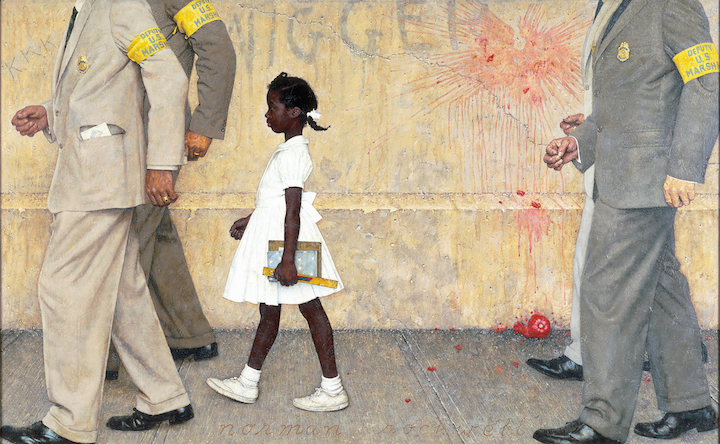
“The Problem We All Live With” by Norman Rockwell
1964 / Oil on canvas / 36”x58” / Norman Rockwell Museum, Stockbridge, Massachusetts
The painting was originally published as a centerfold in the January 14, 1964 issue of Look magazine
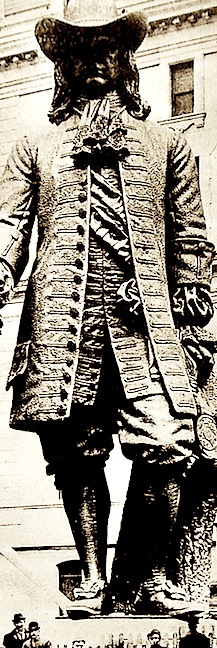
Alexander Milne Calder: Born August 23(?), 1846

BigBillyAlexander Milne Calder was born in Aberdeen, Scotland, the son of a tombstone carver. He began his career in Scotland, working for sculptor John Rhind, the father of sculptor J. Massey Rhind while attending the Royal Academy in Edinburgh. He moved to London and worked on the Albert Memorial. Calder immigrated to the United States in 1868 and settled in Philadelphia…In 1873, he was hired by architect John McArthur, Jr. to produce models for the architectural sculpture of Philadelphia City Hall. The commission involved more than 250 pieces in marble and bronze, and took Calder 20 years to complete.~Wikipedia

City Hall (Philadelphia)~ http://philadelphiaencyclopedia.org/archive/city-hall-philadelphia/

Three Generations of Calders in Philadelphia~
https://www.associationforpublicart.org/apa-now/story/three-generations-of-calders-in-philadelphia/

The World’s First Cartoon: Fantasmagorie (1908)


On August 17, 1908, Cohl released the cartoon “Fantasmagorie”

Émile Cohl is one of the earliest pioneers of animation, along with John Stuart Blackton. Together they laid the foundations of the medium in the early 1900s, with simple caricatures and stick figures. Cohl goes down in history as the creator of the first genuine fully animated cartoon: ‘Fantasmagorie’ (1908). He was also the first to adapt a comic strip into a regular animated film series. Cohl was furthermore a well-known caricaturist in his day and made a few comics himself.
https://www.lambiek.net/artists/c/cohl_emile.htm

cohl_emile_lerire1899

Auguste Bartholdi: Born on August 2, 1834

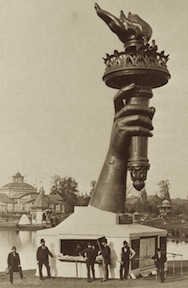
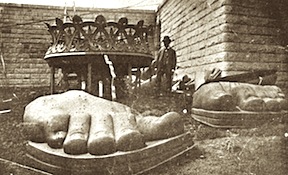
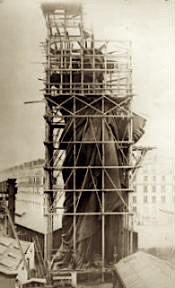
2In 1865, a French political intellectual and anti-slavery activist named Edouard de Laboulaye proposed that a statue representing liberty be built for the United States. This monument would honor the United States’ centennial of independence and the friendship3 with France. French sculptor Auguste Bartholdi supported Laboulaye’s idea and in 1870 began designing the statue of “Liberty Enlightening the World.”
While Bartholdi was designing the Statue, he also took a trip to the United States in 1871. During the trip, Bartholdi selected Bedloe’s Island as the site for the Statue. Although the island was small, it was visible to every ship entering New York Harbor, which Bartholdi viewed as the “gateway to America.”
Creating the Statue of Liberty~ http://www.nps.gov/stli/learn/historyculture/places_creating_statue.htm

1

Vintage Photos: Construction of the Statue of Liberty in Paris and NYC~
http://untappedcities.com/2013/10/28/vintage-photos-construction-statue-of-liberty-paris-nyc/

Biography of Auguste Bartholdi~ https://www.nga.gov/collection/artist-info.6761.html

Save

Isaac Stern: Born July 21, 1920

stern1Stern’s family moved to the United States and settled in San Francisco when he was one year old. His mother, a professional singer, gave him his first music lessons. He began studying the violin at the San Francisco Conservatory in 1928. In 1932 he became the third immensely talented San Francisco-area boy to train with the San Francisco Symphony concertmaster Louis Persinger (the others were Menuhin and Ruggiero Ricci). However, he considered Naoum Blinder, with whom he studied until the age of 15, his only true teacher. Stern made his debut with the San Francisco Symphony on February 18, 1936, with Pierre Monteux conducting the Third Concerto by Saint-Saëns.
FROM http://www.allmusic.com/artist/isaac-stern-mn0000965898/biography

However, Stern was to become as famous internationally for his contribution to public causes as he was Stern2for his concert performances and recordings. His social contributions took many forms: his most noted involvement as a cultural activist was his pivotal role in the 1960 salvation of Carnegie Hall, then facing demolition. Elected president of the Carnegie Hall Corporation, he guided the affairs of the edifice he called “our country’s affirmation of the human spirit” (Stern and Potok, p. 141) until the end of his life. He was chairman of the board of the America-Israel Cultural Foundation and founder and chairman of the Stern3Jerusalem Music Center, and in the United States he campaigned for and became a founding member of the National Endowment for the Arts in 1964. In 1975 he received the first Albert Schweitzer Award for “a life’s work dedicated to music and devoted to humanity” and two years later was made a member of the French Légion d’Honneur.
FROM http://www.anb.org/articles/18/18-03785.html

Obituary, New York Times~ http://www.nytimes.com/2001/09/23/nyregion/violinist-isaac-stern-dies-at-81-led-efforts-to-save-carnegie-hall.html

Van Cliburn: Born July 12, 1934

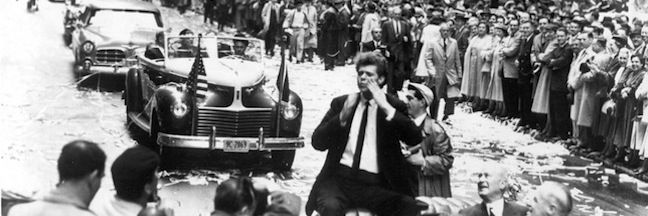
But if the Tchaikovsky competition represented Mr. Cliburn’s breakthrough, it also turned out to be his undoing. Relying inordinately on his keen musical instincts, he was not an especially probing artist, and his growth was stalled by his early success. Audiences everywhere wanted to hear him in his prizewinning pieces, the Tchaikovsky First Concerto and the Rachmaninoff Third. Every American town with a community concert series wanted him to come play a recital.
“When I won the Tchaikovsky I was only 23, and everyone talked about that,” Mr. Cliburn said in 2008. “But I felt like I had been at this thing for 20 years already. It was thrilling to be wanted. But it was pressure, too.”
http://www.nytimes.com/2013/02/28/arts/music/van-cliburn-pianist-dies-at-78.html

TickerTape


Rube Goldberg: Born July 4, 1883


Learn more~ http://www.rube-goldberg.com/
https://www.rubegoldberg.org/all-about-rube/a-cultural-icon/

[Rube Goldberg’s] father…convinced Rube to study Engineering at the School of Mining Engineering at UC Berkeley. He went on to graduate from UC Berkeley with a degree in Engineering in 1904.

After graduation, Rube Goldberg took on a position designing sewer pipes for the San Francisco Water and Sewers Department…he lasted six months. Rube Goldberg followed his passion and began to shift gears to pursue his previous dreams and pursue a career as a cartoonist.

Rube Goldberg made an important observation. In his eyes, many people seemed to be solving simple problems with overly complex contraptions. This…was his main inspiration for the “Inventions!” series. The most famous of which has come to be known as the Rube Goldberg Machine.

Rube Goldberg is the only cartoonist to be listed in the Merriam-Webster dictionary as an actual adjective. The phrase “Rube Goldberg” has been adopted into common use to mean “doing something simple in a very complicated way that is not necessary”.
http://interestingengineering.com/rube-goldberg-the-man-behind-the-worlds-craziest-machines/

The United States of America: Born July 4, 1776

painting

This painting depicts the moment on June 28, 1776, when the first draft of the Declaration of Independence was presented to the Second Continental Congress.

This is the first completed painting of four Revolutionary-era scenes that the U.S. Congress commissioned from John Trumbull (1756–1843) in 1817. It is an enlarged version of a smaller painting (approximately 21 inches by 31 inches) that the artist had created as part of a series to document the events of the American revolution.

When Trumbull was planning the smaller painting in 1786, he decided not to attempt a wholly accurate rendering of the scene; rather, he made his goal the preservation of the images of the Nation’s founders. He excluded those for whom no authoritative image could be found or created, and he included delegates who were not in attendance at the time of the event. In all, 47 individuals (42 of the 56 signers and 5 other patriots) are depicted, all painted from life or life portraits. Some of the room’s architectural features (e.g., the number and placement of doors and windows) differ from historical fact, having been based on an inaccurate sketch that Thomas Jefferson produced from memory in Paris. Trumbull also painted more elegant furniture, covered the windows with heavy draperies rather than venetian blinds, and decorated the room’s rear wall with captured British military flags, believing that such trophies were probably displayed there.
http://www.aoc.gov/capitol-hill/historic-rotunda-paintings/declaration-independence

End the Gun Violence Now

sallyedelstein's avatarEnvisioning The American Dream

Vintage ad 1969 JFK, RFK, MLK

Keep Hope Alive

In July 1969, a full-page advertisement  in the Sunday  NY Times posed a request to the American public:

Hold onto this page for 1 year and hope and pray it’s ended.

The hopeful ad  appeared  one  year after the assassination of Martin Luther King and Robert Kennedy, and 6 years after the shooting  of President John Kennedy.

The copy reads:

The trouble is hoping and praying isn’t enough. Violence won’t end unless you’re willingto start the ending.

I have held onto to this yellowing page for 47 years; the hope for the end of gun violence  nearly extinguished.

In the wake of Orlando, the deadliest mass shooting in U.S. history,  the Senate still can’t take small steps to curb gun  violence.

“My prayers are with you” congressmen numbingly utter, but in the same breath they greedily whisper “my votes are with the NRA.” Our congressional…

View original post 51 more words

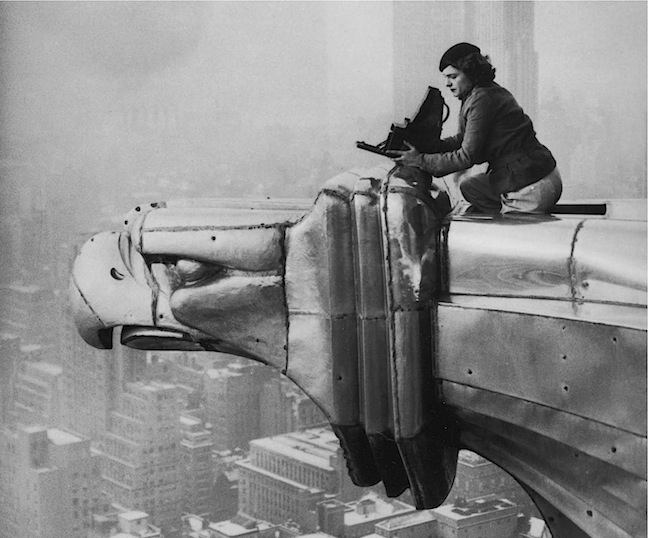
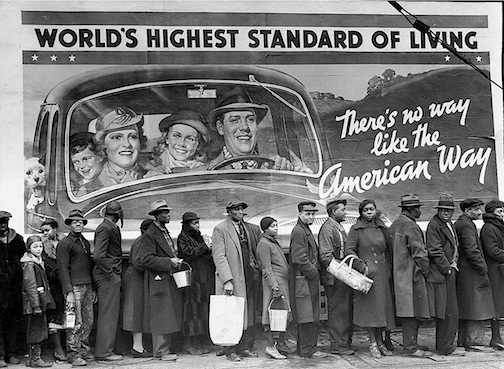
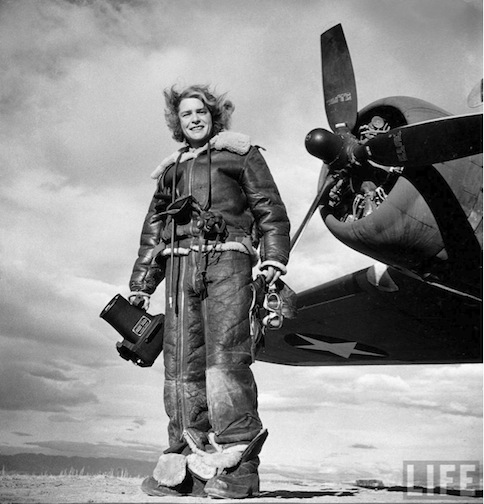
Margaret Bourke-White: Born June 14, 1904

eagle

standardoflvngMargaret Bourke-White was a pioneering photojournalist whose insightful pictures of 1930s Russia, German industry, and the impact of the Depression and drought in the American midwest established her reputation…In 1927 she graduated from Cornell University with a degree in biology, but she spent most of her time establishing herself as a professional photographer. Bourke-White opened her first studio in her apartment in Cleveland, Ohio.
FROM http://www.moma.org/interactives/objectphoto/artists/712.htmlairplane

campAs an artist, Bourke-White continued to use photography as an instrument to examine social issues from a humanitarian perspective. She witnessed and documented some of the 20th century’s most notable moments, including the liberation of German concentration camps by General Patton in 1945, the release of Mahatma Gandhi from prison in 1946, and the effects of South African labor exploitation in the 1950s. Her career was cut short in 1966 due to Parkinson’s disease, and she died in 1971.
FROM https://www.howardgreenberg.com/artists/margaret-bourke-white

International Photography Hall of Fame and Museum~ https://iphf.org/inductees/margaret-bourke/

LIFELIFE’s First-Ever Cover Story~ http://time.com/3764198/lifes-first-ever-cover-story-building-the-fort-peck-dam-1936/

Shorpy Archives~ http://www.shorpy.com/image/tid/208