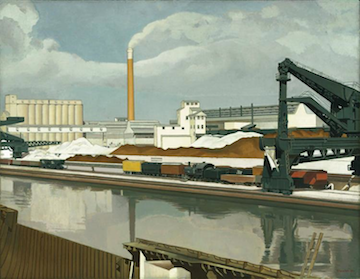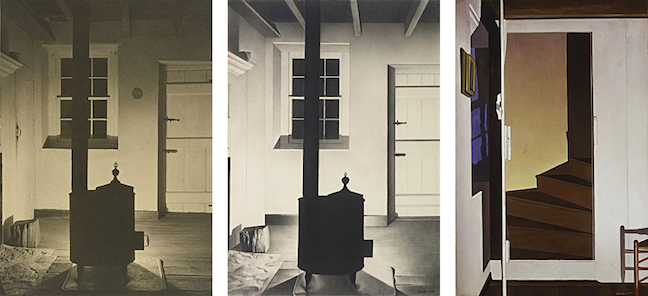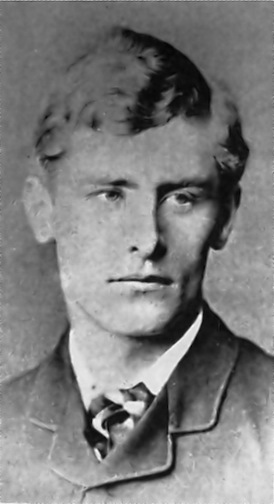
Charles Sheeler: Born July 16, 1883

Sheeler

Charles Sheeler (1883–1965)~
http://www.metmuseum.org/toah/hd/shee/hd_shee.htm
Precisionism~ http://www.metmuseum.org/toah/hd/prec/hd_prec.htm
Power / Fortune, December1940~
https://www.fulltable.com/vts/f/fortune/ills/sheeler/b.htm


The American modernist Charles Sheeler (1883–1965) explored the relationships between photography, film, and more traditional media such as painting and drawing with more rigor and intellectual discipline than perhaps any other artist of his generation. As in a well-conceived scientific experiment, Sheeler used his own photographs and film stills as the basis for paintings and drawings, thus crystallizing the differences and similarities between them. Works in one medium manage to function as independent objects while also being inextricably linked to works in other media.Charles Sheeler: Across Media


James McNeill Whistler (1834–1903)

WMother

James Abbott Whistler was born [on July 11] in 1834 in Lowell, Massachusetts, the third son of West Point graduate and civil engineer Major George Washington Whistler, and his second wife Anna Matilda McNeill. After brief stays in Stonington, Connecticut, and Springfield, Massachusetts, the Whistlers moved to St. Petersburg, Russia, where the Major served as an engineer for the construction of a railroad line to Moscow. Whistler studied drawing there at the Imperial Academy of Science. In 1848 he went to live with his sister and her husband in London, and after his father’s death the following year the family returned to the United States and settled in Pomfret, Connecticut. Whistler enrolled in the United States Military Academy at West Point in 1851, where he excelled in Robert W. Weir’s drawing class. He was dismissed from the academy in 1854, and after brief periods working for the Winans Locomotive Works in Baltimore, and the drawings division of the United States Coast and Geodetic Survey, resolved to become an artist…
FROM http://www.nga.gov/content/ngaweb/Collection/artist-info.1974.html

Victoria Thorne: Whistler’s Bridges and Those Boys on the Bank~
http://design.victoriathorne.com/2012/08/whistlers-bridges-and-those-boys-on-bank.html
Portrait of the Artist’s Mother~
http://www.musee-orsay.fr/en/collections/works-in-focus/search/commentaire/commentaire_id/portrait-of-the-artists-mother-2976.html
The Extraordinary Life of Whistler’s Mother~
http://theconversation.com/the-extraordinary-life-of-whistlers-mother-42027

This slideshow requires JavaScript.

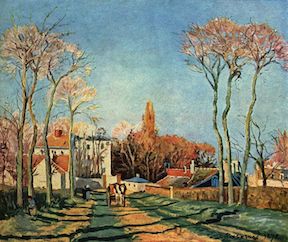
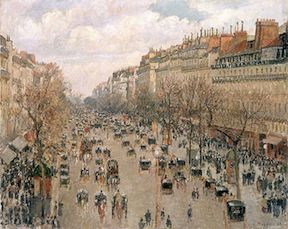
Camille Pissarro: Born July 10, 1830

ONEPissarro in fact was the only artist who participated in all eight Impressionist exhibitions and he was a much-respected father figure to his colleagues…His talents as a teacher made him influential TWOeven among artists of greater stature than himself—Cézanne and Gauguin, for example…During the Franco-Prussian War of 1870–1, when his home at Louveciennes was overrun by the German invaders and many of his paintings were destroyed, Pissarro joined Monet in England. In 1872 he settled at Pontoise, where he THREEintroduced Cézanne to painting out of doors…In 1885 he met Seurat and for several years afterwards he experimented with Neo-Impressionism; in about 1890, however, he reverted to his Impressionist style, though with freer brushwork than in his early work…From FOURabout 1895 deterioration of his eyesight caused him to give up painting out of doors and many of his late works are urban scenes painted from windows (usually of hotels) in Paris and elsewhere…In addition to a large output of paintings and drawings, he was the most prolific printmaker among the Impressionists, working in a variety of techniques and sometimes mixing them.
FROM  http://artuk.org/discover/artists/pissarro-camille-18301903

http://www.degas-painting.info/impresionists/camille_pissarro_biography.htm

Marc Chagall: Born July 7, 1887


https://www.artic.edu/exhibitions/3172/chagall-s-america-windows

https://www.guggenheim.org/artwork/artist/marc-chagall

http://www.jewishvirtuallibrary.org/marc-chagall

Chagall himself said he was a dreamer who never woke up. “Some art historians have sought to decrypt his symbols,” says Jean-Michel Foray, director of the Marc Chagall Biblical Message Museum in Nice, “but there’s no consensus on what they mean. We cannot interpret them because they are simply part of his world, like figures from a dream.” ~The Elusive Marc Chagall, Smithsonian, December 2003

Peter Blake: Born June 25, 1932

Peter graduated from the RCA in 1956 having also completed his National Service. He received the Leverhulme Research Award to study popular art whilst travelling Europe and went on to teach for several years at various London Art Schools, all the while working and exhibiting. His first solo show was held in the Portal Gallery in 1962 and since the early 70s his work has regularly been exhibited in one-man shows and retrospectives around the world. In 1981 he was elected a member of the Royal Academy and in 1994 was made the Third Associate Artist of the National Gallery. He was Knighted in 2002.
Sir Peter Blake | Illustrators | Central Illustration Agency

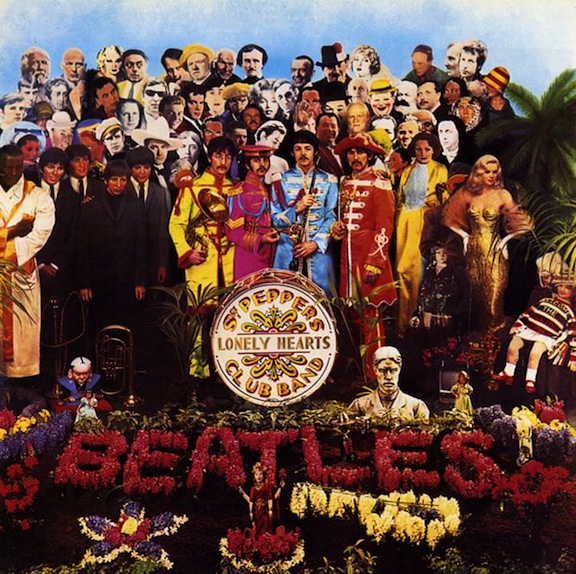
SPLHCB

The Beatles’ Sgt. Pepper’s Lonely Hearts Club Band, released by EMI Records in 1967, is arguably the most famous album sleeve of all time. The image on the album cover is composed of a collage of celebrities. There are 88 figures, including the band members themselves. Pop artist Peter Blake and his wife Jann Haworth conceived and constructed the set, including all the life-sized cut-outs of historical figures. The set was photographed, with the Beatles standing in the centre, by Michael Cooper. Copyright was a problem as Brian Epstein, the Beatles’ manager, had to locate each person in order to get permission to use their image in this context.

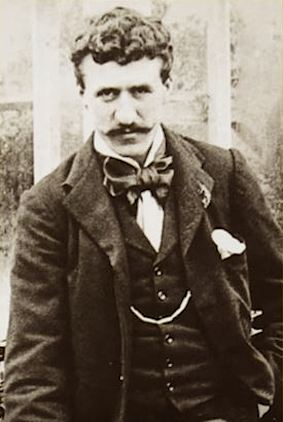
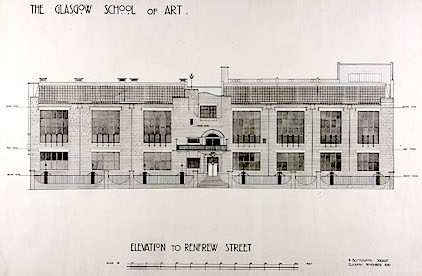
Charles Rennie Mackintosh~ Born June 7, 1868

Charles Rennie Mackintosh (7 June 1868-10 December 1928) “was a Scottish architect, designer, water colourist and artist. He was a designer in the Post-Impressionist movement and also the main representative of Art Nouveau in the United Kingdom. He had considerable influence on European design. He was born in Glasgow…”
FROM https://alchetron.com/Charles-Rennie-Mackintosh-1221200-W

“Mackintosh was apprenticed to a local architect John Hutchison, but in 1889 he transferred to the larger, more established city practice of Honeyman and Keppie.

To complement his architectural apprenticeship, Mackintosh enrolled for evening classes at the Glasgow School of Art where he pursued various drawing programmes.”
FROM https://www.crmsociety.com/about-mackintosh/charles-rennie-mackintosh/

“The majority of Mackintosh’s architectural practice was supported by his wife Margaret Macdonald with whom he had studied at the Glasgow School of Art. Her mind was often responsible for the artistic flourish that became so integral to the aforementioned Mackintosh Rose motif. In his time as a professional architect, Mackintosh worked with his wife to design buildings ranging in use from residential, to commercial and religious.”
FROM https://www.archdaily.com/639483/spotlight-charles-rennie-mackintosh

“Despite success in Europe and the support of clients such as Blackie and Cranston, Mackintosh’s work met with considerable indifference at home and his career soon declined. Few private clients were sufficiently sympathetic to want his ‘total design’ of house and interior.

A move to the South of France in 1923 signalled the end of Mackintosh’s three-dimensional career and the last years of his life were spent painting. He died in London on 10 December 1928.”
FROM https://gsaarchives.net/collections/charles-rennie-mackintosh/

Design Museum~ https://designmuseum.org/designers/charles-rennie-mackintosh#toggle-submenu
Charles Rennie Mackintosh Society~ https://www.crmsociety.com/


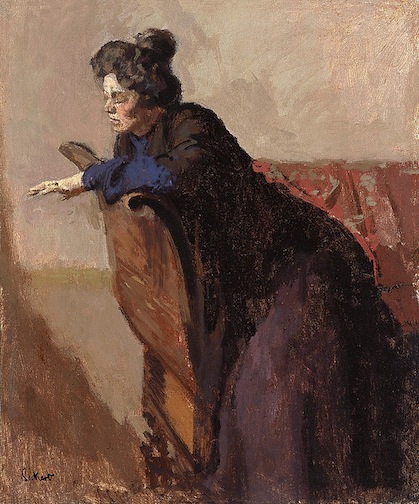
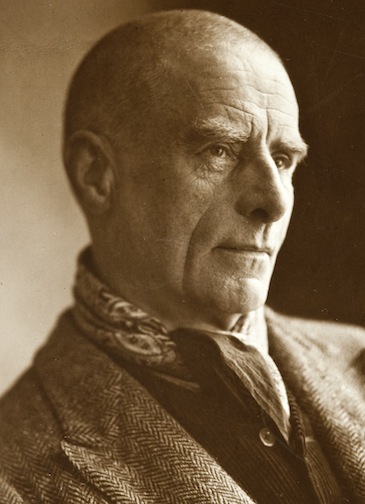
Walter Richard Sickert: Born May 31, 1860

Persuasion

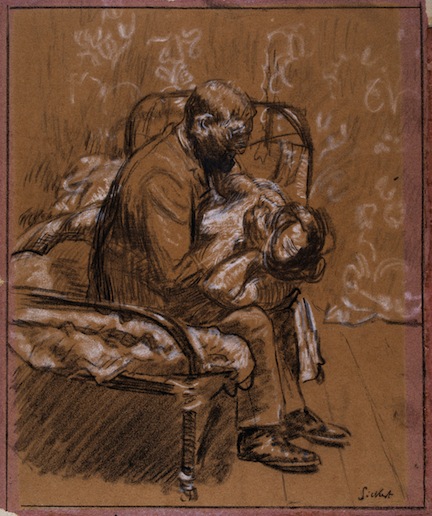
Sickert1Unlike the majority of the Camden Town Group, Walter Richard Sickert was recognised during his own lifetime as an important artist, and in the years since his death has increasingly gained a reputation as one of the most influential figures in twentieth-century British art…His art, like his personality, is multifaceted, complex and compelling.

The twenty-first century has seen a sustained period of Sickert research and exhibitions,TheRing crystallising his reputation as one of the most significant British artists of the early modern period.
FROM http://www.tate.org.uk/art/research-publications/camden-town-group/walter-richard-sickert-r1105345
Sickert2The most popular and famous theory as to the identity of Jack the Ripper…was first posited by author Stephen Knight in the 1970s.

He claimed the Ripper’s victims were really killed to cover up a scandalous secret marriage between the Queen’s son Prince Albert Victor, then second in line to the throne, and a Catholic prostitute named Annie Elizabeth Crook, who bore Albert’s child.

Knight got much of his information from Joseph Gorman-Sickert, who claimed to be the illegitimate son of painter Walter Sickert, himself a Ripper suspect.
FROM http://theunredacted.com/jack-the-ripper-the-royal-conspiracy/

Top 10 Stupidest/Weirdest Jack the Ripper theories~ http://swallowingthecamel.me/2013/11/10/top-10-stupidestweirdest-jack-the-ripper-theories/
Bob Dylan: Born May 24, 1941

Bob Dylan Through The Years~
http://www.rollingstone.com/music/pictures/photos-70-photos-of-bob-dylan-on-his-70th-birthday-20110524

 Bob Dylan: Official Site~ http://www.bobdylan.com/us/home

Bob Dylan: Halcyon Gallery~ https://www.halcyongallery.com/bob-dylan/

Bob Dylan: Castle Fine Art~ https://www.castlefineart.com/artists/bob-dylan