This painter played an important role in the formative years of the New York School, but did not achieve recognition for his own work until late in his career.
Despite 27 years of clashes with Disney, this artist and children’s book author rose through the ranks to become both illustrator and screenwriter before finally leaving.
What American figurative sculptor’s lifelike figures, made of cast fiberglass and polyester resin and dressed in everyday clothes, often fooled the public into believing that they were viewing real people?
What cartoonist left Havana for New York in May 1960, knowing only Spanish, but with his daughter acting as interpreter went to the offices of Mad Magazine with his drawings and was hired on the spot?
This prominent late 19th/early 20th century illustrator’s most famous poster was a young woman dressed in a Navy uniform with the caption, “If I were a man, I would join the Navy”.
This American artist’s images depicted the flapper era in a way that both satirized and influenced the styles of the time, and have continued to define the jazz age for subsequent generations.
What Mad Magazine artist studied architecture at the University of Mexico, despite having already begun his cartooning career at age 17 by selling professionally to a wide array of Mexican publications?
What Post-Minimal painter also designed two large mosaic murals for the New York City subway system: one at the 59th Street/Lexington Avenue station and another at the 23rd Street/Ely Avenue Station?
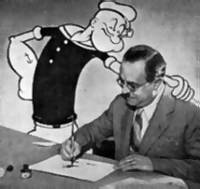
In 1900 Max began to work as an errand boy at the Brooklyn Daily Eagle. By 1904 he was a staff artist. In 1905 he married his childhood sweetheart, Essie Gold; they had two children. After he left the Eagle, Max briefly did artwork for two companies and then became art editor of Popular Science Monthly in 1914. There his childhood interest in mechanical matters was reignited.
In fact, it was a mechanical problem that pulled Max Fleischer into the field of animation. Early animation was frequently very choppy. Max theorized that if live-action footage were traced, frame by frame, fluid motion could be achieved. He enlisted the help of his brothers Dave and Joe, and the three developed the Rotoscope, a camera mounted under a piece of frosted glass with a crank to advance the film, so each frame could be traced.
It took the brothers a week to build the Rotoscope, but it was a full year before they finished their first cartoon. Dave donned a clown suit, and Max and Joe filmed him. Then they traced the clown on the Rotoscope. Work on the cartoon was completed in 1916, and a patent for the Rotoscope came through a year later. FROMhttp://anb.org/articles/20/20-01567.html
The Fleischers put popular, modern music at the center of many of their films, building entire cartoons around jazz legends such as Cab Calloway, Louis Armstrong and Don Redman. These cartoons often featured the Fleischers’ signature combination of live action and animation; in fact the earliest known footage of Cab Calloway in performance can be seen in the Fleischer classic Minnie the Moocher.
In 1929 the Studio made a major agreement with Paramount that would allow Paramount to distribute all Fleischer films. That same year the Studio changed its name to ‘Fleischer Studios.’ FROMhttp://www.fleischerstudios.com/history.html
What Seventeenth Century painter explained that, to him, various subjects made different demands on an artist and required very different expressive means to properly fulfill them?
What artist–renowned for drawings, paintings, prints, collages, and sculpture–drew the famous 1976 New Yorker cover “View of the World from 9th Avenue”?
What British author and illustrator, best known for his humorous cartoon drawings in the 1930s and 1940s, was once a salesman of advertising space for the Daily Telegraph?
What politically radical graphic artist of the 1930s went on to acclaim as an illustrator of dozens of children’s and nature books?




 The Misty Miss Christy