This youngest member of De Stijl worked in numerous mediums, but three-dimensional relief — which he developed into a high art form — came to dominate his output.
This American sculptor, printmaker, and draftswoman is a pioneer with her use of unconventional materials, including scavenging and repurposing objects.
This prominent late 19th/early 20th century illustrator’s most famous poster was a young woman dressed in a Navy uniform with the caption, “If I were a man, I would join the Navy”.
This American artist’s images depicted the flapper era in a way that both satirized and influenced the styles of the time, and have continued to define the jazz age for subsequent generations.
What Italian Baroque painter and printmaker became known for her ability to so quickly paint beautifully finished canvases that many visited her studio to watch her work?
What artist was one of the most universally admired painters of late 19th century Britain, so identified with that period that later on he was reduced to relative obscurity?
What German expressionist’s ardor for war was extinguished during his experiences in WWI, with the result that he is mostly known for his later sculptures warning of war’s tragic consequences?
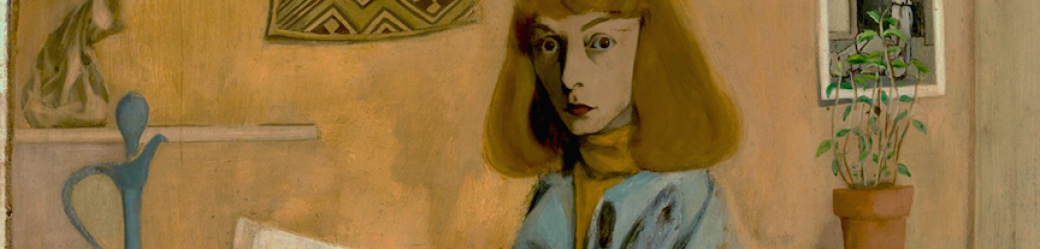
What American surrealist was one of only three Americans in the landmark 1932 exhibition at the Julien Levy Gallery in NYC, which introduced European surrealism to the United States?
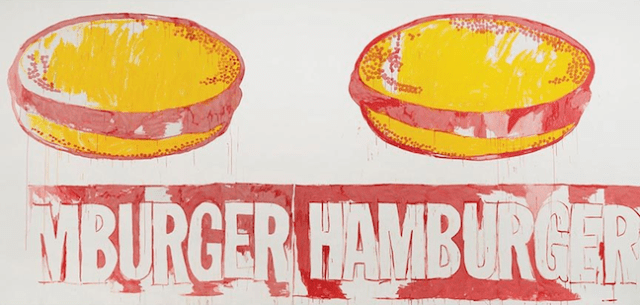
Stopping off in New York City on his way back [from Europe], he paid a call on Leo Castelli, whose gallery showed Jasper Johns, Robert Rauschenberg, and Frank Stella. No introduction, no calling beforehand—he just walked in with the Paris paintings under his arm. Castelli, all European charm and suavity, said that Ruscha’s work looked interesting, and told him to stay in touch. Ruscha stayed in touch for twelve years, visiting the gallery on his occasional trips to New York, and in 1973 Castelli became his New York dealer. Ruscha never seriously considered moving East. “That was too big a decision, and too big a jump,” he told me. “It just didn’t feel like it was meant to be.” He wanted to live in Los Angeles, and by the time he returned from Europe he knew that the only thing he could possibly be was an artist. “I could see I was just born for the job, born to watch paint dry,” he said. FROM http://www.newyorker.com/magazine/2013/07/01/ed-ruschas-l-a
Katsushika Hokusai (c.October 31, 1760-May 10, 1849) was a Japanese artist, ukiyo-e painter, and printmaker during the Edo period. Born to an artisan family in present-day Tokyo, he began painting at a young age, and became apprenticed to a wood-carver as a teenager. At the age of 18, he was accepted into the studio of Katsukawa Shunsho, an artist of the ukiyo-e style, which was focused on the depiction of the booming merchant class, including courtesans, Kabuki actors, and sumo wrestlers. After Shunsho’s death, Hokusai began experimenting with other styles of art, including Western styles. But he didn’t fully develop his own signature technique until he was expelled from the Katsukawa School.
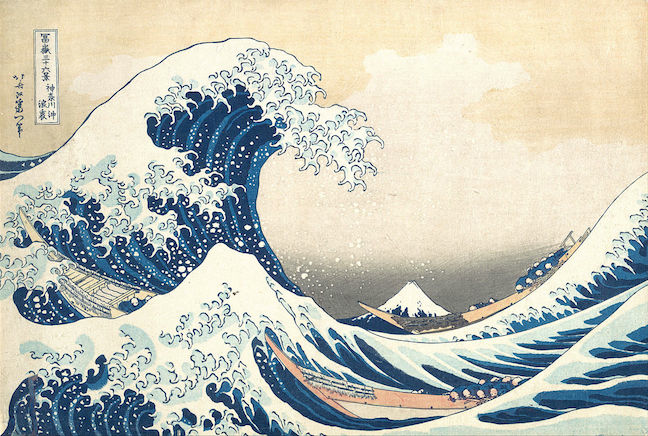
Hokusai is best known for the woodblock print series Thirty-Six Views of Mount Fuji which includes the internationally iconic print The Great Wave off Kanagawa.
Hokusai created the monumental Thirty-Six Views of Mount Fuji both as a response to a domestic travel boom in Japan and as part of a personal obsession with Mount Fuji. It was this series, specifically The Great Wave off Kanagawa and Fine Wind, Clear Morning, that secured his fame both in Japan and overseas. While Hokusai’s work prior to this series is certainly important, it was not until this series that he gained broad recognition.

 The Misty Miss Christy