Camille Pissarro: Born July 10, 1830

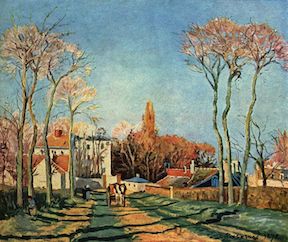
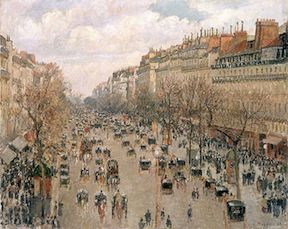
ONEPissarro in fact was the only artist who participated in all eight Impressionist exhibitions and he was a much-respected father figure to his colleagues…His talents as a teacher made him influential TWOeven among artists of greater stature than himself—Cézanne and Gauguin, for example…During the Franco-Prussian War of 1870–1, when his home at Louveciennes was overrun by the German invaders and many of his paintings were destroyed, Pissarro joined Monet in England. In 1872 he settled at Pontoise, where he THREEintroduced Cézanne to painting out of doors…In 1885 he met Seurat and for several years afterwards he experimented with Neo-Impressionism; in about 1890, however, he reverted to his Impressionist style, though with freer brushwork than in his early work…From FOURabout 1895 deterioration of his eyesight caused him to give up painting out of doors and many of his late works are urban scenes painted from windows (usually of hotels) in Paris and elsewhere…In addition to a large output of paintings and drawings, he was the most prolific printmaker among the Impressionists, working in a variety of techniques and sometimes mixing them.
FROM  http://artuk.org/discover/artists/pissarro-camille-18301903

http://www.degas-painting.info/impresionists/camille_pissarro_biography.htm

Marc Chagall: Born July 7, 1887


https://www.artic.edu/exhibitions/3172/chagall-s-america-windows

https://www.guggenheim.org/artwork/artist/marc-chagall

http://www.jewishvirtuallibrary.org/marc-chagall

Chagall himself said he was a dreamer who never woke up. “Some art historians have sought to decrypt his symbols,” says Jean-Michel Foray, director of the Marc Chagall Biblical Message Museum in Nice, “but there’s no consensus on what they mean. We cannot interpret them because they are simply part of his world, like figures from a dream.” ~The Elusive Marc Chagall, Smithsonian, December 2003

Rube Goldberg: Born July 4, 1883


Learn more~ http://www.rube-goldberg.com/
https://www.rubegoldberg.org/all-about-rube/a-cultural-icon/

[Rube Goldberg’s] father…convinced Rube to study Engineering at the School of Mining Engineering at UC Berkeley. He went on to graduate from UC Berkeley with a degree in Engineering in 1904.

After graduation, Rube Goldberg took on a position designing sewer pipes for the San Francisco Water and Sewers Department…he lasted six months. Rube Goldberg followed his passion and began to shift gears to pursue his previous dreams and pursue a career as a cartoonist.

Rube Goldberg made an important observation. In his eyes, many people seemed to be solving simple problems with overly complex contraptions. This…was his main inspiration for the “Inventions!” series. The most famous of which has come to be known as the Rube Goldberg Machine.

Rube Goldberg is the only cartoonist to be listed in the Merriam-Webster dictionary as an actual adjective. The phrase “Rube Goldberg” has been adopted into common use to mean “doing something simple in a very complicated way that is not necessary”.
http://interestingengineering.com/rube-goldberg-the-man-behind-the-worlds-craziest-machines/

Bill Moggridge: June 25, 1943-September 8, 2012

In 2010, as the new director of the Cooper-Hewitt, National Design Museum, Bill Moggridge rode into New York from California with a formidable resume: cofounder of Ideo, inventor of the first laptop computer, author of the seminal work on interaction design, educator, and winner of a slew of international design awards.
But as a city full of designers and design-lovers was quick to discover, rarely has such an illustrious bio been animated by such a delightful person.

“If there is a simple, easy principle that binds everything I have done together, it is my interest in people and their relationship to things.”
FROM http://www.fastcodesign.com/1670751/in-remembrance-of-bill-moggridge-1943-2012

Peter Blake: Born June 25, 1932

Peter graduated from the RCA in 1956 having also completed his National Service. He received the Leverhulme Research Award to study popular art whilst travelling Europe and went on to teach for several years at various London Art Schools, all the while working and exhibiting. His first solo show was held in the Portal Gallery in 1962 and since the early 70s his work has regularly been exhibited in one-man shows and retrospectives around the world. In 1981 he was elected a member of the Royal Academy and in 1994 was made the Third Associate Artist of the National Gallery. He was Knighted in 2002.
Sir Peter Blake | Illustrators | Central Illustration Agency

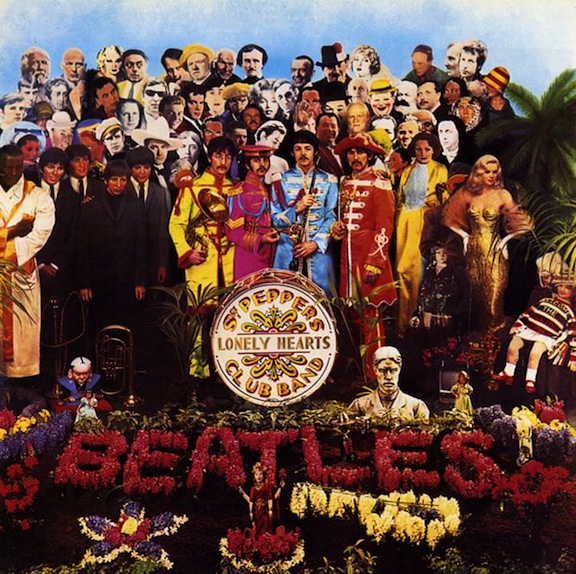
SPLHCB

The Beatles’ Sgt. Pepper’s Lonely Hearts Club Band, released by EMI Records in 1967, is arguably the most famous album sleeve of all time. The image on the album cover is composed of a collage of celebrities. There are 88 figures, including the band members themselves. Pop artist Peter Blake and his wife Jann Haworth conceived and constructed the set, including all the life-sized cut-outs of historical figures. The set was photographed, with the Beatles standing in the centre, by Michael Cooper. Copyright was a problem as Brian Epstein, the Beatles’ manager, had to locate each person in order to get permission to use their image in this context.

Irving Penn: Born June 16, 1917

Penn

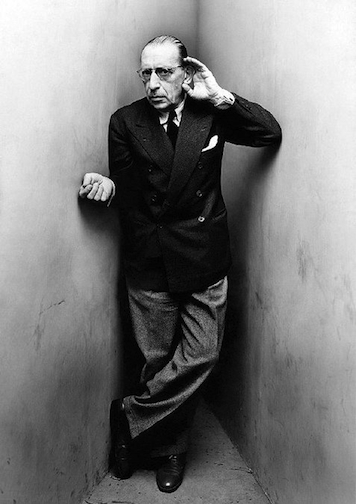
CapoteThe photographer Irving Penn put Marcel Duchamp in a corner, exposed Colette’s forehead and swaddled Rudolf Nureyev’s lithe body in layers of winter clothing. His subjects, who included many of the greatest creative talents of the 20th century, emerged from their portrait sessions with their carefully shaped personas profoundly shaken. Mr. Penn died on Oct. 7, 2009; he was 92.Fashion1
As one of the 20th century’s most prolific and influential photographers of fashion and the famous, Mr. Penn’s signature blend of classical elegance and cool minimalism was recognizable to magazine readers and museumgoers worldwide.
FROM https://www.nytimes.com/topic/person/irving-penn

Irving Penn Foundation~ https://irvingpenn.org/

Fashion2Art Institute of Chicago: Irving Penn Archives~ https://archive.artic.edu/irvingpennarchives/overview/Igor

Time Magazine: Appreciation –The Photos of Irving Penn~ http://content.time.com/time/photogallery/0,29307,1929105_1964784,00.html

Margaret Bourke-White: Born June 14, 1904

eagle

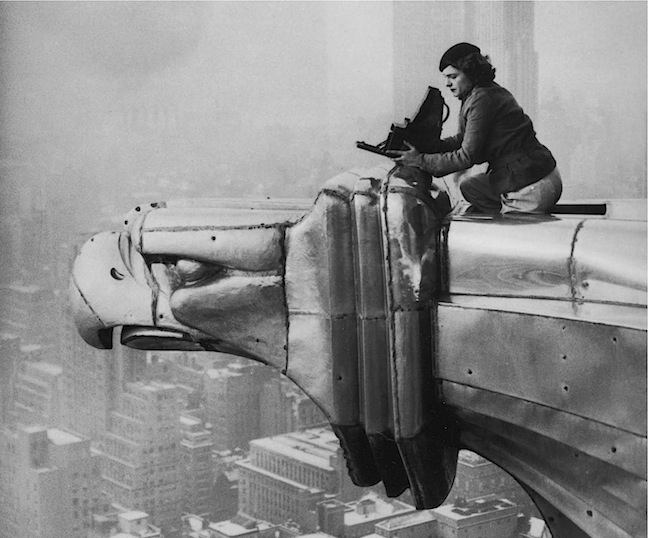
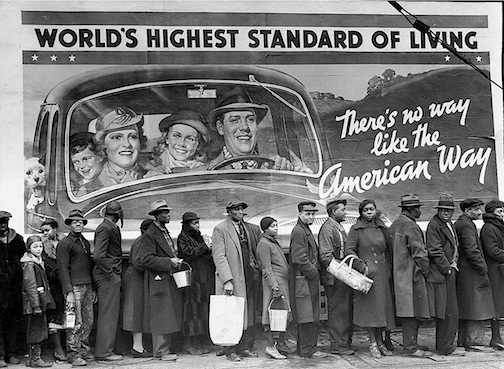
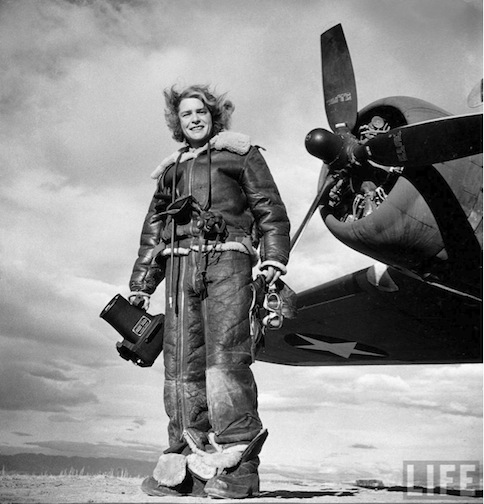
standardoflvngMargaret Bourke-White was a pioneering photojournalist whose insightful pictures of 1930s Russia, German industry, and the impact of the Depression and drought in the American midwest established her reputation…In 1927 she graduated from Cornell University with a degree in biology, but she spent most of her time establishing herself as a professional photographer. Bourke-White opened her first studio in her apartment in Cleveland, Ohio.
FROM http://www.moma.org/interactives/objectphoto/artists/712.htmlairplane

campAs an artist, Bourke-White continued to use photography as an instrument to examine social issues from a humanitarian perspective. She witnessed and documented some of the 20th century’s most notable moments, including the liberation of German concentration camps by General Patton in 1945, the release of Mahatma Gandhi from prison in 1946, and the effects of South African labor exploitation in the 1950s. Her career was cut short in 1966 due to Parkinson’s disease, and she died in 1971.
FROM https://www.howardgreenberg.com/artists/margaret-bourke-white

International Photography Hall of Fame and Museum~ https://iphf.org/inductees/margaret-bourke/

LIFELIFE’s First-Ever Cover Story~ http://time.com/3764198/lifes-first-ever-cover-story-building-the-fort-peck-dam-1936/

Shorpy Archives~ http://www.shorpy.com/image/tid/208