Category Archives: Birthdays
Artist Birthday Quiz for 1/8~
What Italian Baroque painter and printmaker became known for her ability to so quickly paint beautifully finished canvases that many visited her studio to watch her work?
What artist was one of the most universally admired painters of late 19th century Britain, so identified with that period that later on he was reduced to relative obscurity?
Answers here~ https://schristywolfe.com/2016/01/08/january-8/
Artist Birthday Quiz for 1/5~
This self-taught Paris-born American painter was introduced into the circle of surrealist artists in 1924, and subsequently participated in all the Surrealists’ major exhibitions.
Known for his use of thick impasto and his highly abstract landscape paintings, this Russian-French painter was one of the most influential European artists of the post-war period.
Answers here~ https://schristywolfe.com/2016/01/05/january-5/
Artist Birthday Quiz for 1/3~
Which 17th-century European artist is considered the greatest French follower of Caravaggio, and one of the great champions of naturalistic painting?
Which Vermont-born artist, a neoclassical sculptor who worked in Florence for more than half a century, designed the Lincoln Tomb in Springfield, IL?
Answers here~ https://schristywolfe.com/2016/01/03/january-3-2/
Artist Birthday Quiz for 1/2~
What German expressionist’s ardor for war was extinguished during his experiences in WWI, with the result that he is mostly known for his later sculptures warning of war’s tragic consequences?
What American surrealist was one of only three Americans in the landmark 1932 exhibition at the Julien Levy Gallery in NYC, which introduced European surrealism to the United States?
Answers here~ https://schristywolfe.com/2016/01/02/january-2/
Edward Ruscha: Born December 16, 1937
Stopping off in New York City on his way back [from Europe], he paid a call on Leo Castelli, whose gallery showed Jasper Johns, Robert Rauschenberg, and Frank Stella. No introduction, no calling beforehand—he just walked in with the Paris paintings under his arm. Castelli, all European charm and suavity, said that Ruscha’s work looked interesting, and told him to stay in touch. Ruscha stayed in touch for twelve years, visiting the gallery on his occasional trips to New York, and in 1973 Castelli became his New York dealer. Ruscha never seriously considered moving East. “That was too big a decision, and too big a jump,” he told me. “It just didn’t feel like it was meant to be.” He wanted to live in Los Angeles, and by the time he returned from Europe he knew that the only thing he could possibly be was an artist. “I could see I was just born for the job, born to watch paint dry,” he said.
FROM http://www.newyorker.com/magazine/2013/07/01/ed-ruschas-l-a

Biography~ http://www.tate.org.uk/art/artists/edward-ruscha-1882
Where is Rocky II?~ https://www.hollywoodreporter.com/news/documentary-mysterious-ed-ruscha-work-gets-north-american-premiere-at-lacma-962057
Edward Ruscha’s Deadpan Artistry~ http://broadstreetonline.org/2015/01/edward-ruschas-deadpan-artistry/
How Kandinsky helped create abstract art

Lyrical (from Sounds) (1911) by Wassily Kandinsky
Facts within art history aren’t always as solidly verifiable as we would like them to be. Can we say with certainty that Wassily Kandinsky, born on this day, 16 December [4 Dec. Old Style], in 1866, was the first abstract painter?
Read more here: How Kandinsky helped create abstract art | Art | Agenda | Phaidon
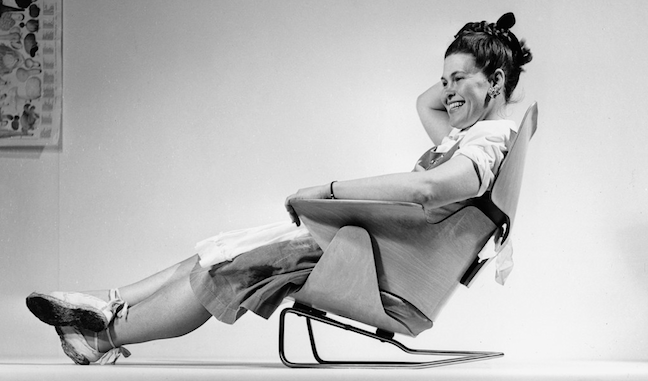
Ray Eames: Born December 15, 1912
Ray-Ray was the nickname given to Bernice Alexandra Kaiser by her family. Beyond that, little is known of her childhood in Sacramento, although Ray’s artistic talent was evidently recognized early on. After high school she left California with her widowed mother for New York City, where she studied with the German Abstract Expressionist Hans Hofmann and exhibited her paintings. After her mother’s death, Ray left New York for further training at the Art Academy in Cranbrook, Michigan, where Charles Eames was one of her teachers and mentors. After divorcing his first wife, Charles married Ray in 1941 in Chicago. The couple left immediately for Southern California, where they opened a design office.
An extraordinary personal and artistic collaboration began with this move, an unusually creative partnership that resulted in innovative designs for furniture, houses, monuments, exhibitions — even toys.
FROM http://www.fembio.org/english/biography.php/woman/biography/ray-eames/
Eames Foundation~ http://eamesfoundation.org/
Official site of Ray and Charles Eames~ http://www.eamesoffice.com/eames-office/charles-and-ray/
Frank Sinatra: Born December 12, 1915
Francis Albert Sinatra [was born] in Hoboken, New Jersey. Although his mother had hoped that he would be the first person in the family to attend college and was disappointed that he did not finish high school, she encouraged his ambition to be a singer. His father, on the other hand, was opposed and insisted that he should find a job. The young Sinatra worked briefly as a truck driver for a newspaper, a riveter in a Hoboken shipyard, and a fruit hauler. By 1932, he had decided that he wanted to be a professional singer.
FROM http://www.anb.org/view/10.1093/anb/9780198606697.001.0001/anb-9780198606697-e-1803570His break came in 1937, when he and three instrumentalists, billed as the Hoboken Four, won on the Major Bowes Original Amateur Hour. After some touring, the group disbanded. Harry James signed Sinatra to sing with his orchestra, and on July 13, 1939, two weeks after his debut as a big-band vocalist at the Hippodrome Theatre in Baltimore, Sinatra cut his first disc, “From the Bottom of My Heart,” with the orchestra.
FROM https://www.rollingstone.com/music/music-news/an-appreciation-of-frank-sinatra-1915-1998-59176/
James graciously freed Sinatra from his contract when the singer received a more lucrative offer from bandleader Tommy Dorsey in December 1939. By 1942 Sinatra’s fame had eclipsed that of Dorsey, and the singer yearned for a solo career.
FROM https://www.britannica.com/biography/Frank-SinatraBetween 1943 and 1946, Sinatra’s solo career blossomed as the singer charted a slew of hit singles. Sinatra made his movie acting debut in 1943. In 1945, he won a special Academy Award for The House I Live In, a 10-minute short made to promote racial and religious tolerance on the home front. Sinatra’s popularity began to slide in the postwar years (but) in 1953, he made a triumphant comeback, winning a supporting actor Oscar for From Here to Eternity.
FROM https://www.biography.com/people/frank-sinatra-9484810
In the mid-’70s Sinatra’s career slowed down, but in mid-1980, after a five-year recording hiatus, he released Trilogy which included a version of “Theme From New York, New York” that the city fervently adopted. In 1985, he was accorded the Presidential Medal of Freedom, the nation’s highest civilian award. Frank Sinatra died of a heart attack on May 14, 1998, in L.A.
FROM https://www.rollingstone.com/music/music-news/an-appreciation-of-frank-sinatra-1915-1998-59176/


JF Auburtin: Born December 2, 1866
Jean Francis Auburtin was a 19th Century Symbolist painter, an heir of Impressionism, influenced by Japonisme, and sometimes 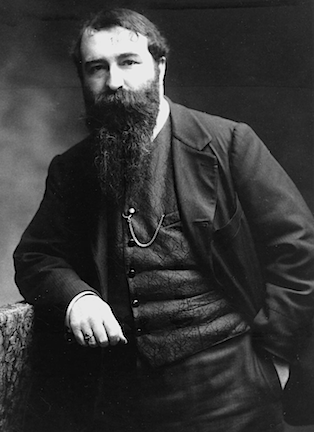 referred to as “the Symbolist of the Sea”. Born December 2, 1866, Auburtin was apprenticed early to the painter Louis-Theodore Devilly. He then enrolled at the Alsatian School of Paris in 1875 where he
  met his future wife Marthe Deloy, a sister of one of his classmates. After further education at the Ecole des Beaux-Arts, Auburtin found himself attracted to painting the cliffs and the ever-changing effects of light on the sea and as a result lived in various locations that offered these views. Auburtin mainly painted in gouache and watercolor, depicting the Normandy coastline, the sea, and later in life figures of dancers. At the end of the
  nineteenth century, Auburtin became interested in Japanese art and began a small collection of
 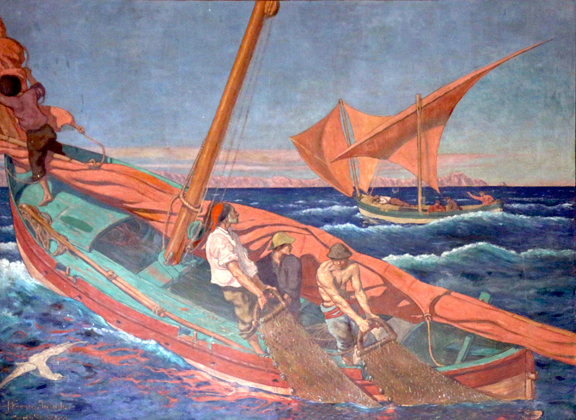 prints, some painted by the famous Japanese painter Hokusaï, which influenced his own work in no small measure. Jean Francis Auburtin rose to the rank of Officer of the Legion of Honor. From 1904 onwards he lived in Varengeville; when he died in 1930 he was buried in the cliff-top cemetery of Varengeville-sur-Mer, which is also the final resting place of Georges Braque.
 The Misty Miss Christy